
Tears of the Sun
Film review
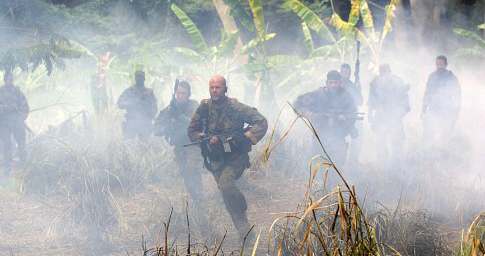
FILMMAKERS have always done their part to sway public opinion on the major political issues of the day -- and they often appeal to religion to make their point. But faith rarely guides the politics in these films; instead, it is often little more than a pious gloss on pre-existing political positions.
In 1916, at a time when many Americans wanted to stay out of World War I, Thomas Ince produced Civilization, in which Jesus was clearly on the side of peace. But when America joined the war a year later, Ince's film was re-cut so that Jesus now came out in favour of the war effort.
Sometimes films that are designed to rally the troops can also be reasonably complex in their treatment of politics and religion. Some of the most fascinating war-time films I have ever seen are the British films produced by Michael Powell and Emeric Pressburger during World War II.
Forty-Ninth Parallel, for example, follows a group of German U-boat officers who lose their ship in Hudson Bay and then trek across Canada while dodging the authorities. Along the way, they meet a Quebecois fur trapper who talks of sending missionaries to Germany, as well as a Hutterite colony whose witness of faith and peace wins over one of the Nazis.
In addition, this film, and other Powell-Pressburger classics like The Life and Death of Colonel Blimp, also made subtle references to the darker side of British and Canadian wartime policies, such as the creation of internment camps.
The new, post-September 11 breed of war movie is not so self-critical. In fact, the only significant criticism that one hears in films like Tears of the Sun -- a sombre Bruce Willis action flick filled with religious language, and released just in time for the impending war in Iraq -- is that America has stood by and stayed out of foreign conflicts for far too long. Act now, think later, seems to be the film's motto.
Directed by former music-video maestro Antoine Fuqua (Training Day) from a script by Alex Lasker and Patrick Cirillo, Tears of the Sun takes place amid a civil war in Nigeria. In real life, this country is struggling with the rise of militant Islam and the imposition of sharia law, but in the film, it is not clear who is behind the violence tearing that country apart. The perpetrators could be Muslim (the opening narration briefly alludes to the Muslim Fulani tribe), or they could be Christian (an American officer says the rebels are killing their fellow Nigerians for "going to a different church"), or they could be a purely secular militia (we never see them do anything particularly religious).
If there is any confusion over who the film's "bad guys" might be, there is none whatsoever over the identity of the "good guys" -- a group of predominantly Christian Ibo tribespeople who follow several American Navy SEALs through the jungle, hopefully to Cameroon and to safety.
Led by Lt. A. K. Waters (Willis), the SEALs are supposed to keep out of the Nigerian conflict; their mission is to evacuate Lena Kendricks (Monica Bellucci), a widowed American doctor who works in a Catholic mission. But Lena insists on saving as many of the locals as possible, and at the last possible minute, Waters agrees -- though it means defying his orders.
Waters' change of heart is never explained, even when one of his men asks for a reason; one minute he is just following orders, the next he is acting on some higher principle. But the film leaves us in no doubt that Waters is doing the Right Thing. At the start of the film, a cynical Waters says God has "already left Africa." But when he opts to rescue the native Nigerians, one Ibo woman tells him that God will bless him; she repeats this sentiment at the film's conclusion.
At first, Waters and his men only intend to protect a ragtag group of refugees, but soon they are avenging a village that has been raped and pillaged by rebel forces, and then they find themselves saving a man who may be the key to Nigeria's political future -- although, because he is the "heir" to the country's democratically elected president, it is not clear just what sort of government he might represent.
Waters and the SEALs don't waste much time pondering the complexities of the political situation they have waded into, and the film doesn't ask us to ponder such things, either. Instead, it focuses on showing how the military can get the job done, once they figure out just what the job is. You might think that there would be serious repercussions, once an American soldier takes it upon himself to rewrite foreign policy and involve his men in a war he knows nothing about, based on nothing but his own gut feeling -- but if there are, we never hear of them.
The film concludes with a title card which quotes, in bold red letters, that famous Edmund Burke line about evil needing nothing in order to succeed except that good men do nothing. This, then, is a story about "good men" who decide to do something. But one might argue that real life and true Christian faith should lead us to be suspicious of any story which encourages us to see ourselves in such a pure light.
Internet Movie Database | Movie Review Query Engine
USA: R | BC: 14A | ON: AA