
The Way Home
Film review
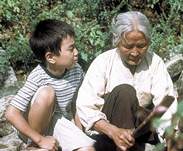
MOVIES ABOUT grown-ups and children tend to be upbeat and sentimental, but don't let the poster for The Way Home fool you -- that image of an old woman and her grandson smiling happily against a quiet rural background takes a long time to become a reality in this film, which was one of the biggest hits of the year in its native South Korea.
The characters and the countryside are certainly there from the start, but for most of the film, the relationship between them is anything but happy -- and this is due mainly to the fact that the boy in question is a spoiled and terribly rude brat, even by North American standards. One suspects the sight of a child who kicks dogs, whines incessantly, urinates in other people's shoes, swears at his mother and physically pushes his frail grandmother around would be even more offensive to Asian audiences, for whom respect for one's ancestors is pretty much a religion.
In one sense, director Jeong-Hyang Lee has taken a familiar foreign-movie cliche and turned it on its head. In films like Kolya and Central Station, children have been figures of innocence or purity who are dropped in the laps of jaded or irresponsible adults and somehow help them to become better people. But Lee gives us a child who is selfishness personified, and he entrusts this child to the care of an elderly woman who offers the lad persistent, unconditional love. The boy is, of course, redeemed by the end of the film, but until that point, he is nearly as persistent with his bad manners as his grandmother is with her generosity -- though there are hints along the way that his stubborn resolve may be starting to crack.
The film is especially challenging to watch because Lee allows us, even encourages us, to identify with the whining brat. Seven-year-old Sang-woo (Seung-ho Yoo) is a city boy -- and moviegoers tend to be city folk -- whose mother has dragged him out to a remote village and left him with his grandmother (Eul-boon Kim, a non-professional who had never even seen a movie before she was cast in this film) while she goes looking for work. We don't learn much about Sang-woo's mother, but we gather she doesn't get along with the grandmother all that well, either. Stuck in the country far from home against his will, Sang-woo isn't used to the slow pace, the creepy-crawly insects, or the lack of electricity and indoor plumbing; and because Sang-woo's grandmother is mute, the only way she can get his attention is by intruding on his space, and Lee often conveys that sense of intrusion by having the grandmother's hands appear from just outside the frame, tapping on windows or shoving gifts in Sang-woo's face.
At first, Sang-woo clings to his Gameboy and insists on eating the spam and drinking the Coca-Cola that he brought with him, but eventually his batteries die and his food runs out, and he makes feeble attempts to acquaint himself with his new environment. In particular, he develops a crush on a local girl, and his efforts to enlist his grandmother's help in impressing this girl are as amusing as they are frustrating. At times, it is not too hard to empathize with the boy -- who can't identify with his grief over a haircut gone wrong? -- but his typical lack of gratitude, even at the best of times, will try the patience of many viewers. Then again, patience, of the sort embodied by Sang-woo's persevering grandmother, is what The Way Home is all about.
-- Peter T. Chattaway
Internet Movie Database | Movie Review Query Engine
USA: PG | BC: G | ON: PG