
Christians hoping for mass conversions of Indias untouchables
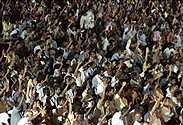 THE HINDU-BASED caste system of India has been in place for several thousand years. The lowest caste, the Dalits -- now numbering some 300 million -- are famously known as the untouchables.
According to Gospel for Asia, the Dalits "have lived in a never-ending cyle of bondage and despair with no hope of escape. For [them], pain and suffering are all too familiar. They are trapped in a caste system that determines their fate in life: a fate that prescribes a life with no education, no safe drinking water, no paying job, frequent forced labor, no rights to own land or homes, no access to worship at the local temple, no right to walk on certain roads -- and segregated living, to keep them far away from more privileged upper-caste people . . . Although laws have been passed in India forbidding caste discrimination, little has been done to prosecute offenders and conditions have improved little."
Over the past few years, many in the Dalit community have decided to leave Hinduism as a means of renouncing the caste system. It is widely anticipated that large numbers of them -- possibly millions -- will soon be embracing other faiths as an alternative. Dr. Joseph DSouza, president of the All India Christian Council, writes: "The Dalit federation reports that there has been a huge response to their Quit Hinduism campaign in most of the north Indian States . . . [This] has strengthened their conviction that conversion is the right move for the Dalits to move out of bondage and discrimination. The Dalit leaders continue to publicly maintain that their people are also free to move to Christianity or any faith where they can find salvation and human dignity . . . Church leaders from around India report that Dalits are contacting them and expressing their desire to come into the Christian faith."
A massive Dalit rally is scheduled November 4 in New Delhi. Observers expect many in attendance to accept Buddhism; others believe thousands will embrace Christianity. Noted Indian evangelical and author Vishal Mangalwadi has been observing the movement with much excitement. The following is a modified version of a statement he recently issued:
To the Christian leaders in India:
A few years ago, Dalit spokesperson Ram Raj, who is leading a million Hindus to embrace Buddhism, approached some national Christian Leaders in India. He appealed to them to issue a nationwide call for Dalits to quit Hinduism and to become Christians if they wanted to.
Raj has declared himself a Buddhist. He has also become friends with various Christians. A few months ago, I also had the privilege of getting to know him; he very kindly wrote a powerful foreword for my latest book (see below).
I am writing this letter because Ram Raj has repeatedly challenged many Christian leaders to baptize at least 20,000 Dalits at the rally on November 4. Some Christian and a few Buddhist leaders from Maharashtra oppose this idea for a variety of reasons. I address these issues below.
Some of us feel that we should participate in the rally wholeheartedly, and embrace as many people as possible who choose to repent (quit Hinduism), and to publicly declare their belief in Jesus and their choice to become Christians by being baptized.
Whatever your rationale for not baptizing, the fact is that if the Church refuses to receive Dalits who quit Hinduism November 4, then most Dalits will hear only one message: "You are not good enough to be accepted by Christ and his Church." The Church will lose an historic opportunity to lead large numbers of Dalits to salvation, as well as to be publicly identified with the Dalits in their quest for freedom and dignity.
If there are no baptisms on November 4, then the rally will send a message to all the Dalits in India that Buddhism is their only hope. If a significant number also become Christian, the rest of the Dalits will examine both Buddhism and Christianity.
To be a part of a large conversion movement, especially one which includes a politically powerful group of Dalits, will minimize chances of widespread persecution. I believe the Indian government will allow mass conversions to happen peacefully, as that will show that they are not a Hindu equivalent of the Taliban [Afghanistans extremist Islamic rulers] as some Christians have maintained.
Indian society, politics, economy, arts, urban, rural and moral life need thoroughgoing Reformation. A mass baptism ceremony in New Delhi could become the Indian equivalent of Luther nailing the 95 theses on the Castle Church of Wittenburg and later declaring: "Here I stand, I can do no other."
Most of us have not recognized the power of the gospel to transform and reform whole nations, as it did in Rome, Germany, England, Scandanavia, the South Pacific, etc. India has no other hope -- and we have no option but to make that hope clear before the nation. We must recognize what our Father is doing in India and obey our Lord Jesus as he commands us. God has been dramatically shaking Hinduism and Buddhism. He has been publicly presenting the claims of Christ to the whole nation. He is executing his judgements on the gods of India as he did on those of Egypt. Recall these recent major events:
1) India gave Mother Theresa the highest possible honour of a State funeral, in recognition of her service of expressing Jesus love to the dying.
2) Pope John Paul II eloquently declared to India in 1999 that "religious freedom constitutes the very heart of human rights." He explicitly rebutted efforts to publicly coerce him to declare all religions equal. While recognizing the need to be sensitive to peoples conscience, he refused to give in to the demands of some Hindus that all conversions be stopped.
3) A fanatical Hindu mob tried to silence the witness of missionary Graham Staines by brutally burning him and his two sons. However Jesus, Lord over India, transformed this evil act and used it to again present the claims of Christ through all public media in India and around the world. This reached far more than those Staines had touched in his lifetime. God has used Staines martyrdom to elevate the concept of conversion to a national debate, and to make it a common discussion topic throughout India.
4) The cyclone in Orissa, and the Christians helping those devastated by it, gave India another dramatic example of Gods transforming love.
5) The Crown Prince of Nepal slaughtered the King and his royal family. God allowed those who imprisoned believers and pastors to destroy each other.
6) The events of September 11 in the USA have shaken the whole world, including India. It has challenged people with the issue of life and death. The acts of those suicide terrorists and the Talibans actions have presented the raw face of extremist Islam.
The Lord Jesus has commanded us to baptize and make disciples of all nations. Let us consider some arguments which have been marshalled for not baptizing the Dalits:
1) Ram Raj founded the Lord Buddha Club, and plans for one million Dalits to quit Hinduism on November 4 and to become Buddhists. Some Buddhist leaders feel that, since they are the ones doing all the hard work of mobilizing people for the rally, conversions should only be to Buddhism. This is understandable. However, Raj and other Dalit leaders also know that many of their brothers and sisters prefer to become Christians. Raj has explicitly recognized this in his foreward to my book. He specifically gives them the freedom to choose whichever religion they wish. Raj has listened to his colleagues for 3 years and overruled them. He is capable of persuading his organization to accept conversions to all faiths. It seems that it is some Christian leaders who are promoting the voice of a few Dalit leaders against baptisms, as an excuse to get out of their obligation to make disciples of Jesus Christ.
Two million conversions to Buddhism will not shake the foundations of the caste system as much as will 20,000 conversions to Christ. A mass conversion to Buddhism could trigger a cultural revolution in India. However, only a movement to Christ will launch Indias Reformation. Any cultural revolution is bound to fizzle out, with little lasting benefits.
2) Some Christians oppose conversion because they dont believe that Jesus is the only way to salvation. They try to present all religions as equally valid. At this moment, one vital fact is that the Dalits themselves dont believe that there is any salvation for them in Hinduism. Their experience is that Hinduism is the cause of their slavery. Would you deny them the salvation that Jesus offers? What will you say when you stand before Jesus, and he asks you: "Did you teach them that I Am the Way, the Truth and the Life, no one comes to the Father but by me, as I commanded you to?"
3) Other Christian leaders oppose conversions, because it could lead to social conflict and persecution. However, Jesus taught his disciples that such conflict was inevitable for those who believed in him. Is it Christian to allow our desire for peace and security to override the Dalits need for emancipation from centuries of slavery? More importantly, Jesus explicitly prepared his disciples for persecution and martyrdom. He commands us to "love one another as I have loved you" -- even unto death. He also commands us to "take up our cross." Jesus explicitly promised that he would acknowledge or deny us before his Father based on whether we acknowledged him or denied him before men (Matthew 10: 32-33). How can we but choose to publicly acknowledge him?
4) Some Christian leaders oppose baptisms because they believe that only mature believers should be baptized, after due teaching and examination. This is a legitimate concern. Other Christians see baptism as a symbol of acceptance of a repentant sinner by God and his church. Therefore, such Christians will baptize even newborn believers and disciple them later. At Pentecost, Peters command was to "repent and be baptized." That same day, the Church of 120 baptized 3,000 who repented and believed. They were not discipled until later (Acts 2: 37-43). Extensive teaching and examination before baptism is a good tradition, but it does not appear to be an absolute biblical example, let alone a requirement for salvation. This is obviously a point on which believers can differ with each other sincerely. Can we not unite together November 4 in our witness? After all, Jesus is interceding to the Father for our unity (John 17: 22-23), while giving each other the freedom to follow their own conscience in this matter of whether to baptize "baby" Christians or wait until they are "mature" adults. Some may see baptism as a certificate of enrollment in the school of discipleship; others may see it as a graduation diploma. Those who hold the first view should have the freedom to baptize on November 4. To prejudge the Dalits, by assuming that they cannot possibly be ready, is a prejudice.
5) Some Christian leaders are hesitant to participate, fearing that these would be "political baptisms" and not "biblical baptisms." However, 3,000 repented, believed and were publicly baptized at Pentecost. Their baptisms in Jesus name very publicly repudiated the acts of Jerusalems religious and political authorities in condemning and executing Jesus. This could equally have been considered a very political act -- yet the Apostles baptized them immediately, despite the political implications and dangers.
Consider the consequences for Dalits who "quit Hinduism" on November 4, publicly declare their commitment to believe in Jesus Christ and are publicly baptized. Will they not face even greater ostracism, persecution and possibly martyrdom?
As for the possibility that some may be baptized without truly understanding or accepting the gospel: Jesus explicitly instructed us to weed out the "tares" from the wheat, but to let both grow together lest we root up some wheat. Only Jesus can separate them on the last day, when he directs the angels to do so (Matthew 13:24-30). Jesus even called and discipled Judas. Let us accept all whom God brings, and leave to Jesus the responsibility to separate the "wheat" from the "tares".
Further, only a tiny portion of those seeking Christ will come to New Delhi on November 4. By far the majority of those needing to be baptized and discipled would be coming to local churches across the country. Already about 70 percent of Christians in India are Dalits. Yet these 25 million are a tiny portion of the 400 million Dalits, lower castes and tribals who could come if they were truly welcomed. Jesus appeals: "Come to me all who are weary and heavy laden." Dare we hinder these oppressed people from responding to Jesus call, by making them feel unwelcome? Paul challenges us: "I have become all things to all men so that by all possible means I might save some" (1 Corinthians 9: 22). Let us use "all possible means" to make them welcome, even if it stretches us out of our traditions and comfort zones.
6) Some Christian leaders are hesitant to baptize on November 4 because they do not grasp the logistics of baptizing 20,000 or more people. Remember, the early church only had 120 to baptize 3,000. To accomodate these concerns, we propose to do the following: bring together more than 5,000 counselors on November 2 and 3 for prayer and training; rent the Ambedkar Stadium, for November 3 and 4; have at least one evangelist preach the gospel and give an altar call; have the rest of us distribute response cards; and transport those who believe and want to be baptized to the Ambedkar Stadium by bus. At the stadium, more teaching can be given; counselors can talk to the applicants individually or in small groups, lead them to fill out response cards, pray the sinners prayer, and be baptized -- or persuade them to wait for instruction and discipleship before baptism.
7) Immersion is obviously a practical challenge. It might be difficult to arrange for sufficient conventional tanks to immerse 20,000 or more people. Perhaps large-scale shallow "swimming pools" of plastic and bamboo could be set up. How did the Apostles baptize 3,000 in about seven hours in arid Jerusalem? What do Baptists do if a sick and dying person, who cannot be immersed, wants to be baptized? Many Baptists would make exceptions in such impossible situations and allow sprinkling. If the numbers of new believers on November 4th presents an impossible practical situation, then why not see it as an exception and allow both immersion and sprinkling?
The historical conflicts of the European church have obviously generated attitudes which have made baptism-by-immersion-only a matter of self-identity for some churches. I believe the present situation should force us to question whether it is right to constrain the expansion of Jesus kingdom by the quantity of water used in baptism. More fundamentally, is it right to let the Indian church be bound by the conflicts and attitudes of Europe? If Presbyterians, Anglicans and Lutherans have no problem with sprinkling, shouldnt they be given the freedom to go ahead and follow their conscience before God? Those who follow the Baptist tradition could later baptize such believers after discipling them. But on November 4, could they not join in welcoming these courageous new believers as brothers and sisters?
In conclusion: Ram Raj has challenged us to baptize; many have taken up the challenge, labouring to organize this huge event. Let us help by demonstrating Christs love through practical service at the rally. I urge as many as possible to come from all over India to pray, to volunteer and to support this effort. Let us pray for our Lord to guide, unite and empower us.
Your servant in Christ,
Vishal Mangalwadi
Mangalwadis latest book is The Quest for Freedom and Dignity: Caste, Conversion and Cultural Revolution. The text can be viewed at www.vishalmangalwadi.com under the internet title Touch Thy Neighbour.