
Modern Mohawk miracle
HARVEY GABRIEL will never forget accidentally giving his teacher the strap. He had learnt only Mohawk in his Kanehsatake home northwest of Montreal but at school on the reserve only English was permitted -- even at recess. The young boy had been caught uttering Mohawk. As the teacher whipped the dreaded strap down, Harvey instinctively pulled his hands back and she lashed her own knees instead.
Eventually almost a whole generation of native people lost their mother tongue with such strict English-only instruction.
Harvey, now 60, still cherishes his Mohawk language. He works as a tool-and-die specialist in Montreal but after work he devotes two or three hours a day, seven days a week, to Bible translation. He has drafted into Mohawk: Genesis, Job, Jonah, Daniel, Romans, Ephesians, Philippians, James, The Epistles of John and Revelation; and he has begun Acts.
Harvey is continuing in the footsteps of his great-grandfather Sose Onasakenrat, also known as Joseph Swan, who was a Mohawk Bible translator and preacher. Harvey is a tireless translator but he is not alone.
Yes and No
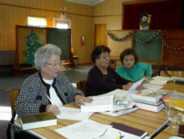 |
When she started school in 1924, Josie Horne knew only two English words, "yes" and "no." Like Harvey, she heard only Mohawk at home. Bewildered by her English-speaking teacher, Josie still went on to become a teacher herself, fluent in Mohawk and English. Now 83, she has retired from 14 years in the classroom but volunteers as a noted translator.
Josie is part of what is affectionately called "the sisterhood." Charlotte Provencher, 79, and Dorris Montour, 80, were, like Josie, school teachers at Kahnawake, Dorris for 22 years, and Charlotte for over 40 years. They are related not by ties of blood or marriage, but by their strong Christian faith and Mohawk culture.
Many women their age are playing canasta or bingo. Instead, the three are busy translating their beloved Bible into Mohawk. Working from several English versions, they carefully draft in longhand a Mohawk translation. After working independently all week, they gather every Monday to compare notes. They have finished Ruth and are tackling Proverbs and Esther.
"It means a great deal more after you've translated it," Dorris said.
Josie and Harvey with Mavis Etienne have produced a CD Rom to accompany 2 Corinthians.
The sisterhood will bequeath a tremendous spiritual and cultural legacy to the next generation. Charlotte said of her translation work, "I will give up everything else, before I give up this."
 |
Prayer Warrior
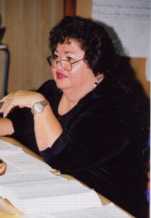
Mavis Etienne, a negotiator during the 1990 Oka crisis, is a prayer warrior. She discovered the impact of her native language, Mohawk, when she began to use it in prayer.
"Because my language is so descriptive, it expresses the deep feelings from my heart. Recently when I was praying in Mohawk, I just broke down and cried, sobbing, as I confessed to God and spoke to him out of the depth of my heart." As a child, Mavis spoke only Mohawk in her Kanehsatake (Oka) home, but was restricted to English at school. Today she is bilingual in Mohawk and English. As clinical supervisor at Onen'to:Kon Treatment Services, Mavis works daily with people who have been devastated by the residential school system. Yet she is not discouraged. "The main way God reaches the needy is to use us -- our arms and our voices -- to give consolation and comfort and we need to feed the poor before we give the bread of life."
As project coordinator for the Mohawk Bible Translation team, Mavis also tries to provide her people with the bread of life.
The translation project all began when Mavis Etienne wanted to read Mohawk Scriptures on her weekly radio Mohawk Gospel Program. She was frustrated, however, with only having available the four Gospels in Mohawk. She discovered that between 1787 and 1839, all of the New Testament had been translated into Mohawk -- except 2 Corinthians. Only Isaiah had been translated from the Old Testament.
The original goal of the team was simply to translate the missing epistle, which they did. But Mohawk, like any living language, constantly changes. The team realized there was a desperate need for a completely modern Mohawk Bible. Their work had only just begun.
Back-translations
Once a month the sisterhood and Harvey meet with Mavis and other native speakers to determine if their translations are accurate, clear and natural. Mavis, along with her brother Rodger Cree and their sister, Hilda Garcia then translate the Mohawk back into English (called a back-translation).
These back-translations are then checked against the original Hebrew and Greek by Tim Stime, the project facilitator and a former Wycliffe Bible translator, and Hart Weins, Director of Scripture Translation for the Canadian Bible Society along with Ruth Spielmann, a CBS consultant. The threesome provide the native translators with linguistic and theological support.
While the translators are moving swiftly through the draft stage, the community and consultant checking process is inevitably time-consuming. Meanings of words can vary among the six Mohawk communities. It took twenty minutes and twenty letters to agree on the Mohawk word for "the strongest authority," raoianerenserasatste.
Meaning rather than word for word translation is crucial. "In the flesh" was misleading because "flesh" had been translated as "meat." A new phrase had to be found.
When consensus has been reached on all the changes, Celine Bastien Genest transcribes the final version into computer format.
Recently the sisterhood, Mavis and Harvey studied at The Summer Institute of Linguistics in Arizona where other North American indigenous translators were amazed at the enormous strides the Mohawk project had taken.
Race against time
Still at the current pace these dedicated translators will not live long enough to complete the huge project. The translators, in consultation with the Canadian Bible Society, are exploring ways to speed things up. One solution would be to have one or more of the translators working full time on translation. This would require an increase in funding for the project. Catholics and Protestants work together on the current translation team while funding comes from across the denominational spectrum. Last year, the United Church of Canada, the Canadian Conference of Catholic Bishops and the Anglican Church of Canada joined the Canadian Bible Society in making significant donations to the project.
The Mohawk population today represents about 30,000 people in North America. While only about 15% speak Mohawk, this number is growing with aggressive language maintenance programs.
For many Mohawk children today, the situation has completely reversed from when the translators attended school. Today's Mohawk students hear only English at home with their parents yet are enrolled Mohawk immersion for their first four grades. Afterwards, if they wish, they can continue in a bilingual program right through high school.
The Mohawk translation team hopes to place modern Mohawk Scriptures in their hands, trusting God will place it in their hearts.