
On the trail of the Jesus Lama: Thomas Merton in Asia
 |
BETWEEN November 2000 and January of this year, I retraced the 1968 journey of Thomas Merton -- Christian, monk, writer, contemplative spirit, social activist, and multifaith pioneer. Born in France, he grew up there and in Britain, moved to the United States as a university student, became a Roman Catholic in 1938 and a Trappist-Cistercian monk in 1941. Many would say that he is the pre-eminent Christian spiritual writer of the twentieth century.
I visited all the places he had visited, and was fortunate to meet some people he had met. In India this took me to New Delhi, Kolkata (formerly Calcutta) and Chennai (formerly Madras), three of its largest cities. In Chennai I visited, like Merton, the sites at Little Mount and St Thomas Mount where, according to Indian Christians, the apostle Thomas brought the Christian gospel in the year 52, and where he was martyred in the year 72. It took me also to Dharamsala, where the Dalai Lama lives -- Merton had had three interviews with him, but I was unable to see him. Later I visited sites in Sri Lanka and Thailand, including the Red Cross Centre in Samut Prakan, near Bangkok, where Merton died accidentally on December 10, 1968.
The highlight of my trip, however, was an audience with Chadral Rinpoche, an 88-year-old high lama in the Nyingma denomination of Tibetan Buddhism. Merton had had a longish conversation with him in which they discussed Buddhist and Christian teaching, including the meaning of the resurrection of Jesus. I wanted to know what he thought of Merton after so many years, and how much of their conversation he remembered. So I went to his monastery at Salabari, in West Bengal, and was briefed by a Canadian student/disciple on the protocol for my meeting with him. I checked out with this student the questions I intended to ask, all of them about Merton. His only comment was that, being a spiritual teacher, Chadral expected to be asked for "a teaching." I was agreeable to this, and added a note of it to my list of questions.
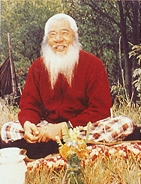 |
I approached Chadral early the next morning. He sat cross-legged on a square cushion on a dais under a canopy covered by the branches of a large peepul tree, grown from a slip taken from the tree in Bodh Gaya, under which the historical Buddha had experienced enlightenment. After the opening protocols, which for my benefit included a warm handshake, I presented him with the gift I had brought from Canada: a genuine Thomas Merton fridge magnet. He held it at arm's length, and after a moment's squinting, said in an emotional voice, "Oh, it is my friend." I do not know why, but I had been in tears since the first moment I stood in front of Chadral -- not crying, not sobbing, just quietly weeping.
I managed to get out my first question about what he remembered about his conversations with Merton, and he gave a brief answer; but I then decided to junk the rest of the questions, and go straight to the one that had been suggested to me: "Do you have a teaching for me?" "Yes," he said immediately: "just decide what is the most important thing Jesus ever said, and then take it as far as you can." Unworthy Christian that I am, this finished me. Weeping became sobbing, I bowed respectfully in farewell, and was taken by my young Canadian friend to be rehabilitated with Kleenex and tea.
Some weeks later, it suddenly occurred to me that I had had with Chadral an experience parallel to one which Merton recounts in his very early autobiography, The Seven Storey Mountain. There he tells of his early interest in Asian religion, and how when he met a Hindu monk, Bramachari, in New York, he asked him what he should be reading. "The Confessions of St Augustine and The Imitation of Christ would be a good place to start," said Bramachari. Merton had been pointed to two Christian classics by a Hindu; and I had been instructed by a Buddhist to decide what I felt was the most important thing Jesus had ever said. I am still shaking my head about this, and wondering how many Christians would be equally gracious to any Hindu or Buddhist they might meet, and how knowledgeable about their traditions.
And of course when I tell this story I am always asked, "And what did you choose?" Some weeks later, having considered a number of important passages, I came to rest on Matthew 5.37: "Let your yes be yes and your no be no." Months later I continue to reflect on the profundity of words I have been familiar with for decades.
Merton spent two hours with Chadral, who recognized Merton as a kindred spirit, living a kindred lifestyle as a Christian monk; and so Chadral dubbed Merton, like himself, a lama, but of a different kind: a Jesus lama. Retracing his path in Asia, I had the amazing experience of being directed, re-directed, to the gospel itself. Currrently I am working on a book about my experiences, and hope that it can be published under a title which also I owe to Chadral: Jesus Lama -- With Thomas Merton in Asia. Meanwhile, I continue to try to let my yes be yes and my no be no.
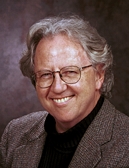
Donald Grayston is an Anglican priest, and vicar of St Oswald's Church in Port Kells, Surrey. He teaches religious studies at Simon Fraser University, where he is also director of the Institute for the Humanities.