
Colombian refugees find new home in Canada
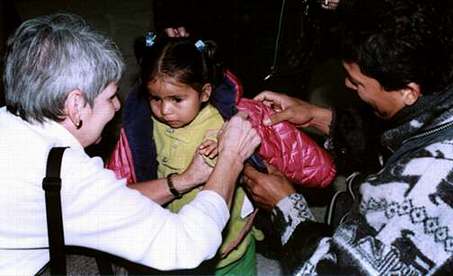
WITH THE HELP of the Mennonite Church Canada, the Mennonite Central Committee (MCC) and the Mennonite Church in Colombia, Colombian pastor Enrique Torres is trying to make a new home in Canada for he and his wife, Miriam, and their two-year-old daughter.
The Torres family (not their real name) fled their country as refugees because of threats made against them by the FARC, a left wing guerrilla organization in Colombia; they have relied on the aid and generosity of Mennonite churches in relocating to Winnipeg.
The pressure and difficulties of transplanting his family have been offset by the kindness of the church groups that helped to bring them to Canada, Torres said through an interpreter. "There are many things that run through your mind, and it doesn't take long before those feelings of emptiness start to set in. It was so good to see people ready to greet us in Winnipeg with smiles and open arms. The situation is bad in Colombia. It will likely be a very long time, if ever, before we get an opportunity to return."
"I think we were all a little nervous waiting at the airport," said Katy Thiessen, who was one of several Mennonites who went to meet the Torres family at the Winnipeg airport. "More than anything, it's about having that human contact." Winnipeg, she added, "is now home for them."
Mennonite churches in Canada and MCC have been working with the Mennonite Church in Colombia for the past year to identify and help those in danger. Colombia has been mired in civil conflict for decades as government forces, paramilitaries and local guerrilla groups fight for area control.
According to an MCC press release, Enrique had been serving first as a pastor and then community leader near the communities of Santana Ramos and San Vincente (approximately 250 kilometres southeast of Bogota), where threats were made on his life.
He said that he was targeted because he was a community and church leader. "At first, the FARC left the church alone. But with a change in their leadership came a change in attitude; and when we refused to bow to extortion pressure, those of us working in community leadership were forced to leave."
He asserted that the various sides in the conflict -- the Colombian government, right wing paramilitaries and left wing guerillas -- are all guilty of crimes and atrocities against the Colombian people. "It was about justice when the war first began. It has nothing to do with those ideals any more. Colombia's conflict is about money and power."
Torres spent most of his time working in areas patrolled by FARC guerillas, MCC stated. He first began working on social issues in the early 1990s, serving as a pastor in the small agricultural community of Santana Ramos.
Torres moved to San Vincente, a city of approximately 25,000 people, and spent the next several years studying business administration and working as a pastor. It was there that he met his wife Miriam, and started a family.
San Vincente was initially controlled by the Colombian government; but in February, 1999, the government agreed to forfeit the city and five municipalities to the FARC, in order to encourage peace talks. When those talks failed in February, 2002, the region was again plunged into civil unrest.
"I hadn't planned on leaving the country; but we weren't left with many choices," Torres said. "We were talking to anyone who would listen -- government and non-government organizations -- about what was really going on. The peace talks were taking place in San Vincente; but at the same time, the FARC was using other locations in the region to recruit and train new soldiers -- some as young as 13. The people of San Vincente asked us to find non-violent means to end the war."
With the failure of the peace talks, Torres and several others -- including the city mayor -- were forced to flee to Bogota; but they soon discovered that even the capital was not safe for them.
"We kept moving around; but the FARC kept following us and leaving messages on our phones," he said. "They killed the wife of a municipal leader one month after we left San Vincente. It was then I knew that my family would not be safe."
With the help of the Mennonite churches in Colombia and Canada, as well as the Mennonite Central Committee, Torres and his family were able to immigrate to Canada on December 9.
Douglas Mennonite Church in Winnipeg is one of the congregations that responded to the call for sponsors from MCC. Douglas Mennonite has agreed to provide financial support for the Torres family over the next year, as well as to help them familiarize themselves with the practicalities of life in Canada -- such as finding a doctor, registering at the library and enrolling in English classes.
"Many of the people in our congregation are first or second generation immigrants to this country," said Douglas Mennonite Church youth pastor Bryan Moyer Suderman. He said church members will do what they can to help Enrique and Miriam acculturate themselves to Canada, and to reduce the emptiness of leaving family and friends behind.
"We need to be a social support for Enrique and Miriam so that they don't feel alone."