
Former Clinton advisor has a few thoughts on same sex unions
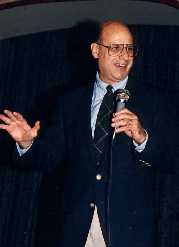 |
WHEN BAPTIST clergyman, sociologist and sometime presidential advisor Tony Campolo comes to Ottawa, he has a few pointed things to say about same sex unions.
That is because Campolo is one of about half a dozen evangelical Christian leaders in the United States who line up from right to left along the political spectrum on social issues that currently preoccupy the body politic.
Not that he talks to politicians when he comes to Canada, to speak on behalf of World Vision Canada's $170 million in international child development and micro-enterprise programs a fair amount of which receive government assistance at one level or another. WVC assigns that work to Kathy Vandergrift, the organization's Ottawa-based public policy analyst, whose name and work are well-recognized in the capital's many political and bureaucratic hallways.
But before reporting some of Campolo's carefully-crafted and somewhat controversial views on same sex unions, let's give his statements a little context.
Some of the best-known American evangelical leaders and political influencers positioned along that heretofore-mentioned spectrum would be, from right to left, Jerry Falwell of Liberty University; James Dobson of Focus on the Family; Marvin Olasky, the Jewish-cum-Presbyterian proponent of compassionate conservatism; Franklin Graham, his sister Anne Graham Lotz and their father Billy; Robert Schuller of the Crystal Cathedral; Tony Campolo; and Jim Wallis of Sojourners magazine.
Every one of the above-mentioned have Canadian linkages. Falwell periodically teams up with Canada Family Action Coalition, currently led by Canada Christian College's Charles McVety. Dobson's and Schuller's media influences are well positioned in Canada. Olasky used to break bread occasionally with the Byfields of Alberta Report and undoubtedly will do the same with Ezra Levant's new Western Standard.
The Grahams are well respected in Canada for evangelism and development programs, including the Christmas shoebox projects overseen by Samaritan's Purse's. Wallis is part of evangelicalism's left wing, which finds acceptance in such places as Regent College at the University of BC, the Mennonite Central Committee, Atlantic Baptist University and, to a lesser extent, Trinity Western University.
This analysis requires a caveat. None of the above are primarily political organizations. But each of their spokespersons capture the interest and attention of one part or another of the Christian public, including the politicians who are informed by their faith. Add the numbers together, and that represents about 20 per cent of the Canadian population and double that percentage south of the border.
Campolo's podium, so to speak, is Eastern University in Philadelphia, one of the American forerunners to the above-mentioned Canadian Christian universities. Among other things, he leads and teaches in master's programs that focus on poverty and social issues both in urban America in dozens of less-developed nations around the world.
But Campolo's name received fair public exposure in the '90s, when Bill Clinton asked him for counsel on sexual addiction issues in the wake of Monicagate. Today, he is tight-lipped about whether Clinton really listened to his weekly sex advice, but maintains modestly that the then president did not turn a deaf ear to his economic and social recommendations.
All of which brings us to same sex unions, the subject of a February 6 interview in an Ottawa hotel where he was speaking to area pastors.
Campolo's views have caused some consternation in the American evangelical and social conservative communities, because they run counter to those of some in the socon sector -- including the Vatican -- who oppose any legal recognition for same sex unions.
Campolo's perspective intrigues, in part because he and his wife, Peggy, have differing views -- and are invited periodically to debate the issue publicly. He maintains that marriage is between a man and a woman, she affirms same sex unions and is not opposed, when push comes to shove, to permitting the parties of such unions to call themselves "married".
Tony's differences with his more socially conservative brothers and sisters relate to his belief that church leaders should be prepared to stand together with gay activists in urging full legal equality for both traditional and same sex partnerships. Only by doing that, he says, can Christian leaders demonstrate what they mean by love, dignity and justice.
Several other of Campolo's major planks on this issue:
* His assertion, as a Christian sociologist, is that there are few completely homosexual or heterosexual people. He points to 210 sexual traits possessed by every human being, including the length of the fingers, the makeup of the eyes and the texture of the hair. Each person finds himself or herself somewhere on that complex continuum.
* He refuses to get into the "heredity or environment" argument. And from that position, he maintains that, while "miracles" do occur, those who successfully leave homosexual behavior to take up male-female sexual relationships permanently, are almost invariably bisexual rather than homosexual.
* He challenges pastors to recognize that there are at least a few gay men and/or lesbians in every congregation, almost without exception. Church leaders, he suggests, need to provide real support systems to homosexuals who want to be celibate, rather than simply moralizing or trying to change their orientation.
* Churches that work with people in the arts communities, he asserts, are relatively more likely to be ministering to gays, because, as a group, they are attracted to the arts and bring a great deal to that community. Often, for example, gay people provide musical or drama leadership in churches, to such an extent that congregations would be deprived of worship resources if those people were not there.
* He suggests that risk-taking pastors will provide pastoral care to gay people, even to the extent of encouraging and recognizing stable relationships. He says such pastors will be prepared to counsel for such stable relationships thus encouraging gay people to leave promiscuous lifestyles.
* The Bible, for the most part deals with homosexuality in Romans 1, he says, but the great themes regarding poverty, economics, environment are woven through all parts of Holy Writ. In making that assertion, he takes his stand for the somewhat conservative/liberal mix in his views on poverty, development, economics and Christian responsibilities in those areas. Yes, he says, Stephen Lewis' campaign to change economic and social systems in Africa is vital to dealing with the AIDS pandemic. But so is the work of agencies that care for and give hope to the families made orphan by AIDS.
And, in summary, Campolo urges traditionalists to accept the premise that divorce, rather than the legalization of same sex unions, is the greater threat to the institution of man-woman marriage.
Lloyd Mackey is editor of ChristianCurrent Ottawa. He can be reached at lmackey@christiancurrent.com