
Canadian's Asian experiences preserved in vivid images
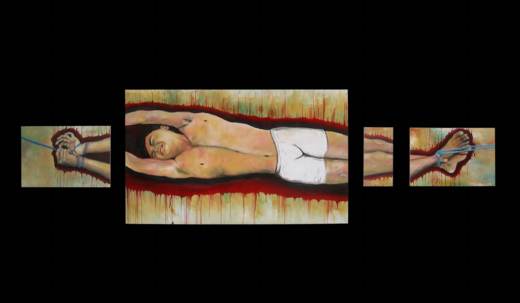
THE PAINTINGS are stunning. Huge canvases with striking images. They force you to look closer. You know there's a story here.
For Chris Rollins, an artist and storyteller from Langley, B.C., the paintings have become a way for him to process a year spent in Thailand, working as a volunteer with Burma Issues, an organization with a focus on organizing work among grassroots communities in Myanmar (formerly known as Burma).
While ethnic minorities struggle for independence, the government of Myanmar is fighting with rebel armies. The conflict is forcing thousands to flee their villages and homes, often to refugee camps along the border with Thailand. Burma Issues is devoted to a peaceful resolution in the struggle for human rights and democratic rule. Rollins spent a year in Thailand, working at documentation and education, including editing a weekly newsletter and contributing articles to a Burma Issues monthly publication. His travels in Myanmar and his interaction with those he met had a profound effect on him.
Upon return to Canada, Rollins wanted to find a way to continue to support the work of Burma Issues here. He also wanted to tell the story of his experiences; and he added a twist, putting his fine arts degree to use.
"Painting was a medium I was comfortable with," he says, and he knew it would add a visual dimension to his stories. It also became a way for him to process the experience of living in another culture with people who have less and appreciate simple things, something that is a challenge living in the affluent West.
"It is very difficult to suddenly just leave and cut one's self off from how you lived there and what you learned," he says. He hopes that the paintings will also be a vehicle through which he can both educate and inspire others as he shares the stories of his experiences in Thailand and Myanmar.
"While working on these paintings I was thinking about the content, subject matter, the suffering and how these paintings could be effective to those who would be seeing them," he says. "For now my participation in South East Asia is finished. How can I continue (to share my story) at home?"
The largest painting, and perhaps the most difficult one to look at, is called 'Human Hammock.' The image is of a man, bound and stretched out, like a hammock. The pain in his face is evident. His body is twisted and turned. But what is shocking is blood that drips from either side of his body. Rollins divided the image onto three canvases: the man's hands and feet make two smaller paintings, his body one large central one.
"I wanted to create a feeling of distortion," Rollins explains. The method works, creating a feeling that the man could be stretched out for miles. The image comes from a true story.
"This man was a political prisoner and was strung up like a hammock between two trees," Rollins says. "During that time, people actually sat on him as if he was a hammock. After two days, he was dead."
Rollins explains that villagers are sometimes accused of hiding rebels or providing food for them. Torture is a routine way of trying to extract information. Documenting stories like these and making them known is one way in which Burma Issues hopes to draw attention to human rights violations and put an end to them.
His other paintings, while not as violent, deal with other realities faced by villagers in Myanmar. In one, a villager tries to put out an enormous fire with nothing more than a branch. The futility of his actions is palpable. Rollins has a gift for shadow and light; the fire seems to be moving in this painting, which only adds to the feeling of futility and desperation on the part of the villager.
Rollins' gift for light is also evident in a larger painting that is almost entirely black. A huge thundercloud hangs over a line of villagers fleeing their homes. They are silhouetted against the sky by a flash of lightening. Rollins explains the inspiration for the image.
"I was traveling on a bus during a thunderstorm and tried to picture what it would be like for people hiking as they flee their villages," he says. His silhouettes depict various family scenarios: an elderly woman traveling alone, a woman carrying her child, an adult child carrying an elderly parent.
One of the things that Rollins appreciates about the medium of painting is how people will interpret his paintings differently. He shared this particular painting with a friend who saw something very different than Rollins had intended.
"I saw the painting as very negative, with clouds approaching and the people about to get drenched," he says, "but my friend saw the clouds as retreating and saw the sun breaking through, a much more positive image!"
The last painting is perhaps the most poignant and bears the longest title. It is called "They destroyed my home, but I still have my knife so we can build another one." A young boy, perhaps six years old, holds his machete, ready to cut down the branches he'll need to help rebuild his house. Rollins says that the resilience of villagers is astounding. "Some villages have been burned down five times, but they still come back and rebuild."
His experiences in Thailand and Myanmar have caused Rollins to reflect on his faith. The teachings of Christ inspired him to work overseas in the first place. The year of working with Burma Issues has created a new desire to work closely with issues of injustice and human rights violations.
"To live and work for humanity with nothing to gain from successful efforts but peace and love is a tremendous connection to God," he reflects. "I have lost that to a certain extent since coming back to the West -- and so I cannot say that I have felt the same while working on these paintings. Perhaps through the paintings I am trying to re-live or re-create that and keep some passion alive."