
Pope John Paul cast long shadow across Canada
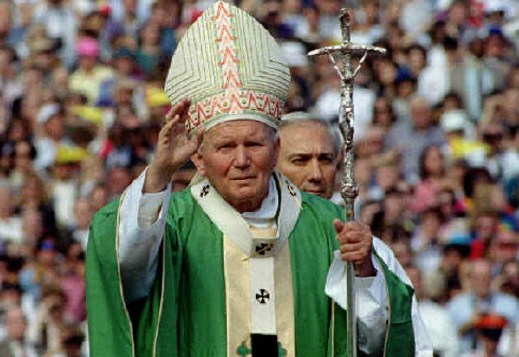 |
"I HAVE looked for you. Now you have come to me. And I thank you."
This final message from Pope John Paul II to the thousands of Christians gathered in St. Peter's Square could just as easily be seen as a last greeting to the multitudes outside the faith who are now mourning his passing.
Speculation over his successor, and debates about controversies during his papacy, have been greatly overshadowed by an outpouring of grief, warmth and immense respect -- which has stretched far beyond the borders of Catholicism.
One of history's longest-serving and most influential pontiffs, the pope passed away April 2, after succumbing to the combined effects of a urinary tract infection, septic shock and heart failure. Multiplied millions of people worldwide are anticipating his funeral April 8 with a mixture of sadness and appreciation. Vatican secretary of state Angelo Cardinal Sodano summed up the feelings of many, stating: "In a world disturbed by wars, fratricide and genocide, the pope was the centre of the civilization of love."
John Paul's effect on the general Christian community was encapsulated by a statement from the executive committee of the World Evangelical Alliance (WEA), which was meeting in Toronto at the offices of the Evangelical Fellowship of Canada (EFC) when his death was announced. "We join with all people of goodwill in mourning the passing of Pope John Paul II," stated the WEA. "He was more than the leader of the Roman Catholic Church; he was an international statesman who sought to reach out to persons across cultures and religions to bridge differences and promote peace, freedom and human rights. His was a message of hope and understanding. He was a man of courage and conviction." WEA chairman Ndaba Mazabane added: "His deep concern with the current culture of death and his promotion of a culture of life was significant and welcome."
"Karol Josef Wojtyla," declared the Anglican Journal, "was the first pope (and religious leader) to achieve rock star status, at times drawing millions in countless visits to some 130 countries around the world. He was the first to visit a synagogue, the first to visit a mosque, the first to publish bestsellers (including books of poetry), the first to make extensive use of technology to advance evangelism, and the first to draw both praise and condemnation -- for his liberal views on politics and human rights, on the one hand; and conservative views on sexuality and women, on the other."
Much of the media attention on the pope's passing focused on the pontiff's courage in the face of debilitating ailments.
"In the final days," wrote Jonathon Gatehouse in Maclean's, "the man who was never afraid to speak was reduced to silence, the papacy that reached out across the globe confined to a bedroom overlooking St. Peter's Square. But to more than a billion faithful, Pope John Paul II remained a potent symbol to the end, proof that the frailty of the body need not diminish the strength of the spirit."
On assignment in Vatican City for the National Post, Father Raymond J. De Souza noted "a heightened sense that this death was simply the final act in [the] life of a former stage actor whose life had always seemed unusually scripted. Scripted not according to the secular calendar, but to the rhythms of the liturgical year."
The pope has been widely credited with being a key factor in the fall of Soviet communism; and his visit to Cuba resulted in greater freedom for that country's people. Spiritually, his heartfelt outreach to the Jewish people was groundbreaking; and he was candid in repenting of some of the church's historic mistakes. However, many observers noted that the pontiff's personal charisma impacted some people even more than his accomplishments.
"He has touched hearts everywhere," Father Owen Keenan of the Archdiocese of Toronto told CTV's Canada AM, adding: "It's not surprising that those hearts have been touched by the beauty of his pontificate."
"One billion Catholics," observed Catholic Register publisher Joe Sinasac, "whether or not they agreed with the Pope's positions -- which he proclaimed strongly, clearly and repeatedly, and held to firmly -- still loved him deeply. And that's because he loved them all. Even when the Pope was admonishing us for our weakness in the face of materialism, relativism, pleasure without responsibility and the lure of affluence and power, he did it with love."
Others stressed John Paul's individuality. "This pope somehow did things you didn't expect popes to do," said Aloysius Cardinal Ambrozic, one of three Canadian cardinals who will help choose the pope's successor.
Canada's Catholic prime minister, Paul Martin, stated: "In his 26 years as the head of the Roman Catholic church, this noble son of Poland achieved an extraordinary impact, not only as a source of spiritual guidance, but as a true apostle of peace."
The pontiff cast a wide shadow across Canada in his 1984, 1987 and 2002 visits, touching Christians from many denominations. "People were very taken, Catholics, non-Catholics, by the pope himself -- his radiance, his generosity of spirit, his warmth, his genuine concern for people," said Toronto theology professor Dan Donovan of St. Michael's College, speaking to CTV.ca News.
"At a time when evangelicals in Canada were stepping out into the public square to engage in an increasingly secularized culture, we found common cause with Catholics who were empowered by Pope John Paul's clear and unwavering affirmation of the biblical themes of the sanctity of human life and care for the vulnerable," EFC president Bruce Clemenger told CC.com. "Despite theological differences, an openness to conversation and joint action -- rooted in a basic agreement on issues such as the rights of the unborn, euthanasia and the definition of marriage --resulted in new levels of cooperation and understanding between Catholics and Evangelicals."
Lutheran Church-Canada president Ralph Mayan expressed similar sentiments, stating that LCC has "deeply appreciated the life-issue advocacy of Pope John Paul -- and with his passing, the Christian community has certainly lost a strong pro-life and pro-family voice. We have been most grateful that he chose to speak so strongly and so publicly, in support of the sanctity of life and the biblically-based teaching on marriage and the family."
"He made himself accessible to people, and communicated the gospel not only in words -- but also by action," stated Canada's Anglican Archbishop, Andrew Hutchison. "I join with all Christians in thanking God for his life and witness, and I rejoice that he is now experiencing the joy of the resurrection in the kingdom of heaven."
Veteran political and evangelical observer Lloyd Mackey, recently retired as editor of Christian Current Ottawa, shared a Canadian anecdote involving the pope and another Christian icon.
"It is an old story now, but worth the retelling. I was secretary of the executive committee of the Vancouver (Canada) Billy Graham mission in 1984. It took place in October, in BC Place . . . Three weeks before, the pope had, himself, spoken at BC Place.
"At the time of the pope's visit to Vancouver, Billy was travelling in Russia. Someone of his staff woke him in the middle of the night to tell him the pope was speaking from Vancouver on the radio. Billy listened to the message which, as I recall, was the extolling of the need for Catholics to 'know Christ and to make him known.'
"When Billy got to Vancouver and held his press conference -- at BC Place -- he recounted the story of listening to John Paul. He said the pope's message could not have been better preparation for the gospel that he, himself, was responsible to proclaim for the next eight nights. Later, he was in his best self-effacing frame of mind. One of the reporters asked him if he was sort of a Protestant pope. He replied [with] words to the effect that, 'Oh no, you could not say that. After all, the pope has a popemobile.'"
Catholics have "lost a pastor on earth and gained a saint in heaven," said Robert Stackpole, professor of theology at Redeemer Pacific College in B.C. Referring to the pope's 2002 visit, he told CC.com: "The pope's message to Canadians was a combination of encouragement and challenge. He said the people of this country were justly famed for their compassion -- but also asked Canadians to extend their compassion to unborn children, immigrants, refugees and the homeless. He challenged Canadians to see the family as the fundamental cell of civilization."
Stackpole also extolled the pope's impact on Canadian youth. "He inspired some of our students at World Youth Day. They were greatly moved -- unexpectedly so. He inspired a number of vocations to the priesthood in Canada and the U.S. It's happening so much that they're calling it 'the John Paul II generation' of priests."
Anglican John Conway, professor emeritus of history at University of British Columbia, commented that the passing of major pontiffs has often inspired church authorities to look for change. Leaving aside John Paul I, who he said had not been in power long enough to make much impact, Conway cited John Paul II's most influential predecessor.
"Paul VI was a quiet, reserved, efficient administrator. What the cardinals wanted -- and got -- was an outgoing, ebullient world traveler who would present the faith to the world in a new manner -- and that's what he did. The price to be paid for this is that John Paul II wasn't the least bit interested in administration. The primary gifts he had to offer were his writings, which were thoughtful and inspiring."
Conway fondly recalled the pope's 1984 visit. "The entourage was something fantastic. It was a tremendous show." However, such extravaganzas, he observed, had less high-profile consequences. "Back home, things got neglected. When the man got older, he wasn't capable of carrying the burden of both his travelling and taking care of the enormously consuming daily affairs of the church."
Thus, he told CC.com, "the electors are almost certainly going to look for someone who is going to take care of the enormous backlog of office work -- the nitty-gritty everyday administration of the church. They will likely choose someone not as charismatic as John Paul, someone not as much in the public eye." As world leaders, legions of media representatives and ordinary believers gather to honour the pontiff, many will recall his eloquence as a writer. This was emphasized at a mass held in Rome April 3, when Archbishop Leonardo Sandri read a prayer which he said the pontiff had written shortly before he died.
"The joyous Hallelujah of Easter resonates today too," declared John Paul II. "This mystery of love is at the centre of today's liturgy . . . dedicated to the cult of divine mercy. To humanity, which at times appears lost and dominated by the power of evil, of selfishness and fear, the Lord resurrected offers as a gift his forgiving love, reconciles and reopens the spirit to hope. It is a love that converts hearts and gives peace.
"How much need the world has to understand and receive divine mercy! Oh Lord, who with your death and resurrection reveal the love of the father, we believe in you -- and with confidence we repeat today: Jesus, I trust in you; have mercy on us and the entire world."