Talisman case to proceed despite Canadian intervention
SERIOUS ALLEGATIONS made against one of Canada's most controversial corporate citizens are at the centre of an international dispute pitting human rights activists against Canada's federal government.
Calgary's Talisman Energy is currently facing a lawsuit under the Alien Tort Claims Act in the United States District Court for the Southern District of New York. The company, which spent four years as one of several companies carrying out oil explorations in Sudan, is accused of complicity in the genocide attributed to the hard-line Islamic government of that country. The plaintiffs are the Presbyterian Church of Sudan and various Sudanese individuals.
Talisman attempted to have the case dismissed; their motion was denied in a June 13 decision by U.S. District Judge Denise Cote. According to the Toronto Star, Judge Cote declared that "corporations may be held liable under international law." The case is complicated by the fact that the Canadian Embassy in Washington has attempted to intervene on Talisman's behalf.
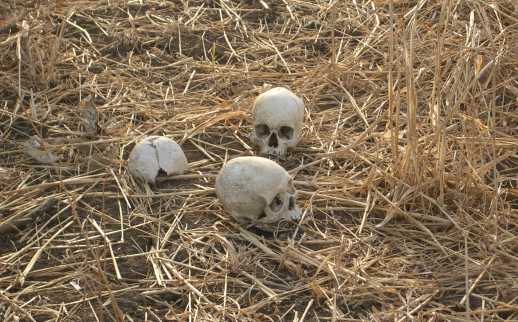
Alberta-based Mel Middleton, executive director of Freedom Quest International, is a Christian who has been advocating for peace in Sudan over the past several years. In a recent press release, Middleton said he had recently visited Ruweng County, one of the areas in Sudan where Talisman once operated.
Ethnic cleansing
"The survivors that I met virtually all had lost immediate family members to the ethnic cleansing. When asked whether they thought the oil companies knew what was going on, the people laughed, stating that the oil companies were helping the government directly. After the helicopter gun ships and tanks would go through the area, wiping out villages and massacring civilians, the oil company personnel, a few days later, would come and dispose of the bodies."
A key piece of evidence involving the Ruweng County region was unveiled by the plaintiffs in 2002. It is a 1999 memo circulated by Sudan's Petroleum Security office, which stated: "In accordance with directives of His Excellency the Minister of Energy and Mining, and fulfilling the request of the Canadian company, the armed forces will conduct cleaning-up operations in all villages from Heglig to Pariang." The declared purpose of the troop deployment was to "ensure the security and wellbeing of employees and company property"; the incursion was also intended "to eliminate Heglig village and the Unity State in Toor."
According to the Harker Report, commissioned by the Liberal government of Paul Martin's predecessor, Jean Chretien, the memo was dated two days before a major offensive in the Ruweng area. The report stated: "Helicopter gunships supported troops using armoured personnel carriers. Roads built by the oil companies enabled these to reach their destination more easily than before. Heavy bombing occurred . . . The attacks began within a day or two of major deliveries of food by the UN's World Food Programme, and much of the foodstock was destroyed."
Vigorous defense
Talisman has long insisted that the lawsuit is unwarranted, and has expressed confidence that it will ultimately be vindicated. "The judge . . . has instructed both parties to avoid comment in the media," company spokesperson Barry Nelson told CC.com. "Talisman is obeying her instructions and will not comment on the case beyond saying that the allegations are completely untrue. Our company has a well documented history of corporate behaviour that is completely contrary to these false allegations, and we will defend ourselves vigorously." Nelson decried Middleton's recent allegations, asserting: "These outrageous claims are absolutely untrue."
"I have recorded statements from local people on videotape, which may or may not be admissible evidence in court," Middleton told CC.com. He clarified his previous statement, saying that Talisman was part of a consortium which included a company operated by the Sudanese government, the communist Chinese PetroChina, and a Malaysian operation. "The locals who reported to me could not distinguish between the different oil company employees," he said. "So while the locals did say that the oil company personnel did assist in the disposal of the bodies, this does not necessarily mean that Talisman employees themselves were involved.
"What it does mean, however, is that the atrocities were a lot closer to Talisman's activities than the company has so far been prepared to admit. Talisman CEO Jim Buckee is on record at his annual AGM stating categorically that no massacres had occurred in their concession areas. This is a canard. Furthermore, even if we give Talisman the benefit of the doubt, and if Talisman's employees were not involved in the 'clean up' of the bodies, it is impossible to imagine that they did not know what their business partners were doing."
Embassy stationery
Middleton has publicly denounced the evident involvement of the federal government in the case. He supplied CC.com with a fax of a January 14 letter printed on Canadian Embassy stationery, and bearing an official stamp; the document had no signature, but initials are visible beside the stamp. Among other things, the letter says the court action "infringes on Canada's conduct of foreign policy," and that "there is no connection with the U.S. either through the plaintiffs or the defendants or the location where the alleged actions took place."
Further, the letter stated that Canada "has taken the foreign policy decision to use access to trade support services as an incentive in support of the Sudan peace process . . . . The inducement for Sudan if they achieve peaceful resolution of their internal disputes will be the reinstatement of trade support services." The lawsuit, said the document, "removes that inducement." The case would, it added, have a "chilling effect" on the Sudanese economy. "Should the suit proceed, Canadian firms will likely absent themselves from Sudan and therefore not contribute to its economic revitalization out of fear of U.S. courts."
In an Open Letter to prime minister Paul Martin, Edmonton MP and former Secretary of State David Kilgour expressed dismay at this lobbying effort. "Talisman is accused of helping Sudanese officials to bomb churches, kill church leaders, and attack villages to clear the way for oil recovery in southern Sudan." Canada's intervention, he wrote, could be viewed as "a demonstration of a lack of concern for justice for the victims of the regime's brutal oil-fuelled crimes against humanity in southern Sudan."
Kilgour added: "Why would the Canadian government wait for almost three years before contacting the U.S. State Department seeking to intervene in the case -- after the lawyers for the plaintiffs had gone to the effort of acquiring over one million pages of documentation and evidence? It has been suggested that our government did this in the hope that most of the Canadian public might have already forgotten the allegations involving Talisman Energy."
He decried the government's "constructive engagement" approach, saying it was "precisely the policy which Ronald Reagan used in South Africa. It was unsuccessful [for Reagan], and it has never produced results when dealing with genocidal dictatorships."
The government's attempt to intervene in the court case, he wrote, has "led many to question whether Canada's own economic interests are -- like so many other countries with oil interests in Sudan -- preventing us from calling to justice a government deeply complicit with widespread ethnic cleansing and blatant human rights abuses."
According to Middleton, the lobbying initiative got a sympathetic response from the U.S. government, which could have conceivably scuttled the lawsuit. "The Bush administration -- no enemy to big oil -- [wrote] a brief to the New York court asking it to back off and requesting intervenor status."
Blind eye
Martin's government, he wrote, "completely turned a blind eye to the death and brutality in Ruweng, and . . . will continue Canada's cozy economic relations with Sudan's military junta . . . . This has gone on for so long, and in such an unconscionably immoral manner, that anything short of calling for the complete resignation of our 'government' is insufficient." Canadian companies, he added, "could profit by building the gas chambers for another Hitler, and there is no law in Canada to stop them. To date, our government has done nothing to fill this legislative gap . . . They are interfering with the only avenue the victims of Talisman's ill-fated fiasco in Sudan have to obtain justice."
Sebastien Theberge, a spokesman for Canadian foreign affairs minister Pierre Pettigrew, denied that Canada was getting improperly involved in the court proceedings. "Canada did not intervene in this case, nor did we file any document in the court," he told the Toronto Star. However, Theberge added: "We have expressed to the United States that a U.S. court was exercising extraterritorial jurisdiction."
Barry Nelson maintained that Talisman has been unjustly vilified, and that its work in Sudan has had a lasting beneficial effect. "After U.S. Senator John Danforth, President Bush's envoy to Sudan, was assigned to encourage peace talks between the warring parties, he noted that oil revenues could be a catalyst to peace. This has proven to be the case. A peace agreement based on sharing resource revenue is in place, and rebel leader John Garang is vice-president of Sudan."
Middleton was dismissive of such claims. "When the Exxon Valdez messed up and created an environmental disaster, they were obliged to pay for the clean up and repair to the environment. Similarly, Talisman is morally obligated to clean up the human rights disaster it left behind in Sudan . . . We are waiting for a mea culpa from Talisman management -- including an acknowledgement of their error, and the implementation of appropriate steps to ensure that it can never happen again." Talisman, he contended, "must also pay adequate compensation to the lives they've helped to ruin in Sudan."
"We believe our published corporate responsibility reports have addressed our former investment in Sudan in detail," responded Nelson. "We are proud of the many successful community development projects that we supported and continue to support in Sudan."
According to the Talisman website, Canadian business publication Corporate Knights recently ranked the company 26th in its list of Canada's Best 50 Corporate Citizens. In addition, Moody's Investors Service commended Talisman, saying that the corporation "has strengthened risk assessment processes in recent years, partially in response to the Sudan controversy -- and risk management and assessment practices appear strong."
Talisman's 2004 Corporate Responsibility Report affirmed that the company "conducts its business activities with integrity and shows respect for human dignity and the rights of the individual. . . . We lead by example, demonstrating values of tolerance and respect throughout our conduct." Talisman says it is "committed to continue funding our development projects through 2005 . . . Today, the Unity State Model Farm, the Agriculture and Community Development Program and the Basic Adult Learning and Training programs endure as a testament to the company's commitment to improve education, health and economic realities for those Sudanese living near or within the Greater Nile Petroleum Operating Company concession."
Middleton recently disputed this assessment, writing of Ruweng County: "The area is completely devastated. No one there had any knowledge of the 'humanitarian' work that Talisman claimed to have carried out in all its corporate social responsibility reports."
The activist concluded his comments to CC.com with a cautionary statement for his fellow Christians -- who, he said, "need to understand that decisions which we make here in Canada . . . can literally affect the lives and livelihood of millions of people. We are our brother's keeper, and it is our duty to ensure that our personal and corporate activities are promoting justice and world peace . . . Christians need to insist that all their investments are restricted to institutions which have ethical and moral investment policies."