
Long-term relief an afterthought for most
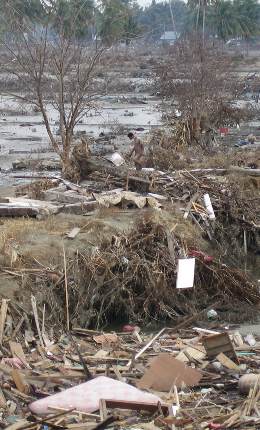
LAST YEAR'S South Asia tsunami left more than 200,000 people dead and five million lacking the most basic human needs. Countries affected the worst included Indonesia, Sri Lanka, southern India, Thailand and the Maldives.
The Canadian government immediately committed $425 million to relief efforts, to be used over five years. The Canadian International Development Agency (CIDA) manages $383 million of the total amount. Some $213 million was raised by the 23 non-governmental organizations that participated in the government's Matching Funds Program; the deadline for donations was January 11.
But almost a year later, medics, builders, counsellors and educators remain in the disaster zones, quietly working while the world's attention is drawn from one catastrophe to another. And each time, people have been eager to give an initial donation to help the situation.
"But the media always have to find something new to keep people interested," said Greg Toews, national director of the Thailand arm of Partners Relief & Development, a non-profit charity in the United States, Canada, Norway, and Australia.
"The public is fickle. [Hurricane] Katrina is barely talked about; it is already old news. But those people's homes won't even be rebuilt this year. A long-term response is needed by the Christian community, to follow up on their initial acts of love."
Toews told CC.com that significant events like the tsunami and this year's hurricanes take a generation to rebuild, and that the magnitude of the disaster requires care for a longer time than any media coverage will ever give it.
Stephanie Burns of Samaritan's Purse Canada, based in Calgary, agreed that people should take it upon themselves to initiate involvement in reconstruction after an 'act of God.'
"We've seen an unprecedented amount of disasters and long after the camera stops rolling, the needs are still great," Burns told CC.com. "Align yourself with a non-profit group that is helping and do something, either through prayer, funding or by actually serving. Canada does have a role to play in the long term."
On August 8, CIDA announced a series of new reconstruction projects, bringing the total to $72.1 million for 15 reconstruction initiatives.
Just one of these, in five villages along the coast in Tamil Nadu, India, will restore the livelihoods of 1,800 families in areas such as fishing, agriculture, and weaving; tsunami-resistant homes; children's parks; schools and shelters; roads, water, sanitation, and electricity; and training for 20 co-operatives and self-help groups.
Organizations involved in this project, which extends into 2007, include the Mennonite Central Committee, Presbyterian World Service & Development, the Primate's World Relief and Development Fund and the United Church of Canada.
"Emergency relief opens incredible opportunities to closed countries, closed hearts and closed minds to tell people that someone loves them, and that's just the start," Toews said. "There's so much follow-up to be done. It's just like when someone converts to Christianity: it's not just the sinner's prayer, it takes years of maturing as a Christian."
In Indonesia, permanent housing is being built for 3,000 families by Samaritan's Purse. In Sri Lanka, the organization has provided shelter for more than 800 families and is helping to rebuild an orphanage. Samaritan's Purse is replacing hundreds of fishing boats and gear, putting thousands of fishermen back to work. A vocational center in Indonesia trains widows and other women who now must provide for their families. The center offers trauma counseling and will produce school uniforms for local children.
"A lot of our relief projects have rolled into development projects," said Burns. "Our temporary shelter program turned into a permanent shelter program. We went in with temporary water purification projects last year and they have turned into community water filters that helped purify larger bodies of water."
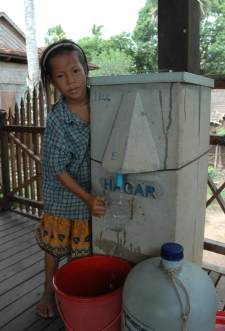
Burns is talking about the BioSand Water Filter program, a technology designed by a former University of Calgary engineer professor who gave permission for Samaritan's Purse to use it for humanitarian purposes. Costing only $75, they make the filters in the country of need, training the nationals how to do it, and starting a micro-enterprise.
"[The water filters] are concrete containers filled with alternating layers of gravel and sand," said Burns. "At the top, a bio film forms and a filter gets put on top of that. The contaminated water gets poured in and as it works past that bio film layer, contaminants are filtered out. Through gravity, clean water is produced. This will provide access to safe water and it's virtually limitless, with not much maintenance."
In Indonesia, Partners is working on small development projects and a children's home in Medan on the main island of Sumatra. The infrastructure on Nais Island was so severely damaged that children are being sent to live at this home in Medan.
In many south Asian countries, evangelism is illegal, making emotional and spiritual counselling somewhat difficult for Christian aid organizations.
"You just take Christian principles of love, forgiveness and healing, you teach counselling techniques," said Toews. "You bring up hope and a future and say there are people who love you. You point arrows in the direction of God, all while respecting their local religion."
Most effective is to hold training clinics, where local medics, nurses, counsellors, village elders are trained in counselling techniques, equipping a force of 50 locals who understand the culture to be able to communicate with victims.
"It takes just willingness. None of us are any different than them," said Toews. "It's not rocket science -- when people are hungry, you feed them. And do it in a way that's hopefully sustainable.
"None of us can do our job without a supportive community at home," he continued. "Prayer coverage opens doors and brings favour and money is needed. All of our funds are from caring individuals at local churches. There is value in standing beside something and seeing it through to completion."