
Pro golfer relies on faith through diagnosis
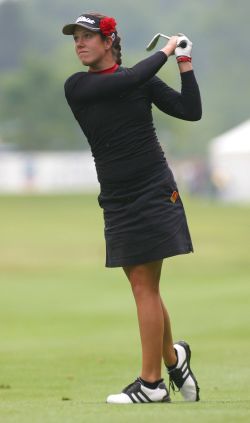
IT HAS been less than a month since Canadian golfer Isabelle Beisiegel revealed to the public she has been diagnosed with Graves' Disease. She has withdrawn from the Ladies Professional Golf Association (LPGA) Tour's qualifying school.
But the 26-year-old woman from Mont Saint-Hilaire, Quebec told CC.com she has already decided the disease will be merely a hiccup in her career and she will rely on God to guide her through it with grace.
"I hope that in the future, other people will benefit from my experience with the disease, and will be able to detect the disease earlier and find better treatments," she said. "I know that God is in control of my life, and this diagnosis brings me closer to him. I know that I will be strengthened through this hardship."
Graves' disease has negatively affected Beisiegel's golf career since early March. Symptoms of the disease include muscle weakness, fatigue, nausea, sleeplessness and rapid heart rate, which, for Beisiegel, have been progressively worse and debilitating. Originally diagnosed with fibromyalgia, or "chronic fatigue syndrome," she told the National Post in September that she had "learned to tolerate [it]."
Graves' is treatable, but incurable. It is the most common form of hyperthyroidism, occurring when the immune system mistakenly attacks the thyroid gland, causing it to overproduce the hormone thyroxine.
"Treatment should take a few months and I hope to resume my career when I am fully recuperated," she revealed. "My career on the LPGA in 2006 depends on the decision of officials to extend me a medical exemption."
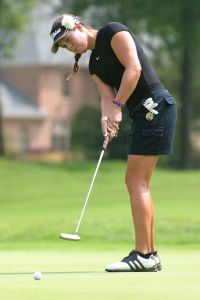
But not much seems to get in the way of this record-setting woman. In 2004, she was the first woman to compete at the PGA Tour's qualifying school in California. This year alone, she achieved the highest ball speed ever recorded, at the Titleist Performance Institute in California (female) -- 150 mph; and she achieved the highest swing speed ever recorded, at the Golf Expo in Oklahoma (female) -- 106 mph.
"In 2005, I placed well in the first two LPGA events of my golf season," she said. "Then, my health progressively deteriorated and I did not know what was happening. I started struggling and I was cut in the remaining events of the year. In mid-November, I was finally diagnosed with Graves' Disease."
Her website states her belief that "physical strength is only a small component [of golf]. Agility and skill, mental toughness, course management, and equipment make up the remaining aspects of the game. Women can be at a slight disadvantage to some men when it comes to strength, but gender has no play in the other areas."
Despite the sharp mind Beisiegel has to compete against the best, her rigorous training schedule in the off-season includes 165 workouts in 105 days, depending on her condition. There is always an opportunity to get stronger and faster, according to the website, and this schedule will insure every opportunity is taken.
Beisiegel turned professional in 2001, after being an amateur three-time Quebec Junior Ladies Championship winner (1994-96) and after winning the Quebec Amateur Championship (1997). She tied for 36th place in the 1998 U.S. Women's Open and was a member of the Canadian National Golf Team (1998-99). She was also a two-time Big-12 Conference Medal Award winner (1999-2000).
She was introduced to golf at the age of five, when her father taught his only child about his love for the game. He told her golf was "a wonderful game because you get to travel, make lifelong friends and enjoy the outdoors." It has since been her dream to do it professionally.
"Golf reminds me of the game of life, where we walk with God through the ups and downs, birdies and bogeys," she explained. "My faith has defined who I am and it plays a great role in my career. I believe God is always at work in our lives, down to the very detail. I quit golf in 2000, because I did not have a purpose for it. I learned in my time away from golf that I was burying my gift, and through faith I picked up the sport again, in April 2001."
Growing up an atheist led Beisiegel to seek a career for motivations different from today. Not until December of 1999 did she turn her life to Christ.
She met her husband, Daniel, now a financial analyst, through a mutual friend at the University of Oklahoma, where she studied International Business. She discovered in her time at school that the things meant to be driving her -- money, fame, success -- were causing her to fall into depression. When she met Daniel, a Christian, she said she saw something "good" in him.
Subsequent discussions and much study led her to believe there was a God, but only because of a delayed flight did she and Daniel see the movie The Green Mile.
"I realized through that movie that Christ had been humiliated and hated on the cross and died for me," she told CC.com. "That's when my prayers were answered and I became a Christian.
After her conversion, Beisiegel immediately saw the correlation between her depression and her motivations and quit the game altogether in 2000. She married Daniel that February, but after a few months working behind a desk, she realized her lack of ambition in the business world. She realized she was burying her gift, that she could use it for good, rather than for greedy, purposes.
Her golf mentor and coach is Don Maddox whom she met at Southern Hills Golf Club in Tulsa, Oklahoma, where she worked during the summer of 2000 before quitting the game. When she came back to golf, he agreed to help her reach her goals. He is also a Christian, according to Beisiegel.
"I don't want to get to the Pearly Gates and have God say that I could have pushed harder, that he would have been right there with me, helping me," she concluded in her vision statement online. "It is only a matter of time and discipline before I break the barrier. Until then, I will keep pushing."