
'Cartoon jihad' boils over worldwide
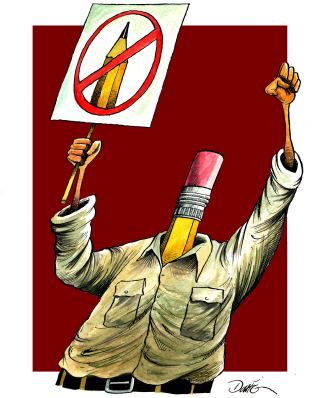 THE MOST notorious image shows the Prophet Muhammad wearing a bomb-shaped turban; another depicts him telling suicide bombers that there are no virgins left for them in heaven.
At least eight people have died so far in violent protests by thousands of Muslims, over several editorial cartoons poking fun at Muhammad. In an ominous escalation, an Italian priest was murdered February 5 in Turkey. Compass Direct stated that a Turkish television station, NTV, reported that the Muslim murder suspect "confessed that he committed the murder as a reaction against the caricatures of the prophet Muhammad."
The cartoons originated with Danish newspaper Jyllands-Posten, which commissioned them as a test of free speech last September. The paper apologized January 30 for any offense taken by Muslims, but defended its right to publish the images.
Agence France-Presse reported that Denmark's prime minister, Anders Fogh Rasmussen, stated February 7 that Islamic "radicals, extremists and fanatics" are using the crisis to "push forward their own agenda." Rasmussen said he hopes to "reach out to all people and countries in the Muslim world [and] work together in the spirit of mutual respect and tolerance."
While protests have been aimed primarily at Danish interests, other countries where the cartoons have recently been printed -- such as France and Norway -- have been targeted. Protests have also been held in various Muslim-dominated countries, including Pakistan, Egypt, Yemen, Nigeria and Bangladesh.
The crisis is being exacerbated by a popular state-run Iranian newspaper, Hamshahri, which has announced a contest in response to the controversy. Initially, the competition invited depictions of the Holocaust.
According to Bloomberg News, the paper "wanted to see whether the West would extend the principle of free speech to the Nazi genocide," in the wake of the Muslim cartoon furor. However, the paper has since decided not to use the Holocaust as the subject of contest entries; it has modified the competition "to include any caricature that tests 'freedom of expression.'"
Violence decried
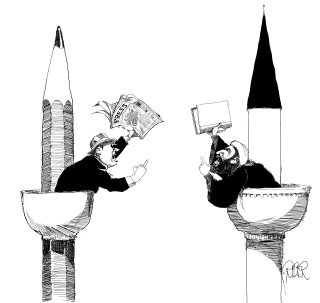 As Islamic protesters have vented their rage against various embassies and other targets, Western critics have been quick to decry the violence.
"British subjects march through the streets of the capital calling for their fellow citizens to be 'beheaded,' 'massacred' and 'annihilated," lamented a Daily Telegraph editorial, adding: "All respectable Muslims should be horrified at the antics of [these] ignorant loudmouths . . . At best, they have disgraced their religion. At worst, they have incited terrorism."
"The instant that any person or ideology is considered off-limits for critical examination and even ridicule, freedom of speech has been replaced by an ideological straitjacket," stated Robert Spencer of Jihad Watch. "Westerners seem to grasp this easily when it comes to affronts to Christianity, even when they are as sharp-edged and offensive as Andres Serrano's Piss Christ or Chris Ofili's dung- and pornography-encrusted Holy Virgin Mary. But the same clarity of thought doesn't seem to carry over to an Islamic context."
Daniel Pipes, writing in The New York Sun, asked: "Will the West stand up for its customs and mores, including freedom of speech, or will Muslims impose their way of life on the West? Ultimately, there is no compromise: Westerners will either retain their civilization -- including the right to insult and blaspheme -- or not.
"More specifically, will Westerners accede to a double standard by which Muslims are free to insult Judaism, Christianity, Hinduism and Buddhism, while Muhammad, Islam and Muslims enjoy immunity from insults? Muslims routinely publish cartoons far more offensive than the Danish ones."
Pipes bolstered his thesis with a quote from a Die Welt editorial, which asserted that the protests by Muslims in some countries "would be taken more seriously if they were less hypocritical. When Syrian television showed drama documentaries in prime time depicting rabbis as cannibals, the imams were quiet."
A recent full-page National Post presentation highlighted this inconsistency in graphic detail by displaying 11 blatantly anti-Semitic cartoons from various Middle East newspapers. An accompanying Daily Telegraph commentary by Tim Butcher asserted: "Hook-nosed Jews manipulating American foreign policy, Ariel Sharon . . . drinking the blood of Palestinian children, and Israelis wearing swastikas have all been depicted in newspapers across the Arab world in recent years."
In a National Review Online comment aimed at "making sense of the cartoon jihad," Pipes cautioned: "It certainly feels like a clash of civilizations. But it is not . . . It is a tragic mistake to lump all Muslims with the forces of darkness. Moderate, enlightened, free-thinking Muslims do exist. Hounded in their own circles, they look to the West for succor and support. And, however weak they may presently be, they eventually will have a crucial role in modernizing the Muslim world."
'Enemies of Islam'
Majed El Shafie, head of the Toronto-based One Free World International, told CC.com, "The moderate Muslims are scared." He added that sincere Islamic opponents of Muslim extremism "are worried that if they stand against this they will be considered enemies of Islam."
El Shafie fled his native Egypt some years ago. He said Muslims in Islam-dominated countries "don't have the freedom of expression -- and that is a bad thing." While he conceded that "making a joke" of Muhammad was a misguided endeavour, nevertheless "the person who did the cartoons did not burn a mosque."
He continued: "I don't think it's about freedom of expression versus respect for religion." Muslims, he said, have been shown respect in Western countries. "We gave them equal rights, and gave their TV programs airtime here." Conversely, he contended, Christians in some Muslim countries "are not allowed to build churches. Christians are not allowed to enter Medina and Mecca. In Pakistan, [extremists] burn the churches. It's not about respecting other religions; it's about hearing other voices and other opinions."
Emphasizing the fact that he was once a Muslim, he said: "I want to ask other Muslims a question. If you don't like the USA, Europe and Canada, why are you here? Why come to the West? I say this as an immigrant. I am Egyptian, I am a brown man myself, I came here to escape persecution. I respect the law and freedom of expression."
Most Muslims currently in Europe, he said, emigrated "to escape economic and religious persecution. They should use the peaceful channels Europe gives them to say what they like and don't like."
Citing Article 19 of the UN's Universal Declaration of Human Rights, he said: "Under international law, everyone has the right to expression, regardless of frontiers. Europe allowed them in, to give them freedom; and now the extremists are taking the freedom away from Europe. The cartoonist did nothing against human rights -- and even if he did something wrong, this is not the right way to do things."
Some of the more vociferous protesters, El Shafie suggested, are using the cartoon controversy "as an excuse to look like a victim, and cut away any criticism about Islam."
Overreactions
While the shrill slogans of demonstrators and religious firebrands have received much media coverage, some Islamic leaders have nevertheless taken a firm stand against the violence.
In Lebanon, according to the Knight Ridder news service, "senior Shiite cleric Mohammed Hussein Fadlallah issued a religious order banning flag burnings and attacks on embassies." The Organization of the Islamic Conference stated: "Overreactions surpassing the limits of peaceful democratic acts . . . are dangerous and detrimental to the efforts to defend the legitimate case of the Muslim world."
In Iran, cleric Akbar Hashemi Rafsanjani admonished his followers: "We need to put forward our calm and compassionate side, our gentleness."
In this country, a Muslim Canadian Congress statement also urged moderation. "The boycott of Danish food products by some Muslim owned stores is just another example of our community getting provoked into irrational action -- and validating the stereotypes that exist about us." While denouncing the cartoons as "reprehensible," the organization said the death threats of fanatics "must be condemned with vigour" as "contrary [to] the spirit of Islam, but also offensive to the civic society we have chosen as our home."
The statement continued: "As Muslims, are we not the same people who said: 'Don't blame all Muslims for the actions of one Muslim -- Osama Bin Laden?' Have we forgotten the argument we used to defend ourselves from collective punishment? Then why apply this unfair judgement against innocent Danes, many of them Muslim?"
Canadian Islamic Congress president Mohamed Elmasry, who declined requests for an interview with CC.com, echoed these sentiments, declaring elsewhere that "treating people as guilty by association is against Islamic teachings." However, he added: "Cartoonists, commentators or editors who show no respect for other religions or faiths should themselves be treated no differently than Holocaust deniers. They should be legally challenged on that basis."
Some Muslim commentators have also denounced the violent protests. "When Muslims put the Prophet on a pedestal, we're engaging in idolatry of our own," wrote Irshad Manji in the Wall Street Journal, adding: "The point of monotheism is to worship one God, not one of God's emissaries."
What would Mumammad do?
Tarek Fatah, communication director of the Muslim Canadian Congress, recently asked: "What would Prophet Muhammad have done?"
He wrote that Muhammad "endured insults and ridicule on a daily basis. His opponents mocked his message and used physical violence to stop him from challenging the status quo. At no stage during this ordeal did the Prophet lose his temper or react to these provocations. Tradition has it that he would, instead, offer a prayer of forgiveness to those who showed contempt for him. Today, however, many followers of Prophet Muhammad are acting the exact opposite."
Regarding the offending cartoons, Fatah maintained that "there is no question they are meant to hurt the feelings of Muslims. As I saw them, I had to restrain my anger." However, he continued, "the way some Muslims have reacted to the provocation leaves a lot to be desired. Provoked, they walked blindfolded into a trap set for them, and came out worse than what they started."
Further, "for the Arab League to demand that the Danish Government shut down the newspaper Jyllands-Posten shows how deeply entrenched dictatorial practices are in many Muslim countries. They are so accustomed to closing down their own newspapers, they could not understand why the Danish government could not issue a decree closing the Jyllands-Posten."
University of Toronto's Anver Emon, who teaches Islamic law, made a similar point in the National Post: "What is especially ironic is that Muslims the world over protest their corrupt autocratic governments where free speech is not allowed, and opposition newspapers are shut down regularly. It is hypocritical for them now to call for the closure of newspapers and issue death threats to artists."
As the crisis has unfolded, most prominent Christian leaders have not spoken out about the issues involved. One exception is Bruce Clemenger, president of the Evangelical Fellowship of Canada, who noted that "art which denigrated Jesus has not prompted violence or the threat of violence on the part of Christians." Nevertheless, he said, "as Christians we can understand the hurt that Muslims feel when the Prophet Muhammad is mocked."
He added: "We also understand the importance of the freedom to challenge perceived truths -- as that is why Christ died." However, he emphasized, freedom of expression "does not justify the mocking or scorning of what others consider sacred . . . In a society that claims to be respectful of diversity, freedom must include self-restraint and openness to understanding what is sacred to others."
Clemenger concluded: "In what is being called a clash of civilizations, perhaps we followers of Christ can bridge the seeming solitudes and be the peacemakers Christ called blessed."
-- additional reporting by Chris Wiebe
Related stories:
Violent reaction as offensive as Muhammad cartoons, Canadian Muslims say
Cartoons depicting the Prophet Muhammad as a terrorist are deeply offensive, but so is the violent reaction to the drawings from Islamic extremists, Canadian Muslims said Thursday.
Canadian Press, February 2
Editors weigh free press, respect for religious views
European media are defending the Danish newspaper that first published the images by reprinting them -- unleashing new rounds of fury from offended Muslims. But few media outlets in North America have followed suit.
National Post, February 4
A clash of values
In 2003, artist Dave Brown published a cartoon in Britain's Independent newspaper depicting Ariel Sharon eating a Palestinian baby. "What's wrong?" Sharon is saying. "You never seen a politician kissing babies before?" The cartoon provoked outrage for two reasons. First, it played on the debunked myth that Israel had massacred Palestinian civilians in Jenin the previous April. Secondly, it evoked the ancient libels against the Jews -- the most famous being the claim that Jews use the blood of Gentile children to make their Passover Matzoh. Yet Brown never felt compelled to go into hiding from Jewish mobs.
Jonathan Kay, National Post, February 4
The Prophet cartoons
Sadly lacking in the uproar between a Danish newspaper and the world's Muslims is a sense of proportion or respect
Riad Saloojee, Vancouver Sun, February 4
'Radical Islam week' sparks U of T furor
Campus police at the University of Toronto will be on alert today as a Jewish student group kicks off Know Radical Islam Week, a series of lectures aimed at exposing everything from the alleged enslavement of camel jockeys in the United Arab Emirates to genital mutilation of women in Egypt.
National Post, February 6
An ancient doctrine, wrenched out of context
The cartoons of Muhammad (d. 632) invoke two Islamic legal prohibitions: depicting images generally and, more important, insulting the Prophet.
Anver Emon, National Post, February 6
A nasty lesson in cause and effect
Republishing cartoon endangers reporters in Gaza
Matthew Fisher, National Post, February 6
Bush accuses Syria and Iran of incitement
'The world ought to call them on it'
CanWest News Service, February 9
Bush accuses Syria, Iran of inciting Muslim violence
U.S. joins Canada in condemning the protests and calling for an end to a week of deadly rioting
CanWest News Service, February 9
Orchestrated 'clash of civilizations'
Global protests were anything but spontaneous
National Post, February 9
Nothing 'spontaneous' about it
'A blessing from God." This is how Iran's leaders, starting with President Mahmoud Ahmadinejad, have described the controversy over Danish cartoons of the Prophet Muhammad. A closer look at the row, however, would show that the whole rigmarole was launched by Islamist groups in Europe and Asia, with Mr. Ahmadinejad and his Syrian vassal, President Bashar al-Assad, playing catch-up. God had nothing to do with it.
Amir Taheri, National Post, February 9
The lunacy principle
Public relations between the so-called West and the Islamic Middle East have reached a level of abject absurdity. . . . All this lunacy is understood only in a larger surreal landscape. Tibet is swallowed by China. Much of Greek Cyprus is gobbled up by Turkish forces. Germany is 10% smaller today than in 1945. Yet only in the Middle East does one hear the term "occupied land," one that derived from the military defeat of an aggressive power.
Victor Davis Hanson, National Post, February 9