
Comment: What kind of Christ-figure is Superman?
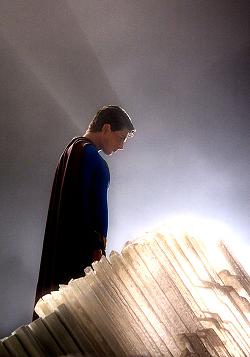
LOOK! Up in the sky! It's a bird! It's a plane! It's . . . Jesus?
Ever since the first Superman movie came out in 1978, Christians and others have had fun pointing out the various parallels between the Man of Steel and the Son of Man. Both of them were sent to Earth by their fathers, both of them were raised in obscurity by earthly parents with the initials M and J, both of them have supernatural powers, etc.
Roy Anker, in Catching Light: Looking for God in the Movies, even argues that the first film has strong Trinitarian overtones. Jor-El (Marlon Brando) tells his infant son that they will live in and through each other, which echoes the biblical idea that the Father and the Son indwell each other. And the green crystal which brings Kal-El to Earth, calls him from his earthly home, and then connects him to his father is like a stand-in for the Holy Spirit.
So much has been made of Kal-El as a Christ figure that little attention is ever paid to the kind of Christ figure that he is. You often hear people argue that Superman raises Lois Lane from the dead in the first movie (though one could also argue that he merely goes back in time to a point before her death and does not actually raise her from the dead, per se).
But what people often don't point out is that Superman brings Lois back to life as a very specific act of disobedience against his father. At several points in the story, Jor-El tells his son that it is forbidden to interfere with the past, and when Superman prepares to do just that, Jor-El's face looms large in the clouds, sternly warning him not to disobey.
This theme -- Superman's almost adolescent rebellion against the demands of his father -- was going to be developed a little further in Superman II, parts of which were shot at the same time as the first movie. But the director was fired and replaced, and the remaining Brando footage was shelved, and the sequel had to be partly rewritten as a result.
Even so, when you look at the first two films together, an interesting pattern emerges -- one that does not necessarily lend itself to orthodox Christian interpretation.
If Superman is a Christ figure, then the Superman of those two films is like the Jesus of The Last Temptation of Christ. He wants to be an ordinary person, he resists the burden of the destiny placed on him by his father, at times he openly acts against his father's wishes, and eventually he abandons his destiny altogether for the sake of a sexual relationship.
And then, when he realizes his mistake, he hits the re-set button -- re-claiming his powers, defeating evil the way he was meant to, and turning back the clock, figuratively speaking, so that it is as though his love affair never took place. In Superman's case, he does this by giving Lois Lane a kiss that erases any trace of their affair from her memory.
I mention all this because some Christians -- such as Stephen Skelton, author of The Gospel According to the World's Greatest Superhero -- have been almost embarrassingly excited by the possibility that Superman Returns, which relies heavily on the first two movies, will provide yet another opportunity to exploit a comic-book story for evangelistic purposes.
I am not so sure that it can. The Kryptonian crystals, once so mystical, are treated here as little more than a technological commodity. And the father-son theme is applied in a way that is less open to Trinitarian interpretation, and more about everyday paternity. For a man that can fly, this Superman is very down-to-earth -- and probably too much so.
Peter T. Chattaway is a film critic for BC Christian News, ChristianWeek, ChristianCurrent and other publications. His review of Superman Returns is at Christianity Today Movies.
Internet Movie Database | Movie Review Query Engine
USA: PG-13 | BC: PG | ON: PG
Related stories:
Fans question Superman's sexuality
Some people want the Man of Steel to come out at the same time as his new film
CanWest News Service, June 16
Superman a Christ figure? Book sparks heated debate
Theory excites evangelicals and upsets Jews
CanWest News Service, June 17
June 29/2006
