
United Church faces backlash for stance on Israel boycott
A BOYCOTT of Israel promoted by a United Church task force has prompted a growing backlash from media commentators and supporters of the Jewish state.
A group affiliated with the church's Toronto conference is supporting an economic boycott of Israel and its supporters. The body in question is the Task Group Implementing Policy for the Toronto Conference for Moral Investment In the Middle East.
A lengthy report called 'Ethical Investment for Peace in Palestine' has been posted at the United Church of Canada (UCC) website. It was prepared for the church's 39th General Council, which is scheduled to meet August 13 - 19 in Thunder Bay, Ontario.
The report maintains that the UCC "has consistently striven for peace with justice in the Middle East . . . [and] has affirmed support for the State of Israel and its right to peace and security."
Further, it states that the church "continues to condemn acts of terrorism and violence by Palestinian extremists, as well as state terror." What the report terms "a just peace" would "require the dismantling of Israeli settlements in the West Bank and East Jerusalem, and an end to the occupation."
The church insists that this report does not call for a boycott of Israel. Instead, it says the controversy began with a June 28 news conference held by a Toronto-based committee "to commend the Ontario branch of the Canadian Union of Public Employees (CUPE) for its recent resolution to support an international campaign of boycott, divestment, and sanctions against Israel until that state recognizes the Palestinian right to self-determination."
The boycott was commended by the Toronto group and not by the church as a whole. Nevertheless, the UCC as a national body is being taken to task over the Toronto stance.
David Katz, secretary-treasurer of the Ontario branch of the Canadian Jewish Congress (CJC), issued a statement calling the UCC stance "unjust and misguided."
Katz further declared: "We call on leaders and members of the United Church of Canada to reject this position outright. Our community cannot help but view this motion as insensitive to Canadian Jewry's inherent and unbreakable attachment to the State of Israel."
Charles McVety, president of Canada Christian College, told Canadian Jewish News that the UCC action denoted "blind sightedness and hatred for Israel."
Frank Dimant, executive vice-president of B'nai Brith, also issued a statement maintaining that the Toronto branch of the UCC has "a long history of looking at the [Arab-Israeli] conflict solely from the point of view of the Palestinians." The UCC, he asserted, "cannot claim . . . to promote peace and understanding among Arabs and Jews and then work to the detriment of one party to the conflict, namely Israel."
Media commentators in Canada were quick to condemn the UCC Task Group's action.
"No sooner . . . did the United Church announce its astonishing assessment of Israel than letters began appearing in the newspapers from the shocked and bewildered members of that church, most of them pointing out the obvious," stated Ted Byfield in the Calgary Sun.
"All over the world," he continued, "Christians are suffering persecution. In China, the persecutors are the Communist government. Almost everywhere else, it's the Muslim fundamentalists. Today the most powerful bastion against this aggression is Israel. That's why Islamic states want to destroy it. Now they have an ally in the United Church of Canada. The mind reels."
"Some Israeli policies, including settlements in occupied areas, are a fair target for criticism," declared a Toronto Star editorial, adding: "Many Israelis are the fiercest critics of their government, despite the terror attacks they have endured. No neighbouring country tolerates such dissent."
However, the Star contended, "Boycotts and 'disinvestment' campaigns for the sake of social justice are always controversial. In this case, they are simply unfair."
"Israel has its flaws," agreed Calgary-based Jewish journalist Ezra Levant, publisher of the Western Standard, in an editorial for the Calgary Sun. "But for the UCC to zero in on Israel's flaws and to ignore the far more egregious flaws of its neighbours and enemies -- well, that can only be explained by a bias."
Further, Levant asked: "Where are the sanctions against Jordan, Lebanon or Syria? Where are the sanctions against the Hamas-run Gaza Strip, which denies basic civil rights to Palestinians?"
Israel, he maintained, "in a state of war with its neighbours and facing an existential terrorist threat, has implemented security measures that sometimes step on personal liberties . . . For the UCC to magnify and condemn the relatively minor inconveniences that Israel causes Palestinians, while completely ignoring the fact Palestinians in the rest of the world are treated far more abusively, is discriminatory."
Lawrence Puchee, co-chair of the UCC task group, said he and his colleagues are calling for the boycott because occupation of Palestinian territory is illegal according to declarations made by the United Nations (UN) since 1948.
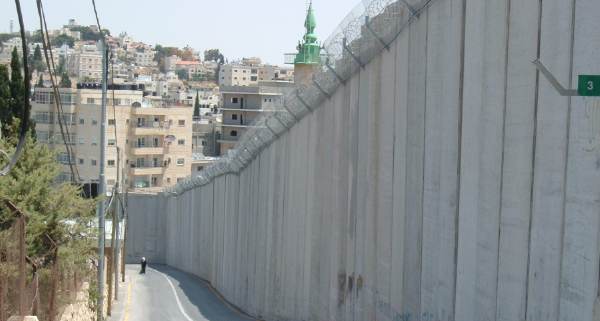
"The UN imposed this on [Palestine], creating problems," he said. "Most of the Muslims and Christians were expelled; it wasn't worked out that well, and people were forcibly moved. The wall should have been put up along the established line, but wasn't. Israelis are pulling out of Gaza, but putting 13,000 more settlers in the West Bank."
Puchee contended that the Palestinians have been "subjugated by the Israelis. The question for our Christian community is this: Can we do something to use our economic clout to influence the situation?"
He said the Toronto UCC hope to stop any investment or purchasing from companies which support Israel and supply the country with weapons and demolition equipment -- including Boeing, General Electric, Caterpillar, Lockheed Martin and Canadian Aviation Electronics.
The task group is also asking the Canadian government to impose tariffs on "Israeli products from the occupied territories."
Although the Task Group opposes many of Israel's policies, Puchee said they do not support extremist positions, and insisted they are not anti-Semitic. "We want Israel to have security and peace for the future, but we also want the same thing for the Palestinians. It's really an economic move -- not against Israel, but against those making money off the conflict."
Further, he said, his group is supported by some Jews. "We have a Jewish member in our group, and have the support of Jewish groups like the Canadian Jewish Women Against the Occupation. Most people don't make the distinction; but there are Jewish groups in Israel that disagree with the occupation, and protect Palestinian farmers from having their homes destroyed by the Israeli government and the settlers in the occupied territories.
"We mention Jews nowhere in our press statement, we talk about the Israelis who are occupying Palestinian territory. Most people don't know about the abuses the Israelis commit everyday by not allowing people to move about the occupied territories and go about their business, preventing them from going to the doctor, or school, or work and disrupting their lives."
Donna Holbrook, a zealous supporter of Israel and director of the Canadian branch of the International Christian Embassy Jerusalem, declined to comment at this time. She said she is waiting for the organization's Jerusalem headquarters to formulate an official reaction to the task group's declaration. She said a statement would likely be released by July 14.
-- additional reporting by David F. Dawes
July 13/2006
