
Christians confront the housing crisis
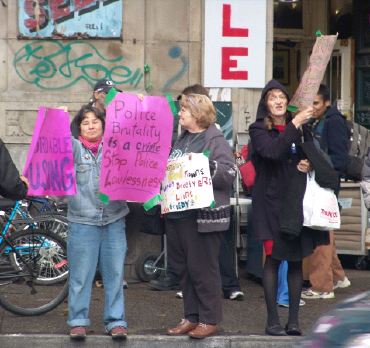
"THERE ARE empty buildings and there are people on the street. That is a crime," yelled one of the 80 protestors at a rally in Pigeon Park in Vancouver's Downtown Eastside.
The rally was held to support eight activists who, earlier this week, began illegally squatting in the vacant North Star Hotel on Hastings Street to demand that the city increase construction of social housing. Police evicted them October 24. About the same time, police evicted a similar group of squatters from a building in Victoria, BC.
It didn't take these protests to demonstrate that there is a housing crisis in Canada. More than a quarter million Canadians are now estimated to be homeless, and the numbers are growing. For instance, the number of homeless counted in the Greater Vancouver area more than doubled between 2002 and 2005, from 1050 to 2057.
However, such counts widely underestimate the problem, since many homeless people move around and try to avoid being noticed. Greg Paul, executive director of Sanctuary Ministries in Toronto says the surveys often count only people who are sleeping on the streets, many people are transitional, and definitions vary. "I know a man who has been couch surfing [sleeping on various friends' couches], and sometimes in hostels, for 20 years," he says. "We have now had him in a housing project for two-and-a-half years, and he is doing well, but it has left him pretty debilitated."
Paul says the "scariest figures" -- "the number of households at risk of homelessness" --are well documented. There are about 365,000 such households in Toronto and maybe 160,000 in Vancouver. That is about 10 percent of the Canadian population. These are people who spend more than 50 percent of their income on housing. "They are one paycheque or one minor mishap away from ending up on the street. Many of them work for a few months, lose their job, become homeless for several months, climb out, then cycle through the whole process again."
How did we get here?
Lorne Epp, executive director of More Than a Roof, a BC-based non-profit society, says the current crisis is a result of "a perfect storm" of converging trends.
* Social housing cuts. Since shortly after the Second World War, the Canadian government had recognized that up to 20 percent of the Canadian population needed some kind of help with housing. By the 1960s, the Canadian government was funding over 20,000 units of social housing per year. Under a cost-sharing agreement with the provinces, the federal government paid two-thirds of the cost and the provinces one-third.
The number eroded throughout the 1980s, until the federal government abruptly stopped the program altogether in its deficit-cutting efforts in 1993. Rather than pick up the slack, all of the provinces except Quebec and British Columbia also cut spending on social housing. The result is that the number of social housing starts dropped to less than 1,000 a year. Over a decade, the previous level of social housing construction would have provided housing for over 200,000 individuals or families.
* Mental illness. Many surveys have found that a significant number of homeless people suffer from mental illness or addiction.
Over the last two or three decades, many provincial governments began de-institutionalizing the mentally ill. This was partly a cost-saving measure, but it was also thought that "community-based care" would be better for the mentally ill than warehousing them in impersonal institutions where abuses sometimes occurred. However, the "community-based care" never materialized. Without encouragement to take their medications and without access to other needed services, many of the mentally ill ended up on the street.
Not well defined is the extent to which living on the street contributes to mental illness. Are people on the street because they are mentally ill, or do people become mentally ill as a result of living on the street?
* Drugs. Another factor is what Epp calls "an influx of cheap, very potent street drugs." He notes that while people addicted to heroin and alcohol "could function reasonably well for an extended period of time", research shows that people who become addicted to meth and crack often lose their jobs and their ability to function within 60 days -- and the brain damage is often permanent.
* Urbanization. As Canadians have continued to migrate from rural areas to the cities, overcrowding has caused housing costs to rise much faster than the rate of inflation.
* Welfare cuts. Again, federal deficit cutting has meant that a majority of the unemployed are now no longer eligible to collect Employment Insurance. At the same time, many provinces have either cut or have failed to increase social assistance payments.
In British Columbia, for instance, the shelter allowance has remained at $325 per month for a single person for the past 12 years, at a time when rents have soared. One result is that developers have no interest in building low-cost housing.
Ron Van Wyk, director of Employment and Community Development for Mennonite Central Committee, says, "It doesn't make sense to develop new stock when the allowances don't cover the costs." This is also one reason why many residential hotels are starting to evict their tenants and redevelop the land.
* Economic casualties. This phenomenon is variously defined. Some attribute it to globalization. Others refer to the "digital revolution", saying those who are computer illiterate can't even run a cash register at a fast food outlet.
Whatever the reason, there are an increasing number of people who are "underemployed", working less than full-time, without benefits at minimum wage. They simply can't afford to pay rent.
Launching a movement
Why isn't the church more involved in this problem?
That was one of the questions answered by 'The Church and Affordable Housing' conference held October 14 at Broadway Church in Vancouver. Billed as "a conference to launch a movement," it is actually the most recent of several events highlighting the issue.
Organizers had at first hoped to gather 20 to 30 people together to talk about the issues. Then they decided they would need at least 150 participants to run the kind of event they felt was needed and cover the cost. It was only a week or so before the event that registration reached those numbers. Then, a flurry of last-minute registrations pushed attendance past 250, including two mayors, an MP and an MLA.
Paul says, "I was terrifically encouraged that more than 250 showed up, and about two-thirds were Christian folk who as yet do not have any direct involvement. People are catching the vision."
Ron Gomez of Wilson Heights United Church says he was "pleasantly surprised" to see that most of the people there were evangelicals and Pentecostals. "It was great to sit down together to work on these problems when we wouldn't normally sit down together. Finally, churches are saying, 'Yes, we will work together.'"
To some extent, the event built on the Street Level conference held in Ottawa in March, organized by the Evangelical Fellowship of Canada's Roundtable on Poverty and Homelessness.
That conference produced the 'Ottawa Manifesto,' a statement of interest and a call to action to engage churches, government, business and the media in issues of poverty. The manifesto was delivered to all MPs and published in the Ottawa Citizen.
Paul, one of the main drafters of the manifesto, says that across Canada, "there is a growing sense of support" for the vision, among both mainline and evangelical Christians.
He says the drafters of the manifesto have a particular kind of voice to offer because they are not primarily members of advocacy groups but frontline workers who "actually look into the eyes of the people on the street." However, he adds, "We haven't carried it anywhere near as far as we could and would like to."
The October 14 conference also highlighted the fact that a large number of churches are involved in a wide variety of ministries related to poverty and affordable housing.
Larry Nelson, chief executive officer of Baptist Housing Ministries, presented a workshop, declaring: "The bulk of housing created by the church since World War II has been for seniors."
He added, that with an aging population, this is going to remain an area of need. His ministry currently provides housing for over 1400 seniors in 14 community complexes. Such projects, while not directed toward the homeless, have the effect of expanding the total stock of available affordable housing.
More Than a Roof, a ministry that grew out of Mennonite Central Committee BC, provides housing for over 900 people in eight complexes. About 60 percent are single mothers and their children. About 20 people in one complex have various forms of mental illness.
"We fly a pretty big Christian flag," says Lorne Epp. More Than a Roof puts full-time workers in each complex who serve as "benevolent landlords" to provide the help that people in social housing often need. "The cornerstone is to hire vibrant Christian people who have people skills and can build community, as a neighbour and friend."
Other church ministries offer emergency shelters for street people, transition housing for people coming out of addiction or prostitution, and permanent housing for people with disabilities.
The model for almost all of these ministries is a reliance on federal and provincial government grants for capital and operational costs and local governments to provide land. Lorne Epp says, "This is inevitable due to the large capital costs." He notes that even the largest churches don't have an extra $10 or $15 million with which to construct a social housing complex.
Governments seem to be welcoming church involvement in this area. Don Luymes, manager of community planning for the city of Abbotsford, BC, says, "Non-profit partners are very important because the city doesn't have the expertise to operate social housing."
Paul says, "We work at home-building. Housing isn't all that is needed. People of faith are best equipped to bridge the gap between housing and a home."
Paul notes that while the evangelical movement began in social justice, evangelicals have been largely absent from social issues in the past century, focusing instead on personal salvation. And even when they enter the public arena, they have largely been preoccupied with moral issues rather than social ones. However, he sees signs that that is changing.
Alice Sundberg, executive director of the BC Non-Profit Housing Association, was one of the keynote speakers at the Vancouver conference. She notes that churches were more involved in social issues in the early part of the 20th century but then government decided to take over solving social problems because it had the money. Now government is saying it can't do it all, and churches are returning to that area.
Although she describes herself as "an agnostic," Sundberg says churches "have a very important role to play." She notes that the church now has an image of being conservative and intolerant but "there are many active community church-based groups that are doing incredible work."
She says even very conservative churches often run a food bank in the church basement "addressing problems created by homelessness." For people who are spending most of their incomes on housing, having food provided can keep them from losing their homes.
Asked what message churches could take from the conference, Epp says, "If you are not doing anything, do something. If you are doing something, do a bit more. If the gospel has relevance, it is Christians with their sleeves rolled up."
October 26/2006
