
Building a place for the children
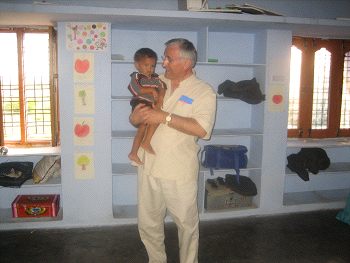
HARRY SCHMIDT started with no money, little education and a serious speech impediment. He went on to become president of Harwood Industries, and an Abbotsford city councilor. He and his wife Marlene now travel around the world using their wealth to build shelters for needy children. Harry's autobiography, The Incredible Dream, is being published in December.
CC.com: Tell us a bit about your growing up years.
Harry Schmidt: My parents came from Europe in 1927 and settled in Wappella, Saskatchewan, a little town close to the Manitoba border. They probably didn't move further west because they didn't have the money and they already had a sizeable family to feed. I was one of 13 children, and there were a lot of things that we didn't have. But we always had enough food to eat, and we were very happy with what we had. Even though we didn't have the things that a lot of children have, we did have a good upbringing. Mother and Father were both devout Christians, and they made sure that we understood what we needed to do to become good Christians and good Canadian citizens.
CC.com: Can you describe the first house that you lived in?
HS: The first house was a very simple place. It had two rooms. Part of it had just a mud floor, and part of it had cement. The house was made of railroad ties chinked with moss. With seven or eight children already, it was definitely a full house. Later, my father pulled a wheat storage building close by, and we also used that as living quarters for a time. It was very primitive, but a very happy home. I still cherish those days.
CC.com: So you would say you had a rich childhood?
HS: Yes. Compared to others in today's world, I think that I had the richest childhood that any child could ever have. In my travels working with children around the world, I see so many evil things happening to children. But we had a loving father and mother, and the few neighbours in the area were all wonderful people. And the essence of our lives was that we were taught that we must pray every morning. We needed to remember that God was in control of everything and to constantly ask God for guidance and help for all the things that we needed for our daily lives.
CC.com: You didn't stay on the farm.
HS: No. As I grew up, it was always instilled in us by mother and father that we needed to give something back, we needed to put something into this big barrel called Life in order to get something out. When the time came for us to move away from home, there wasn't very much that our parents could give us in the way of material things. But they gave us one thing -- a work ethic that was second to none. Whatever needed to be done, wherever there was some work, we were willing to do it.
I had to ride some distance on the railroad, on freight cars, to get to Calgary and start working. I had a severe speech impediment, so it was very difficult for me to even ask for work. Besides, I really didn't know how to go about asking for a job. But we had faith that we were going to succeed, and that certainly helped. I worked at all types of things, digging ditches, then working in a steel plant and cleaning feathers out of a chicken plant, hauling freight in a freight business. Then I had the privilege of meeting my wife Marlene, and that set a new tone in my life because I had a wonderful partner to work with. Shortly after that, we got into the construction business, and the rest is history.
Our parents had told us many, many times that if much is given, much is required. I have never forgotten that. As we went on in life, much was given, much was earned, but we always knew that we needed to give something back. That is why we are working with children around the world. We believe that the money that we have earned does not belong to us. It belongs to the Lord, ever penny of it. Though we have a sizeable amount of money, that is just something that we need to use wisely to help others -- not only to raise our own family, but also to help other children around the world, help people that are in need. That is what it is about for us.
CC.com: You came to Abbotsford in 1969?
HS: Yes. Arriving in Abbotsford was a good experience for us. We already had three children then, two adopted and one born to us . . . We came with the idea that we were going to build a home close to this beautiful little church that we really liked, get a job as a janitor or something like that, work, and raise our little family. And we thought that would be the story of the Schmidts. But that is not the way things worked out. The Lord had other ideas.
The business manager from the new junior college that was just starting up in Langley, BC came and said they needed somebody to supervise the construction of new dormitories and some other buildings. So I went and worked at Trinity Western College for almost six years. That was a wonderful experience, and I met some wonderful people. Cal Hanson, the president, was a godly man that I admired greatly. He taught me many things, including how to be a good steward of the Lord's money. We needed to be very careful how we spent the money there because there wasn't much to spend . . .
During that time, Marlene and I got into the construction business, building seniors' housing. That was the niche we chose, it was something that was needed, our units were well accepted, and we made the best of it. People were getting older and needed to have accommodation. A lot of those folks . . . didn't have a lot of money to retire with. So it was important that we produce good quality housing at an affordable price. The idea was to provide enough space for two people to live comfortably and perhaps even have the children and grandchildren come home. So that is what we did. We concentrated on building seniors' units that had two bedrooms and a bath . . . We built several hundred of these units around the countryside in the US and Canada, and these complexes are still serving well today. We wish that the government would have helped and produced more of these units. Today there are people that need this kind of housing, and it is just not available to them.
CC.com: You went on to build children's shelters around the world.
HS: With our building, we became very successful as far as finances were concerned. But the nagging issue at the back of our minds was that we had made a commitment some years back, before our children were born, that if we were able, we were going to help children around the world. Marlene and I would look at each other and say, "Now what? What are we going to do about that commitment?" So we formed the Schmidt Family Foundation and started building shelters for children. At present, we have funded nine shelters that are still actively working, and have also been financially involved in others. We are just grateful that we had the opportunity to do these things and to be partners in the work of the Lord for children.
Our parents were definitely the driving force for us to do the things that we are doing. Anything that we have achieved certainly must have come from the training we got as young people.
Our first stop was in Ethiopia. A couple from New Zealand were struggling to build shelters there for little ones. We helped put together a building that is used for a school, for sleeping quarters, for an eating area, and for a church. From there, it just kept going. We went to the Philippines and put together two beautiful buildings on the isle of Cebu. We went to Ukraine, to Russia, to South America. In all these places, we built a school or shelter. The children were the ones we were really interested in helping. We have just finished a large complex in India that serves something like 600 children. We hope that the Lord gives us the health and strength to keep doing this, and maybe in another four or five years someone else will take over, maybe one of my children.
CC.com: Why did you write The Incredible Dream?
HS: When I was a young boy out in the fields minding the cows, I would lie down and look up at the sky and wonder what was beyond, what was happening in other parts of the world. And I dreamed that one day I would do something, achieve something, build something, help someone somewhere. Even though I had a speech impediment and was very small in stature, this dream never left me. This was the thing that encouraged me to do the things that I have done. It was a wonderful experience to have that dream as a young boy and then as a man do the things that I dreamt about. I decided the time had come to put that dream down on paper to encourage other people.
CC.com: The proceeds from the book will go to the Schmidt Family Foundation?
HS: Yes, all the money from the book will go to the Foundation to be used for building more shelters and helping more children around the world. We have no intention of using any of the money for ourselves.
CC.com: What do you want people who read the book to get out of it?
HS: If they don't get anything else out of it, I would like them to understand that all of us have a dream within us, all of us have a desire to do something. If all of us would just do a little bit, that maybe would be enough to encourage others to do the same thing. This is a big world, there are millions of children out there wanting for all kinds of things, and it is up to us to go out and do something about it. We can't just say we will leave it to this organization or that organization. We have to be the ones who are going to do what we can. That is what I would like to have people get out of reading this book to understand what can be done by even the humblest and simplest person with very little to work with but the dream and the desire to accomplish something. Many young people are already serving and doing a wonderful job. I would just like to encourage more to do the same thing.
The book is a bit of a biography of this young dreamer, but it also tells what can be done, how mysteriously you can move from one thing to another. Sometimes we say, "I could never achieve that. I don't have the education. I don't have the vocabulary. I don't have this, and I don't have that." But it is amazing what can be accomplished if you really put your mind to it and do the best you can. I don't think we will be judged by how much education or money we had. We are going to be judged one day on what we have done with what we have been given.
November 23/2006
