
Microfinance Summit to be hosted by Canada
THE GLOBAL Microcredit Summit, which is again being hosted by Canada, will take place November 12 - 15 in Halifax, at the World Trade and Convention Centre. The summit will include government leaders, and some 2,000 delegates from more than 100 nations.
Microfinancing was given high-profile recognition as a force for good when the Nobel Peace Prize was recently awarded to the Grameen Bank of Bangladesh and its founder, Muhammad Yunus. The bank and Yunus were recognized for their pioneering work in pulling women out of poverty through the lending of small business loans.
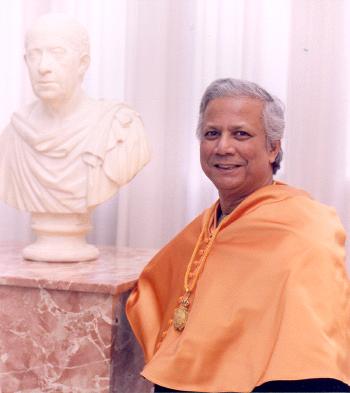
Yunus will make a presentation at the Summit. He once noted that, in his view, poverty is perpetuated by unhealthy worldviews.
"We create institutions and policies on the basis of the way we make assumptions about us and others," he said in a speech delivered in Oslo, Norway in 1997.
"We accept the fact that we will always have poor people around us. So we have had poor people around us. If we had believed that poverty is unacceptable to us, and that it should not belong to a civilized society, we would have created appropriate institutions and policies to create a poverty-free world."
The key thing lacking, he contended, was human will. "We wanted to go to the moon -- so we went there. We wanted to communicate with each other very fast . . . so we bring appropriate changes in the communication technology. We achieve what we want to achieve. If we are not achieving something, my first suspicion will fall on the intensity of our desire to achieve it."
He said he envisioned a world in which poverty will exist only as a distant memory -- reduced to artifacts displayed for educational purposes. "When school children will be on a tour of the poverty museum, they will be horrified to see the misery and indignity of human beings. They will blame their forefathers for tolerating this inhuman condition to continue in a massive way."
Participants in the Halifax event will evaluate the Microcredit Summit Campaign's progress toward the goal of helping 100 million of the world's most impoverished people. The event will also see the launch of the second phase of the campaign -- which is aimed at attaining the UN's Millennium Development Goals.
According to its website, the Microcredit Summit "defines the poorest families in developing countries as the bottom 50 percent of those living below their country's poverty line, or those living on less than $1 a day adjusted for purchasing power parity."
The Summit's mandate for the developed world is to help all people living beneath the established poverty line. "Reaching 100 million of the world's poorest families is only one step in eradicating poverty worldwide," says the website.
In addition, the Summit endeavours to help women in dire straits. The rationale is that women "are often responsible for the upbringing of the world's children -- and the poverty of the women generally results in the physical and social underdevelopment of their children.
Mircofinancing has been around since 1971, and one of its chief proponents is Opportunity International (OI). The organization raises money to finance programs benefiting entrepreneurs in Third World countries. OI has more than 6,000 employees, and the majority of them provide education and training to the poor -- providing a sustainable way to break the cycle of poverty.
B.C. was the first stop in OI's cross-Canada International Visitors Tour, which began October 20 in Vancouver, and was followed by visits to Calgary and Toronto. The purpose of the tour, which leads directly to the Summit, was to raise more public awareness of the benefits of microfinancing.
OI Canada president Gary Walsh recently announced that the organization hopes to mobilize $1 billion by 2012, to help people move beyond poverty in Africa, Asia, Eastern Europe and Latin America.
"This is a historic commitment to harness the potential of the entrepreneurial poor, to turn them into full and valued participants in their national economies," said Walsh. "We are committed to advancing breakthroughs in financial products that help the poor families work their way through poverty, retain their hard earned profits and reduce their vulnerability."
-- additional reporting by David F. Dawes
Nover 1/2006
