
United Church ad campaign gets mixed reviews
 IN AN attempt to bolster its dwindling membership, Canada's largest Protestant denomination launched an ambitious advertising campaign November 7.
The United Church of Canada (UCC) campaign, costing an estimated $10 million, encourages spiritual searchers and people disenchanted with 'organized religion' to interact with a website, with the aim of drawing them to UCC churches in their communities. Critics of the UCC, however, are questioning precisely what sort of church these seekers might be drawn to.
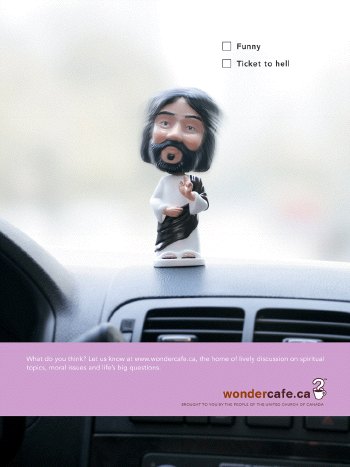
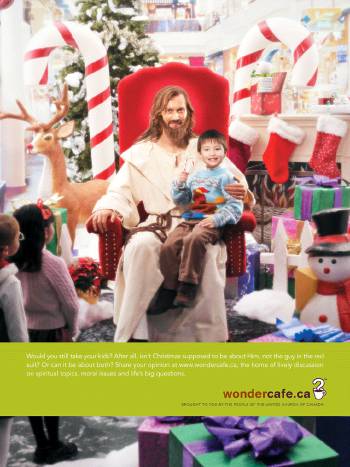
Combining print and internet ads, the campaign is designed to attract the curious to WonderCafe.ca, a forum for thought-provoking questions relating to both faith and social issues. The six ads use colourful, striking images -- including a 'bobble-head' Christ, two male figures on a wedding cake, and Jesus depicted as a department store Santa -- to highlight challenging questions.
The website has, so far, generated lively cyberspace discussions of issues such as global warming, foreign aid, income trusts, celebrity adoptions, and Tom Cruise's Scientology beliefs. There is also a fanciful section featuring 'E-Z Answer Squirrel' -- which features the woodland creature answering questions 'yes' or 'no,' accompanied by a musical parody of the 'Shaft' theme.
At a Toronto news conference announcing the campaign, UCC moderator David Giuliano cited the results of a poll by Environics Research Group. Focusing on Canadians aged 30 to 45, Giuliano said the poll indicated a majority of them "believe in God, that this belief shapes their lives, and that nearly half pray each day."
However, he cautioned, "a majority of them see the church as judgmental, arrogant, boring and not able to respond to their moral needs."
"Many of them do not even know that the United Church exists, much less what we stand for," said Keith Howard -- head of Emerging Spirit, the UCC initiative which created the campaign.
"There is a visible gap in that age group in our congregations," said Guiliano. "It's also an age group that is beginning to ask some big spiritual questions . . . We would like our churches to be the places where they explore these questions."
"We have a generation that hasn't had any exposure to church," Howard told the Toronto Star. "All they know are the stereotypes . . . Those perceptions are pretty deep rooted."
 Almost three-quarters of those polled identified 'organized religion' as an obstacle, because it "tells you what you have to believe." To counter this, church affiliated researchers concluded that the UCC "must establish its own unique positioning, promote its own values and help people break damaging stereotypes of organized religion."
Accordingly, said the Globe & Mail, the UCC hired a Toronto ad agency "to create a campaign that would attract attention without appearing too slick, too packaged or too evangelical."
While mainstream media generally depicted the UCC campaign as whimsical and thought-provoking, some observers responded with scorn -- and others with sarcasm.
"The United Church of Canada, the church that prides itself on supporting abortion but opposing bottled water, has again committed blatant theft, stealing the bread from a satirist's mouth," wrote Ian Hunter in the National Post, adding: "After all, how can one parody an institution that is itself beyond parody?"
The UCC, commented Rex Murphy in the Globe and Mail, "has a genius for getting the message out. Where centuries of sacred music, the majestic icons of Christian art, the awe and splendour of the great cathedrals, and the unimaginable glories of the language of the King James Bible --where all of these have failed, the bobble-head Jesus will prevail."
Others were more stern in their assessments. According to conservative publisher Ted Byfield, the UCC was flawed from its beginnings in 1925. The union of key Protestant denominations "had been founded upon sheer pragmatism. To bypass doctrinal disputation, tough theological questions that had long divided John Wesley's Methodism from John Knox's Presbyterian Calvinism and Jonathan Edwards' Congregationalism were, in the United Church 'terms of Union,' simply ignored."
Further, Byfield contended, the late 1950s saw the coming of "clergy with strange new ideas . . . Some were clearly political leftists, devoted to 'liberation theology' . . . . Others were simply heretical, rejecting all miracles, the virgin birth and resurrection of Jesus Christ." Byfield attributed the prolonged decline of UCC membership to the absence of a solid orthodoxy; and thus, he maintained the ad campaign was a sign that an "81-year-old experiment in Christian ecumenism" had failed.
This criticism was echoed by Lifesite.net commentator Hilary White, who declared: "It is precisely those religious groups that retain strong and clearly defined doctrinal propositions about God and the purpose and value of human life, including clearly defined moral precepts, that gain and retain the interest of young adherents and converts."
 White concluded that the UCC was one of several Protestant denominations which "have blurred moral and doctrinal precepts and have seen a concomitant large drop in attendance."
Regardless of the response, UCC officials expressed satisfaction with the campaign.
"Declining membership isn't the only reason that this is a worthwhile activity," Giuliano told the National Post. "If not a single person comes into the church as a result of this, I still would feel that it was a good use of our resources."
"Down the road," Howard told the Globe and Mail, "we hope that people will somehow become aware that the United Church exists and that we have something of value."
Related stories:
Ad campaign aims to fill the pews
Provocative United Church ad features bobble-head Jesus
Globe and Mail, November 7
Virtual squirrel can now answer the God questions
United Church's $10.5M-campaign aims to bolster membership
National Post, November 8
United Church launches $10M ad blitz
United Church of Canada turns to eye-catching ads hoping to attract those aged 30 to 45
Toronto Star, November 8
United Church aims to hike numbers
An ad campaign will try to attract people 30 to 45 years old.
Canadian Press, November 8
November 16/2006
