
Military chaplains focus on reconciliation
A MAJOR GATHERING of military chaplains this week in Ottawa is providing an opportunity for reflection on a wide variety of theological and ethical questions.
The Canadian Forces Chaplain General is hosting the 18th annual International Chiefs of Chaplains Conference February 5 - 9 at the Bay Suites Hotel in Ottawa. This is the first time the conference has been held in Canada.
The gathering this year includes chaplains from over 30 countries. It began as a gathering of chaplains from Canada, the US and Western Europe, but now includes delegates from South Korea, South Africa and Australia, as well as some Eastern European countries.
"This is an exciting situation for us," said Major Neil Parker of the Canadian Chaplain General's office.
He noted that the formerly communist countries of Eastern Europe -- countries such as Ukraine, Slovenia, Slovakia, Bosnia and Herzegovina -- have only recently developed chaplaincies, while countries such as Canada have had them for "hundreds of years". Therefore, the conference gives chaplains from these countries the opportunity to "benefit from the training that countries like Canada, the US, and Germany are providing."
Parker said it is "a huge positive step" to be working together with "people who used to be flying what we had been trained to recognize as enemy aircraft." However, in another sense, this working together is not surprising since, "as chaplains, reconciliation is what we are all about."
Sign of contradiction
The theme of this year's conference is 'Finding Spiritual Meaning in the Plurality of our Nations: The Military Mirror.' The sessions include a keynote address by Canadian author Peter C. Newman and theological reflection by Canadian Forces chaplains on their experience with peacekeeping missions.
Asked if it isn't ironic for those in the military to be talking about peace, Parker said, "That is a challenge and an opportunity."
He added: "Chaplains are a sign of contradiction. We are in the armed forces as a sign of peace, a reminder that war is not the answer. We are a witness to a peace that is beyond what we are currently seeing. That is a strong motivation for most chaplains."
Asked if that is a change from the past, Parker said that in previous wars, chaplains often generally started out with the hope of seeing a quick end to the war. "They believed in reconciliation, but the prayers of the chaplains sometimes became less pacifistic as the war went on. We are now more alert to the spiritual danger of demonizing the enemy. The chaplain's role is to remind soldiers that we want victory but that the line between good and evil does not fall between nations but through each individual."
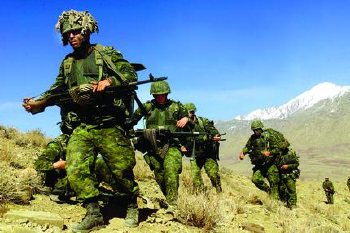
The Canadian chaplains are also making a presentation on their experience with peacekeeping. However, the current Canadian role in Afghanistan is described as "peacemaking", which, while not going as far waging war, still requires more force than peacekeeping.
Parker said this is not so much a drastic change in approach as a shift along a continuum. "Like the police, we (the Canadian forces) try to resolve every situation with a minimum use of force, but we will use force if necessary. And this remained an option even when we were serving as peacekeepers."
Parker described the war in Afghanistan as a "three-block war" -- within the space of three blocks, the same troops may "use force, distribute humanitarian aid, and build bridges of reconciliation," and troops are constantly shifting back and forth between roles.
Parker cited the example of Trevor Green, a reservist from Vancouver who had been in the same unit as Parker. Green was "doing what is culturally sensitive, showing respect by sitting and talking with local Afghan elders" when he was suddenly struck in the head by a young man wielding an axe. The man who attacked Green was immediately shot and killed by Canadian soldiers.
Parker said, "That is the reality of how we work. At any time, the role may shift."
Not exclusively Christian
Canadian Forces chaplains will also be presenting panels on pluralism and the provision of support for those who care for others in stressful situations (based on a successful 'Care for the Caregivers' program that has interested other countries).
"Pluralism is a very important concern for Canadian chaplaincy," said Parker.
Until 2003, the Canadian armed forces had "a Christian chaplaincy," even though there had been some Jewish chaplains during wartime. However, a Muslim chaplain was added in 2003, and the chaplaincy service is looking at adding chaplains from other religions. Parker said this will be "driven by numbers" -- chaplains will be added as there are significant numbers of followers of a given religion.
Parker said the chaplaincy service is not exclusively Christian anymore, but the chaplains' motto, 'Called to Serve,' remains in force.
This means, he said, that all chaplains "agree to work side by side, to respect each other's traditions, and to work within pluralism and diversity." All chaplains are committed to serving all those in the Canadian military, and if they cannot help someone, they will pass that person on to someone who can. For instance, if a Roman Catholic soldier comes to a Protestant chaplain with a question about the Catholic sacraments, the chaplain will refer the soldier to a Catholic chaplain. However, if a Roman Catholic soldier comes to a Protestant chaplain and wants to know about Protestantism, the chaplain is free to tell him -- but he has to wait to be asked.
Parker added, "There is no confusion that I am a Christian chaplain. I have probably had more serious discussions about religion with young soldiers than I have had in church."
Parker was a United Church minister in Burnaby, BC before applying to become a chaplain. His application had to be approved by both the military and the denomination. "You must come in through a church, you must have been a pastor, and you must have training," he said.
Some large bases have both Protestant and Catholic chaplains, but usually one chaplain is assigned to a unit of 500 soldiers and serves everybody in the unit. Parker said this works well for most pastoral needs: "Prayer is prayer, a wife leaving is a wife leaving, and problems with children often just require wise counsel."
The chaplains live with the soldiers and go on deployment with them. "This is a workplace ministry," said Parker. "They know us a religious people, sometimes as wise people, and as people who care about them."
Parker said chaplains deal with "a full range of social issues, all of the things that are part of people's lives." However, there are also some unique problems that soldiers face.
One is that the military life involves long absences and frequent moves, which puts extra pressure on families and individuals. "It is like going to university. There are leaving home issues and being with people different from those you grew up with."
There are also issues of life and death -- beyond just the possibility of being killed. "The bigger issue is what if I kill someone," Parker says. "A lot of people, when given the opportunity, wouldn't pull the trigger."
Chaplains, Parker said, "believe strongly in the just war tradition." When a soldier is uncertain of his role, it is the chaplain's job to remind him of the importance of the mission he is on and that he is not just an individual taking the law into his own hands. "But it is not saying that you are just doing your job. You must deal with it on a deep moral basis." He said there are a lot of resources in the Christian tradition for this, from Augustine and Aquinas to Grotius and Vittoria.
Parker said, "We are very convinced as Canadians that you go to war in order to have peace. Augustine said the only reason to wage is to bring about a more just peace afterward."
The conference was closed to the public, although a few sessions were open to members of the media.
February 8/2007