
Anglicans address divisions in wake of Tanzania meeting
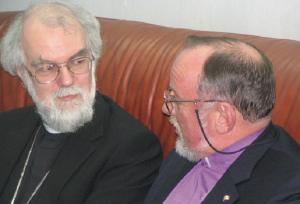
ANDREW Hutchison, primate of the Anglican Church of Canada (ACC), has criticized the outcome of a gathering of primates from around the world which recently met in Tanzania.
The primates, representing 38 territories, met February 15 - 19 to address the turmoil within the Anglican church worldwide over how to deal with homosexuality.
Hutchison told CC.com he was disappointed in the communique which the primates released at the end of that gathering. "My greatest disappointment is that there was no mention of those who live in the margins of the church, namely gay and lesbian people," he said. "They are accepted in Canadian society as part of a legal reality."
Hutchison confirmed that, if Katherine Jefferts Schori had refused to sign the communique, he would have done likewise. Jefferts Schori is the first female primate of the Episcopal Church in the USA (ECUSA), which is the American branch of the Anglican communion.
In a striking show of disunity, seven conservative archbishops declined to receive communion for each of the days that Jefferts Schori attended, because they consider themselves unreconciled to her church so long as it does not repent of its pro-gay actions. They also declined to take part in a group photograph.
These deep cracks in the Anglican communion were inflamed in 2002, when Bishop Michael Ingham of the Diocese of New Westminster said he would authorize the blessing of same sex unions. The following year, the Episcopal Church ordained Gene Robinson, an openly gay and partnered bishop. Jefferts Schori supported Robinson's appointment.
The Tanzanian gathering was especially concerned with the North American churches' response to the Windsor Report, a 2004 document which asked ECUSA and the Diocese of New Westminster to apologize for "the deep offense" their decisions regarding sexuality have caused to "many faithful Anglicans." The ACC is expected to present its response after its General Synod in Winnipeg June 19 - 26.
Hutchison said he felt the Diocese of New Westminster had responded adequately, but he confirmed a further response would be forthcoming in June. Asked if the synod would have to vote on the response, he replied: "It is very difficult to see the way. If it is found that same sex blessings is a 'doctrinal' matter, then indeed it would be a General Synod issue."
The Anglican Communion is currently crafting a 'Covenant' that all member churches will eventually have to agree to in order to belong to the communion. The primates' communique said if churches fail to abide by this covenant, they would be required to undertake "a process of restoration . . . to re-establish their covenant relationship with other member churches."
The actual finalizing of this covenant may be years away, as it moves through various consultations and is offered to the provinces for ratification. According to the current version, any appeal over matters such as same sex blessing would be made to four 'Instruments of Communion'-- global groups, some of which meet infrequently. Churches in profound disunity with their bishop may find that appeal process as lengthy and indecisive as the current one.
When asked about congregations which feel adrift and detached because of disagreement with a bishop who, in their view, has broken with scriptural teachings about sexuality, Hutchison said "alternative episcopal oversight" -- that is, an outside conservative bishop stepping in to provide pastoral care -- can still operate "in partnership" with the sitting bishop.
Hutchison said he prefers to see the Anglican Communion as a "very loose association of congregations," though he acknowledged the time may be right for "some kind of covenant." He expressed frustration that same-sex blessings have happened over time, especially in the United Kingdom, saying: "The English can do this with impunity, and up to now no one has been censored." However, he acknowledged that what is proposed by New Westminster is more than a "blessing" -- and is actually a "rite," with an associated approved liturgy.
Archbishop Terry Buckle, metropolitan of BC & Yukon, said he finds it encouraging that the Covenant, although not finalized, "does hold to the traditional teaching of the church."
"I am pleased with what has come out of that meeting to assist the Anglican church to stay intact," Buckle added.
Hutchison, however, said the past several years have been a "very tough time" for the communion. He added: "Who knows? Down the road, we may see a two-tier Anglicanism."
Ingham, through his spokesman Neale Adams, declined to comment on the Tanzanian gathering, saying he wished to "defer to Archbishop Hutchison."
Related stories:
Anglicans cheer visit by spiritual leader
The Archbishop of Canterbury will visit Canada for the first time since rejecting an invitation almost two years ago, regarded at the times as a snub of Canada over the issue of same-sex unions. Archbishop Rowan Williams will meet with Canadian bishops in April in Niagara Falls, said Archbishop Andrew Hutchison, primate of the Anglican Church of Canada.
National Post, January 29
Anglicans face 'a bit of pruning' over gay rights
Leaders of the 77 million-member Anglican Communion gather in Tanzania today for what is almost universally predicted to be the schismatic death-rattle -- or "a bit of pruning," as one English bishop acidly put it -- of the world's third largest Christian denomination. Anglicanism's titular leader, Rowan Williams, the Archbishop of Canterbury, has proposed a two-tier church that would label the liberal Canadian and U.S. branches as second-class "associates," with New Zealanders and South Africans possibly thrown in. The remaining national churches, or provinces, would bear the status of full "constituent" members.
Globe and Mail, February 14
Top U.S. Anglican stands fast on gay rights
The head of the U.S. wing of the Anglican church, who supports ordaining gays and allowing blessing ceremonies for same-sex couples, will not soften her views even as the issues threaten to break apart the Christian denomination, her aide said Thursday. The leaders of the world's 77 million Anglicans, who are holding a closed meeting this week in Tanzania, said they would discuss the U.S. response to a 2004 report by an Anglican panel that called for a moratorium on consecrating gay bishops and blessing same-sex unions.
Associated Press and Canadian Press, February 15
Michael Valpy on the Anglican Church
The leaders of the world's 77-million-member Anglican Church have asked its U.S. branch and other national churches within the faith to stop consecrating gay bishops and to stop holding prayer services for same-sex couples.
Globe and Mail, February 20
Anglican rift may hit Canada, archbishop says
The spiritual leader of Canada's 800,000 Anglicans warned them yesterday they face the same risk as their U.S. counterparts of being booted out of the world Anglican Communion unless they slam their church doors against full acceptance of homosexuals. Archbishop Andrew Hutchison, the Canadian Anglican primate, made his comments on the way home from what has been labelled a venomous meeting in Tanzania of his fellow primates in the communion, Christianity's third-largest denomination.
Globe and Mail, February 21
An Anglican future, made in Africa
The biblical drama of sin, mercy, healing, salvation and liberation will reassert itself
Fr. Raymond J. de Souza, National Post, February 22
March 1/2007