
Review: Grace promotes politics over Wilberforce's faith
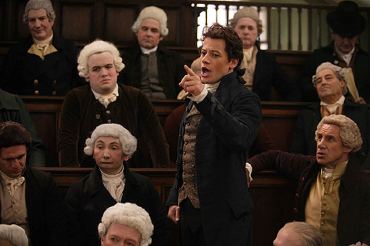
'AMAZING Grace,' the song, is a beloved gospel classic, but once in a while, someone complains that it isn't Christian enough -- at least not in that first, famous verse. Words like "grace" are too vague, and phrases like "I once was blind, but now I see" could refer to just about any spiritual experience, or so the argument goes.
Amazing Grace, the film, has provoked a similar debate. Evangelicals have welcomed the film with open arms -- partly because it shines a light on William Wilberforce, the Christian politician who brought an end to slavery in the British Empire in the early 1800s, but also because it is made with production values much higher than those of the typical Christian movie. In short, it feels like, and is, a "real movie".
But some observers have noted that the film seems to marginalize the role that faith played in Wilberforce's life and work. Reportedly, the film's producers -- including Bristol Bay Productions, which is owned by Christian billionaire Philip Anschutz -- originally wanted the film to focus on Wilberforce's faith. But director Michael Apted (49 Up, The World Is Not Enough) and screenwriter Steven Knight (Dirty Pretty Things) said they wanted to focus on the power of positive politics, instead.
And so Amazing Grace turns William Wilberforce (Fantastic Four's Ioan Gruffudd) into a fairly simple hero for a modern secular age. The content of his faith remains essentially private: we hear about his conversion after the fact, but we never get a sense of why he converted in the first place. His friend John Newton (Albert Finney), the former slave trader who wrote the titular hymn, is likewise portrayed in terms that emphasize his personal spirituality: his life, he says, is one of "solitude".
Wilberforce does hook up eventually with the Clapham Sect, a group of evangelicals who want to abolish slavery, and the film is very effective in showing how they sought to open the eyes of their fellow Britons to the travesties of the slave trade.
However, the film gives virtually no time at all to Wilberforce's other main objective, "the Reformation of Manners." Other characters casually mention that Wilberforce has given up personal habits like gambling, and you get the sense that he doesn't care for comic operas, but the film never lets on that he acted against such things on a social scale. The film also avoids mentioning other deeds of his that might not be palatable to a modern liberal audience, such as the banning of trade unions.
Amazing Grace is a valuable film inasmuch as it draws our attention to a crucial part of our history. The irony is, Wilberforce set out to change the consensus of his age, and succeeded spectacularly after many years, but the film about him has been carefully designed to avoid upsetting the commonly held opinions of our own times.
Related stories:
The man who 'murdered' slavery
Two centuries ago, a British backbencher changed an entire way of seeing the world
Mark Steyn, Maclean's, March 19
'I wanted the heroic side of politics'
Many of those great reformers were Christians. "What I find so nauseating is people today don't try to negotiate between the religious and the secular," says Apted. "Wilberforce knew that you could not get anywhere unless you got down off your moral high horse." Living in America, Apted resists the religious tide. But his brother back in England, a policeman for 30 years, is now a priest and, says Apted, is "dying to see the film."
Globe and Mail, March 22
Movie Reviews: Amazing Grace
As I write this review, the T-shirt, jeans, and sneakers I'm wearing are all probably the result of some form of indentured servitude. The same could be said of the components of the computer upon which I am typing, and of the radio that is playing in the background. Nevertheless, slavery in the sense of chained Africans being carried in lethal holds to overwork and death in the New World is a thing of the past, and Amazing Grace, Michael Apted's new movie, was made to celebrate the 200th anniversary of the abolition of that form of human exploitation within the confines of the British Empire.
Mark Harris, Georgia Straight, March 22
The battle of the men in starchy wigs
Political junkies tired of the last two centuries of debates and filibusters should enjoy this earnest, talky folio-turner, which follows the tribulations of a young Member of Parliament on a decades-long crusade to end the slave trade throughout the British empire. Ioan Gruffudd is best known in this country as Mr. Fantastic from 2005's Fantastic Four and this summer's sequel, but in this movie he's Mr. Nice Guy, a spiritual-minded young man who chooses a life of politics over monastic solitude, the better to do God's work on Earth.
Chris Knight, National Post, March 23
A slave to history
When the team finally does win, with the passage in 1807 of a bill "abolishing the slave trade through the whole of the British Empire," history's proud moment should be the movie's affecting climax. After all, the Brits accomplished through civilized legislation what the Yanks, over a half-century later, would fight a very un-civil war to settle. Alas, the moment comes and we feel nothing beyond the certainty that our lesson is almost over. It's just the last item in a laundry-list of facts, all nicely printed, all duly checked off, all neatly pointing to an exemplary burst of humanity in the checkered annals of humankind. And that's precisely the problem with Amazing Grace -- there's so much to admire and so little to amaze.
Rick Groen, Globe and Mail, March 23
Biopic keeps edge amid period clutter
There's a really important chapter of human history hiding beneath layers of lace, satin and Masterpiece Theatre-styled drama in Michael Apted's Amazing Grace, and it's palpable -- but it's not emotionally engaging, and that's where this well-intentioned biopic stalls.
Katherine Monk, CanWest News Service, March 23
'Amazing Grace': Slave labour
Much as Amazing Grace might be an accurate portrait of William Wilberforce, it is a rather dull movie, about as gripping as a live reading of Hansard.
Susan Walker, Toronto Star, March 23
From religious roots, the birth of social conscience
Two centuries ago tomorrow, the British Parliament passed An Act for the Abolition of the Slave Trade. It was the most important single moment in the worldwide abolition of slavery, as the imperial power, not shy about using the Royal Navy to impose its newly abolitionist values on a recalcitrant world, began to stamp out slavery throughout the empire.
Fr. Raymond J. de Souza, National Post, March 24
The day an evil began to wither
The legacy of slavery and colonialism remains
Royson James, Toronto Star, March 25
Protest mars apology service
Within spitting distance of the Queen and British Prime Minister Tony Blair, a lone black protester today eluded tight security at Westminster Abbey to denounce the national commemorative service to mark the end of the Atlantic slave trade of Africans 200 years ago.
Royson James, Toronto Star, March 27
We ended slavery. So why all the guilt?
This week, we commemorate the 200th anniversary of the abolition of the slave trade by the British parliament. But rather than celebrate Britain's courageous role in ending an abhorrent institution, Britons find themselves embroiled in tedious debates. The Church of England is seriously considering paying reparations for its role in the slave trade, and the city of Liverpool has formally apologized for slavery. Prime Minister Tony Blair, who has expressed regret for Britain's role in the trade, is being pressured to up the ante and make a formal apology too.
Michael Coren, National Post, March 27
March 29/2007