
The Charter at 25
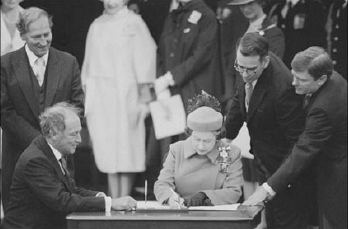
WITH the stroke of a pen, the Canadian Charter of Rights and Freedoms became part of the Canadian constitution 25 years ago, on April 17, 1982.
Since then, the Charter "has affected every area of Canadian law" and "has fundamentally changed the way we approach law," says Don Hutchinson, legal counsel for the Evangelical Fellowship of Canada.
Individualism
The Charter coincided with a massive parallel cultural change, though it would probably be too simplistic to suggest that one "caused" the other, says Hutchinson. Instead of defining themselves in terms of the groupings they belong to, Canadians have become much more individualistic. The attitudes of many Canadians, he says, now begin with "What are my rights?"
Political scientist John H. Redekop says the Charter has some good aspects, but its great weakness is that it has shifted the focus "from the British emphasis on collective well-being to the American emphasis on individual well-being."
The result, he says, is that the courts have "bent over backwards to protect a narrow band of minority and individual rights" but the Charter "has not improved the climate of freedom for large segments of society." He notes, for instance, the mayors and other individuals who have been forced by court decisions on the Charter to declare support for homosexuality.
The British have never had such a charter but historically have a better record of providing freedoms, guaranteed by both tradition and the courts, Redekop says. In that sense, the Charter may be undemocratic in that it does not trust legislatures to protect rights.
Judicial supremacy
The other major change, says Hutchinson, is that Canadians "have grown accustomed to accepting that the courts know best." This was true before the Charter too, he says, but then "Canadians expected government to act if it disagreed with a court decision." Now, "Canadians expect the courts to act if they disagree with a government decision." In other words, Canadian attitudes have changed so that Canadians now place the courts above government.
Section 33 of the Charter -- the "notwithstanding clause" -- recognizes the traditional right of parliamentary government to overrule a law. Redekop says legislation overruling court decisions was quite common before 1982. However, the notwithstanding clause "has been given such a negative view by the Liberal Party and the courts" that in practice it can hardly be used now.
The problem with this, Redekop says, is that it gives judges far too much power. Canadian judges have essentially been appointed on "the whim of a prime minister", based on "a phone call late at night. Judges aren't accountable, and there is no clear removal procedure. The personal preferences of judges are given very much weight."
While the US system also stresses individual rights, Redekop says there is at least some accountability there because lower court judges are elected and Supreme Court justices must be approved by Congress.
Making law
Hutchinson says the Supreme Court has also tended to see the Charter not as "a document frozen in time" but as "a living tree" that "has a life of its own and is continuing to evolve." For instance, the Supreme Court has seen its rulings on "homosexual rights" not as a judicial amendment to the Charter but as an extension of it.
Redekop disagrees. He cites the Vriend decision, in which the Supreme Court recognized that the Alberta legislature had considered adding "homosexual rights" to its human rights code and decided against it; nevertheless, the Court said that the Alberta legislature was wrong and should have included those rights. In essence, says Redekop, an unelected court chose to overrule the majority opinion as represented by the provincial legislature.
Freedom of religion
Hutchinson says the Charter was based on a combination of the Canadian history of recognizing rights, a number of United Nations declarations of rights, and Prime Minister Pierre Trudeau's Jesuit upbringing. Hutchinson says all three have strong ties to a Christian heritage: "In the Catholic tradition, all rights are derived from God, and the most significant right is freedom of religion."
Redekop, however, says the only Christian influence is really in the preamble, which recognizes that "Canada is founded upon principles that recognize the supremacy of God and the rule of law," a preamble that has largely been ignored in practice.
Hutchinson says the Charter has fulfilled initial expectations in that it "has benefitted religious rights in a number of ways." However, it has tended to "tie those rights to the individual" and left "corporate religious expression with a certain amount of legal uncertainty." The courts have used the Charter, he says, to protect private religious belief but have been less supportive of "the corporate expression of religious belief in the public arena."
When the Charter was first proposed, another political scientist told Redekop that Christians would be foolish to support it because "this will work against you." "I didn't believe it at the time, but he was right," Redekop says.
"To some degree, we Christians have neglected our rights" under the Charter, says Hutchison. Christian individuals and groups have often been more reluctant than some other groups to pursue their Charter rights through the courts. They are misinformed about their rights, don't take their faith seriously enough, or don't see it as important enough for the time and money it would require, he says.
One of the biggest problems, says Redekop, is that the Liberal Party, which governed Canada between 1993 and 2006, appointed "very left-leaning, anti-Christian judges. If the rulings had been fairer, the Charter wouldn't have been so consequential." He adds that "political decisions then reinforced the bias of the courts."
Good or bad?
Asked whether the Charter has been good or bad for Canada, Hutchinson says that is no longer a relevant question since the Charter is part of the constitution. He says some Canadians almost worship the Charter and some Canadians loathe it, but neither attitude is helpful. Instead, Canadian Christians should focus on understanding the Charter and learning how it can benefit them.
Redekop is more direct: "On balance, the Charter has not been good for Canada."
April 26/2007