
OttawaWatch: A requiem for Dennis Bueckert
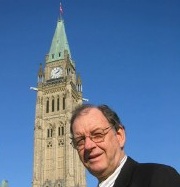 AMONG the 400 plus recalling the life of Dennis Bueckert, at a service of remembrance in Ottawa Mennonite Church last Tuesday, was federal environment minister John Baird.
That was entirely appropriate, because Bueckert, who was the long-time environmental reporter for Canadian Press, frequently wrote with depth and perception about issues that fall within Baird's line of vision. If nothing else, Bueckert's passing can be a gentle reminder to Baird, to research with diligence and listen with care to the points that this prodigious journalist has made through the years.
Bueckert died suddenly on August 2, at age 57. He was known to have struggled with depression for many years.
Indeed, OMC's pastor, Don Friesen, spoke of Bueckert's deep inner turmoil -- as well as the sense of compassion and sometime joy that grew out of his faith.
Friesen did not try to explain the turmoil/faith conundrum.
He pointed out, however, that "God's silence is deafening: God keeps his deepest silence for his saints."
Then he added: "God's love shone through Dennis, and for that I am thankful."
For me, attending the service was emotionally mandatory. Not that I knew Bueckert well: I only spoke to him once, about nine years ago. But his comments to me were unsolicited and very encouraging.
It was shortly after Preston Manning became leader of the official opposition, and Manning had invited members of the Parliamentary Press Gallery to Stornoway, the opposition leader's residence.
Bueckert introduced himself to me, then quietly informed me that he had been picking up copies of Christian News Ottawa (now part of ChristianWeek Ontario) at his church. He made it plain that he thought well of the newspaper. And he made the point of identifying with me as a fellow Christian believer.
I drew strength from those comments. And I learned subsequently, from several other fellow journalists, that he was well regarded both for his professionalism and his ability to craft his words effectively.
Bueckert, himself, was hardly a household word, although as a writer for Canadian Press, the words he wrote had a continuing impact on Canadians for a couple of decades -- particularly in the fields of climate change and stem cell research.
Many Mennonites refer to themselves as "the quiet in the land". Bueckert reflected that. But often, in that culture, quietness is accompanied by depth and he reflected that as well.
In the biography included in the remembrance service bulletin, it was noted that he "was an extraordinarily creative person. He was passionate about music and art and was an excellent story teller.
"He was unassuming about his talents."
Consider these words that Bueckert wrote, just weeks before his death:
We are fragile beings, capable of being laid low at any time by forces beyond our control. That we function normally most of the time is something for which to thank our lucky stars -- and the loving God who put these stars in place. It's a wonderful world and even the painful episodes remind us that we are members of a very select club, the society of the living, the society of conscious, sapient beings with a capacity for hope and faith and love.* * *
The division of responsibility in the service of remembrance and the subsequent interment was interesting to observe.
The pallbearers were all journalists. They were the ones to lay his remains to rest.
Bill Janzen, Ottawa director for Mennonite Central Committee, read several scriptures, including the Isaiah passage that speaks of mounting up with wings like eagles, running and not being weary and walking without fainting.
A church sextet sang 'Sanctuary' and 'In the Rifted Rock I'm Resting.'
Three hymns were sung by the gathered 400, including the colloquial 'Precious Lord, Take my Hand.' Moreover, as is so often the case, Mennonites give the leadership in a way that helps those who are less musically gifted, to join -- through the invariable tears -- the strong four-part harmony.
The homily, entitled 'Requiem for a troubled soul,' came from his pastor, Don Friesen, who ended the service by explaining that "requiem" means rest. Then he turned to the coffin, recalling the ups and downs in Bueckert's life, and declared strongly, with just a touch of break in his voice: "May God give eternal rest to your soul, my friend."
* * *
All this took place just a few miles from The Hill, on a quiet, tree-lined street where the church, in its various revisions, has stood, since the 1960s.
Every time there is a strong and affirming Christian funeral, some benchmarks in human experience are brought to bear.
As the deceased believer's faith culture is laid out for sharing with his fellow professionals and those about whom he is writing, it bears witness in a way that surprises and encourages.
It seems that God's still small voice breaks through where it most helps to be heard.
* * *
Bueckert is survived by his wife, Joan, and sons Anton and Francis. The bulletin biographical notes speak of a recent separation between himself and Joan, and his devastation at the 2002 death of their daughter, Danielle.
He had spoken, at one time, of the birth of Danielle, in 1984, as his greatest life experience.
* * *
Lloyd Mackey is a member of the Canadian Parliamentary Press Gallery in Ottawa and the author of Stephen Harper: The Case for Collaborative Governance (ECW Press, 2006). He can be reached at lmackey@canadianchristianity.com.
August 9/2007