
Carr's art captured her path to her beloved God
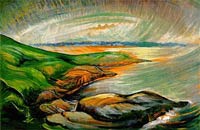
Emily Carr (1871-1945), a Victoria native who did most of her work in British Columbia, is the subject of a touring exhibition, which is the first comprehensive presentation of her work in 30 years.
'Emily Carr: New Perspectives on a Canadian Icon' runs until September 23 at the Montreal Museum of Fine Arts. It will head to Calgary in the fall. On display are 150 of her works, as well as 50 objects, including paintings, ceramics, sculpture and hooked rugs, related to Carr's style, subject matter and period in which her art evolved.
Carr is best known for her paintings of Native villages and their monumental totem poles, and of the BC landscapes to which she turned in middle age due, in great part, to the influence of Lawren Harris of the Group of Seven. Harris was a close friend and a catalyst who got her painting seriously again after a lapse of nearly 15 years. He soon advised her to leave "the totems alone for a year or more" and examine "the elusive that lies behind." She shifted her attention to forests, mountains and seascapes.
"It is a new approach to Emily Carr," says Charles Hill, a curator at the National Gallery in Ottawa. "There has been more written about her than any other Canadian artist. People have come at her from a variety of directions, and in this exhibition, we are looking at how she herself and others have interpreted her."
One important aspect of her life that has often been overlooked, however, is her faith and deep sense of God in her work and in nature, according to Jan Ross, curator at the Emily Carr House in Victoria.
Carr's personal God
Raised an Anglican, Emily Carr was the youngest of six children. Her sister Elizabeth went to the Far East as a missionary. Her sister Edith co-founded the local Young Women's Christian Association, in which Emily, too, was active. But Carr seemed uncomfortable with organized religion.
She spent nearly a decade studying art in San Francisco, London, and several studio schools elsewhere in England and Paris, before returning to BC in 1911 and painting her Native-inspired images for the next two years. But it was only in 1927, when Carr was 56, that she gained widespread attention. Her work was included in an exhibit of West Coast art at the National Gallery in Ottawa, where she met Harris.
All the while, Carr continued to seek answers to her spiritual quest. She explored Buddhism and Theosophy as introduced to her by Harris, but ultimately rejected them as too abstract and as not incorporating God and Christ.
"She needed a personal God," Ross told the Catholic Times. "She had a strong connection to Jesus and she saw her art as a spiritual path to God."
Carr seemed to have a significant spiritual awakening in the 1930s. Her journals document a growing spiritual awareness and its impact on her paintings.
"I have an inner light," she wrote in a 1934 journal entry. Interestingly, light and luminous skies dominated many of her paintings after this.
In another entry that year she wrote about going to Communion at the cathedral. "I couldn't help noticing how melancholy everybody seemed to be. I can't think holiness means being melancholy. I want it to come into my painting, every bit of it, praising nature, praising God."
In yet another entry, she complained that it was very difficult to maintain constant communion with God as she painted. "Too many evil, vain, selfish thoughts come into the mind."
'God is in all'
The exhibit is organized into three sections. The first is a partial recreation of the pivotal 1927 exhibition. The second focuses on a memorial exhibition organized in 1945 by Harris, in which she is seen as an artist inspired by the wilderness. The third deals with her work as seen by contemporary artists.
While the exhibition does not address Carr's faith explicitly, it is in this second section that viewers will see some of those works inspired by her sense of God in nature. They include, among others, Mountain Forest, Fir Tree and Sky, Above the Gravel Pit, Upward Trend and Dancing Sunlight. They were painted between 1934 and 1939.
These pieces demonstrate Carr's awe of God's creation, Ross underlined. They depict tall trees and vast skies. The death and despair depicted in tree stumps and pillaged forest, are counterbalanced with the light, hope and renewal suggested by the swirls of light.
"God is in them all," Carr wrote in her journal. "Now I know that is all that matters. The only thing worth striving for is to express God. Every living thing is God made manifest. All real art is the eternal seeking to express God, the one substance out of which all things are made."
The exhibition has already been to Ottawa, Vancouver and Toronto.
-- Copyright Canadian Catholic News. Not to be reprinted without permission.
September 20/2007