

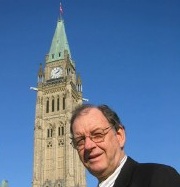
 As Christmas passes and we look forward to 2009, a visual reminder looks back at me from a small, silver-framed photo taken four years ago in Bethlehem, at the most famous site regarded as the birthplace of Jesus.
The two people in the picture are Edna and your humble scribe.
We were there as a retirement gift from the organizations that publish ChristianWeek and BC Christian News. It was at the time of my move, at age 65, from active newspaper editing and development, into the ad hocary of being a senior writer, advisor, editor at large or whatever term might apply to the task at hand.
As I look back, there could be a certain symbolism there; a sense of rebirth. Not the sort of re-birth the carol-writer had in mind when he or she spoke of the coming of the Christ-child as being "born to raise the sons of earth: Born to give them second birth."
It was just a few months after that Bethlehem experience that I entered the process of getting my heart healed, first through the installation of a couple of stents, then, when they did not quite work out, triple bypass surgery.
Four months after the surgery, I was one of about 100 press gallery types who were guests at the pre-Christmas reception at the prime minister's house. Stephen Harper was kind enough to ask how I was doing after the surgery. I replied that I felt I had been given a few more years of new life and was grateful.
Then I recalled reading some of the Old Testament, earlier in life, especially the recounting of the life of King Hezekiah. He had been a good king, and was now faced with an early death, due to some unspecified disease. But he decided to ask God for a postponement of that death, a wish that was granted in the order of 15 years.
But Hezekiah did not remain a leader who "did that which was right in the eyes of the Lord." Instead, he went corrupt, as we might say in contemporary political parlance.
That I should choose to share that bit of doggerel with the prime minister of Canada still causes me to scratch my head a little. But I am grateful that the Hezekiah thoughts came to mind, and, in turn, were uttered by these lips. For me, they confirmed my thanks to God for a renewed life, aided by some very skilled people at the University of Ottawa Heart Institute.
If the prime minister is reading this - and I have no reason to know whether he will - I would want to say that I recognize he went through a political near-death experience this past couple of months, as the prospect of an opposition-based coalition emerged.
My own view is that he was ethically blind-sided by leaders in other parties who promised co-operation in response to his outreached hand, while to varying degrees, at least, were plotting to replace his government without benefit of an election.
Other colleagues of mine in the press gallery, suggest that the prime minister was at least partly to blame, because he allowed his finance minister to bait the opposition with some fiscal measures that they would not be able to support. That he quickly withdrew those measures was, for the plotters, not good enough.
Be that as it may, the result was the installing of a new opposition leader committed to "a coalition if necessary but not necessarily a coalition."
My hope, at Christmas, is that 2009 will be a year of rebirth in terms of a good, ethical and constructive working relationship between the government and the opposition.
* * *
That said, some comments about a few of the 18 new occupants of Senate seats.
I have not been able to detect much in the biographies of the chosen ones to indicate if there are stories of a faith-political interface nature. That does not mean there are none, only that they remain to be discovered.
That assertion leads me to single out Richard Neufeld for mention. My first question, of course, in the pursuit of some faith-based comment, was to try to figure out whether Neufeld has Mennonite background and if so, does it help shape his ethical, business or spiritual values. I have no definitive answer there, because Neufeld is quite guarded about expressing his religious beliefs in the political sphere.
Neufeld has been BC's energy minister since 2001. He has been active in the effort to get the moratorium lifted on offshore oil and natural gas drilling on the Pacific coast.
I had a phone chat with Neufeld, having called him at his home in northeastern British Columbia.
He entered politics in the later years of the Social Credit regime of the late 80s, switched to BC Reform after the Socred disintegration and then, again, to the BC Liberals, after BC Reform fell apart. So, with some variations to the theme, he has been part of the BC tradition of centre-right coalition politics.
I believe I read Neufeld correctly when I suggest that he felt that the incautious mixture of religion and politics, on the part of William Vander Zalm, helped to spell the demise of the Social Credit. The Socreds governed BC from the centre-right, with some judicious faith-based help, for most of 40 years. Vander Zalm succeeded Bill Bennett as premier in the late 80s. The point seemed to be that the faith-based influence went from more to less prudent under the Zalm.
While he was not willing to talk about his own belief system, Neufeld congenially allowed that he had been shaped by his Mennonite heritage, which he regards with warmth and respect.
Neufeld's parents moved from what was known for many years as the Soviet Union, in the 1920s. They settled, at first, near Lethbridge, later moving to the Fort St. John area, like many other Mennonites, to make use of agricultural homesteading opportunities. And, it is in north-eastern BC where he has remained and which he has represented in the provincial legislature since 1991.
* * *
Let's tie the Neufeld question into the other interesting appointment from the west coast - the choice of former BC finance minister Carol Taylor to the chair of the pivotal Economic Advisory Committee. That is the group Stephen Harper has set up to help pilot parliament through the budget process and beyond.
Taylor comes from the blue Liberal side of the BC Liberals, which are, not to oversimplify, a 60-40 amalgam, respectively, of various kinds of conservatives and liberals. Neufeld comes from the fiscally conservative slice of that spectrum.
In fact, in his conversation with me, Neufeld maintained that Gordon Campbell, the current premier, had taken the shell of the BC Liberal party, previously led by Gordon Wilson, who had jumped to the NDP, and turned it into an effective centre-right coalition. And he says that the presence of both Taylor and himself in the Campbell cabinet attested to the premier's ability to hold it all together.
* * *
Permit me one comment with respect to the "expensive Christmas present" that the prime minister has given the Senate appointees.
Nobody has mentioned, yet, the amount that has been saved by not having filled most of the vacant Senate seats since the Conservatives assumed power almost three years ago.
The savings, as closely as I have been able to learn, amount to about $27 million.
* * *
Space and time has run out, but I would like to provide a peek at what I hope to be able to talk about in next week's OttawaWatch.
Those comments will focus on:
• The governor-general's unprecedented but diplomatically-worded release about the prorogation of parliament and what it - and other co-operative actions - might hopefully achieve.
• Some interesting suggestions regarding the lineup of the respective Canadian and American political spectrums. These comments came from a Kelowna Catholic high school student who spoke eloquently to a rally in that city urging government-opposition co-operation, rather than an opposition-led coalition.
• The urging of parliamentary civility, by Evangelical Fellowship president Bruce Clemenger.
• California mega-pastor Rick Warren's response to the flack over his being invited to pray at Barack Obama's inauguration as U.S. president. Warren does a good job of nailing the media's role in inflaming the controversy.
• All of the above, in this writer's view, help make the case for Conservative-Liberal co-operation in getting the budget through, and might even provide some hints for progress during 2009, toward political realignment based on the BC and Saskatchewan models.
* * *
Read between the lines, today, and I trust that you will find reason to suspect that I am trying to communicate some good news that will have helped make Christmas meaningful for our readers and 2009 both productive and happy.
* * *
Lloyd Mackey is a member of the Canadian Parliamentary Press Gallery in Ottawa and author of Stephen Harper: The Case for Collaborative Governance (ECW Press, 2006), More Faithful Than We Think: Stories and Insights on Canadian Leaders Doing Politics Christianly (BayRidge Books, 2005) and Like Father, Like Son: Ernest Manning and Preston Manning (ECW Press, 1997). Lloyd can be reached at lmackey@canadianchristianity.com.
December 31/2008