

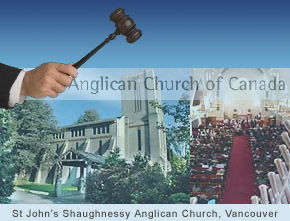
 THE ANGLICAN CHURCH is going through a divorce, and the secular courts
need to assign custody of the church property even if they cannot take
sides on the theological arguments that led to the divorce, four Anglican
parishes argued in a BC
Supreme Court case that concluded last week.
The parishes of St. Matthew's (Abbotsford), St. Matthias and St. Luke's (Vancouver), St. John's Shaughnessy (Vancouver) and Church of the Good Shepherd (Vancouver) are suing the Diocese of New Westminster over the ownership of the buildings in which they meet.
The essence of their case revolves around 'trust' law, said Cheryl Chang, chancellor for the Anglican Network in Canada (ANiC). The assets of a church or other charity are never owned by persons or even institutions, she said, but are held 'in trust' for the purposes for which the church was established.
In this case, the 'Solemn Declaration' made by the founders of the Anglican Church of Canada (ACC) committed the church to the historic beliefs of Anglicanism, including the authority of scripture, and to remaining "in full communion with the Church of England throughout the world." The four parishes contend that the diocese has changed its doctrine while the parishes have remained true to historic Anglicanism, said Chang, and this could mean that the parishes have the right to all the buildings in the parish.
However, that is not what the parishes are asking for. Rather, they are asking the court to recognize that there is a significant theological division within Anglicanism and that what is happening is not the "departure" of a few dissidents, but a "divorce" -- and, as in any divorce, they contend that there should be a fair division of the assets.
Technically, the parish case rests on a legal principle. When it becomes "impossible or impractical" for a trust to be operated in accordance with its original terms, the courts have the authority to order that the trust be operated in a way that is "close to" the original purpose.
The parishes argued that the theological division is such that the trust cannot be carried out by a united diocese as originally intended, and therefore the court should order it to be carried out in a way that is close to the original intent -- which would allow the parishes that leave the ACC to keep their buildings and operate as Anglican parishes under a different diocese.
For its part, the Diocese of New Westminster argued that the 'Solemn Declaration' has no legal standing and therefore there is no trust. The courts should not get involved in judging theological issues, argued the diocese, and as long as a charitable institution follows its own rules in changing its theology, the courts should not intervene.
This is where the case becomes precedent-setting, Chang said -- not just for the Anglican Church, but for other churches as well. "If the ACC can change doctrine and kick out anyone who doesn't agree with them, then any church can do the same thing," she said, adding that trust law clearly defends "faithful minorities" against majorities taking a charitable trust in a new direction.
In the end, the case may turn on whether the court determines that the four parishes are still Anglican. By the nature of a trust, Chang said, the four parishes cannot take the parish properties with them to join another denomination or religion. They can claim a right to the buildings only because they remain Anglican parishes.
The four parishes voted in 2008 to leave the diocese and the ACC and be part of the ANiC under the jurisdiction of Gregory Venables, the Archbishop of the Southern Cone (South America). They are among 100,000 Anglicans who have left the ACC and the Episcopal Church in the US over the blessing of same-sex couples and other theological issues.
The diocese argued in court that those who left the diocese are not Anglicans, because the ACC is the only Anglican body in Canada recognized by the 'instruments of unity' of the worldwide Anglican communion: the Archbishop of Canterbury, the Lambeth Conference (a gathering of bishops held every 10 years), the Anglican Consultative Council and the Primates Council (a gathering of the heads of the 38 national Anglican churches from around the world).
However, Venables said one of the difficulties is that none of the 'instruments of unity' seems to have the authority to decide who is and who is not part of the Anglican communion.
He noted that a majority of the communion, perhaps 70 to 80 percent of Anglicans worldwide, agree with the theological conservatives, who are a minority in Canada. "Far from being dissidents, these people are classic Anglicans," said Venables.
Venables said that on behalf of the worldwide majority, he agreed to provide "a holding place" to allow conservative Anglicans from North America to remain part of the worldwide communion, until a permanent solution can be found. He added that he has had a communication from the Archbishop of Canterbury assuring him that those North American bishops who have come under his authority remain "in communion." Otherwise, he said, there would have been no point in offering oversight.
The beginnings of a more permanent solution will be put into place in late June when various groups that have left the ACC and the Episcopal Church will meet to found a new Anglican province, the Anglican Church of North America (ACNA). However, because of the lack of a central Anglican authority, it may take years before if it is known whether the ACNA will be accepted as an Anglican province. "Anglicanism makes a tortoise look like a hare," quipped Venables.
The diocese has consistently referred to the plaintiffs in the case as "a few individuals." However, Chang noted that the four parishes that left the Diocese of New Westminster, along with other parishes that left earlier, represent well over a quarter of the diocese's active members.
George Cadman, chancellor for the diocese, told CC.com that the diocese has "not sued anybody," and is merely responding to litigation brought by "a group of individuals" who want to leave the diocese and take church property with them. Cadman also said the diocese has never asked anyone to leave the diocese except the clergy from the four parishes who "voluntarily relinquished their orders" in the ACC.
However, he also said that the diocese asked the trustees of two of those parishes to bar the clergy from the parish pulpits. When the trustees refused, the diocese invoked its Canon 15 to replace the trustees with new trustees -- who would in effect take control of the parish buildings and bank accounts in the name of the diocese.
According to Chang, it was this action that led the trustees and clergy of the parishes to launch their legal action.
Cadman said the diocese hopes the congregations will stay; but if they decide to follow the clergy out of the diocese, "that is their choice."
The case finished after using all but one day of the three weeks allotted to it. It could have taken months, but the lawyers agreed to submit the bulk of the evidence in written form. This left the judge with about a metre of documents to plow through before he renders his decision, expected about late fall. That may not be the end, because any decision could be appealed to the Supreme Court of Canada.
The office of the Archbishop of Canterbury declined an opportunity to comment on the case. Similarly, Paul Fehely, principal secretary to ACC primate Fred Hiltz, said Hiltz would not comment on the case. While he is "fully supportive of the diocese," he said it is a matter for the diocese and parishes to decide and "it would be a mistake for us to intervene."
Venables was not so reticent. "It is so sad when the church gets to the place where it is arguing publicly," he said. "What's so sad is the inability to sit down and talk to one another" -- even if, in the end, people agree to disagree.
Venables said he is also disturbed by the attitude sometimes presented that belief is unimportant and that "what matters is the money." It is hard for people to leave behind church buildings that their parents built, and where their grandparents are buried, he said.
"It would be a tragedy if they lost those beautiful buildings, but it wouldn't be the end of the church," he added. "Buildings are not the church. What matters is a relationship with God. Believers are the church."
Related stories:
Anglicans
ponder same-sex protocols
Anglican Church of Canada parishes
in Waterloo Region should soon be able to hold services to celebrate the
relationships of gay parishioners, but they won't be blessing same-sex
marriages for at least another year -- if ever. During his opening
statement to more than 500 delegates at the annual synod (governance
meeting) for the Diocese of Huron, Rt. Rev. Robert Bennett, diocesan
bishop, said he is taking a cautious but pastoral approach.
The
Record, May 29
It's
all church property -- but which church?
Millions of dollars of
real estate is at stake in a lawsuit that pits 'dissident' congregations
against the Anglican Church of Canada
Douglas
Todd, Vancouver Sun, June 3
What
is "orthodox" Christianity?
The crowd attending the B.C.
Supreme Court trial in which four dissident Anglican parishes are claiming
ownership of the multi-million-dollar places in which they worship has
received some entertaining lessons in the meaning of "orthodox." . . .
There was a surprise in store, however, when Regent College professor John
Stackhouse, an evangelical theologian called as an expert witness by the
conservatives, was asked what he believed was the definition of
"orthodox."
Douglas Todd, The Search, Vancouver Sun, June 4
June 18/2009