

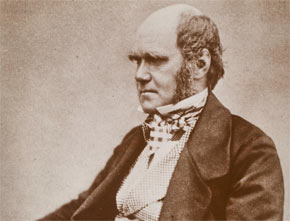
 Two key Charles Darwin milestones were marked in 2009: the 200th anniversary of his birth; and the 150th year since the publication of his seminal work, On the Origin of Species. Rev. Paul Fayter, of Dundas, Ontario, is a United Church minister and historian of science who has studied and lectured on Darwin for more than 30 years. He offers the following reflection on Darwin's complex relationship to Christian faith.
IT WAS the 1980s. The 'creation versus evolution' controversy had heated up again. I was a published doctoral student in late Victorian Darwinism and theology. I had researched Darwin's life from womb to tomb; I had studied his published work, his unpublished archives at Cambridge University, his scientific circle of friends and a ton of theological responses to his work. I was teaching the specialist course in 'Darwin and Darwinism' at the University of Toronto's history of science institute.
Pedestal of genius
And so I was invited to lecture biology profs at the Faculty of Zoology on 'Darwin and the creationists.' The expectation, I suppose, was that I would keep Darwin on his Pedestal of Pure Genius, and expose the religiously fanatic Enemies of Truth for the ignorant hillbillies that they were. I started with an analysis of the structure of The Origin of Species, noting the gaps in Darwin's evidence, and how they affected his argument. Murmurs in the audience grew louder as I described Darwin's theological education and influences. From the 1820s through the 1840s, as he was developing his key idea of natural selection, Darwin was a Christian who saw both evolution and design in nature, God's creation. He was offering in The Origin a scientific argument for how the Creator worked by means of natural laws.
By now the audience -- professional evolutionists all, though none had actually read The Origin -- were freaking out. Darwin some kind of design-theorist? God forbid, some kind of creationist? I was heckled: "You're wrong!" "Lies!" "Darwin was an atheist!" I quickly finished up, but not before mentioning the ethical and scientific legitimacy of some creationist critiques of Darwinism as ideology, and slipping in the news that many creationists had earned doctorates in the relevant sciences from first-rate universities; and that creationists and evolutionists are both guilty of misrepresenting Darwin's life and work to defend an ideological view of faith and science as mutually exclusive and antagonistic. Afterwards one highly indignant prof followed me all the way across campus to my office, spittle flying. Red-faced, at times screaming, he told me I "must be wrong" about Darwin and creationists. "Evolution is real!" (no argument there) and "Darwin rejected God!" (not so) and "Science proves there is no God!" (not possible).
So went my first close encounter with scientific fundamentalism.
Shrouded in mythology
Historically, Darwin's scientific ideas are perhaps the most important ever conceived and confirmed. Yet Darwin the man is shrouded in conflicting mythology. The actual narrative of his life, in particular his eventual turning away from orthodox Christianity, is not as neatly linear as either the evolutionists or creationists would have us believe - and it's considerably more interesting. Thanks to the work of many scholars, we can now peer into it through documents Darwin left behind, unpublished in his lifetime.
Evolution played a part in Darwin's eventual turning away from Christian belief, as did the historical criticism of the Bible. But more crucial in Darwin's religious journey was the theological problem of suffering and evil in a world created by a good God, and -- more deeply personal -- the deaths of loved ones.
Darwin was supposed to become a physician, like his father and grandfather, but he wasn't cut out for it. So it was decided he would become an Anglican priest, a respectable vocation that would allow him to continue studying his real passion, natural history. After reading books on theology and the Apostles' Creed, assenting to the Church's Thirty-Nine Articles, and not doubting "the strict and literal truth of every word in the Bible," Darwin went to Christ's College, Cambridge, early in 1828 to begin studies toward his BA in divinity.
At Cambridge, he cut classes and spent his time hunting, drinking, and beetle-collecting. But he also attended geology lectures and befriended the Rev. John Henslow, a pastor and professor. Henslow taught him botany and recommended Darwin, after graduation, for the round-the-world voyage of HMS Beagle, where he would serve as ship's naturalist. Darwin also mastered the work of the Rev. William Paley, author of Evidences of Christianity and Natural Theology, who looked upon the natural order and saw evidence of God's adaptive designs, both great and small.
Voyage of the Beagle
Darwin set out aboard the Beagle in 1831, intending to be ordained and expecting to find new signs of God's power and wisdom at work in creation. On Sundays, he attended shipboard worship services and read from his Greek New Testament. In his diary he spoke of the Brazilian rainforest as a "temple" filled with the handiwork of "the God of Nature." No one could witness such sublimity, he wrote, "without feeling that there is more in man than the mere breath of his body." Yet, also in Brazil, he witnessed the horrors of slavery -- an offence to his Christian ethics and to his belief that all humans of every "race" constituted a single species, with a common origin.
Gradually Darwin's reading, geological observations, and experiences led him to doubt the literal accuracy of biblical narratives, including Genesis and the Gospels. He came to believe that miracles violated "the fixed laws of nature." He found the Old Testament's portrayal of God as "a revengeful tyrant" objectionable. By the time the Beagle finished her voyage in 1836, Darwin's clerical-naturalist vocation had transmuted into that of a naturalist alone; but he was far from being an unbeliever.
On his return to England he began to focus on the origin of species by general, natural -- rather than direct, 'supernatural' -- means, and saw that characteristics such as eyes or wings could have evolved incrementally, without a Designer. (Indeed, the idea of God could have arisen from primitive instincts, proven useful, and evolved along with our mental and social characteristics.) And in 1838, while reading Rev. Thomas Malthus' Essay on Population, he realized all organisms were continuously struggling to exist and reproduce in a world of limited resources. Those best suited to survive in any given habitat would be 'selected' by nature. Those less 'fit' would be eliminated. Here was a theory by which he could imagine new species, over time, descending with modifications from earlier ones.
A new 'deity'
Darwin slowly began to transfer the creative and providential powers of the Christian God to Nature, or more precisely, to what he called his new "deity," natural selection. That God worked through laws, not whims, did not diminish, but "should exalt our notion of the power of the omniscient Creator," he wrote in 1842. Like God's own radar, natural selection swept over the world scrutinizing "every variation, even the slightest; rejecting that which is bad, preserving . . . all that is good."
Darwin's fateful turn away from orthodox Christianity came in 1851, more than a decade after he discovered the role of natural selection in evolution and eight years before he published The Origin. The catalyst was the death of his first and favourite daughter Annie, who had just turned 10. Darwin had been by her bedside at a clinic in Malvern during her last weeks as she struggled with fever, vomiting and diarrhea. Throughout, he desperately held out hope she would rebound. "I trust in God we are nearly safe. . . . Poor dear little soul," he wrote to his devout wife Emma, home at Down House and too pregnant to travel. It was Easter Monday. Two days later Annie was dead. Her funeral service was taken from the Book of Common Prayer, her gravestone bearing a roundel with "IHS" carved in it: iota, eta, sigma, the first three Greek letters of the name "Jesus."
Angry grief
Darwin's mother, a pious Unitarian, had died when he was only 8; he was a renowned naturalist when his father died in 1848. Then, he had felt a numb absence. Now his tears gave way to angry grief. "We have lost the joy of our household, and the solace of our old age," he wrote. He idealized Annie as a perfect "little angel," undeserving of any punishment in this life or the next. But he could no longer believe that her soul was in heaven. What kind of God could take away such a loving and beloved child?
Darwin was 42 at the time of Annie's death, and he was haunted by it for the rest of his life. Later, in the private autobiography he prepared for his family between 1876 and 1881 he wrote bitterly that he could "hardly see" how anyone could "wish Christianity to be true" for if it were, the "plain language" of the Bible seems to claim that those "who do not believe, and this would include my Father, Brother and almost all my best friends, will be everlastingly punished. And this is a damnable doctrine."
Yet while he ended up rejecting key doctrines of Victorian Christianity, including the divinity of Christ and the afterlife, he never fully rejected religion or the idea of God, the Creator who had designed the laws of nature Darwin so revered.
He declared he had "no intention to write atheistically." Nor would he ever. Darwinism emerged out of a Christian construal of nature. Indeed, Darwin invited his masterwork to be read theistically.
A few examples: while the word "evolution" appears not once in the first edition, "creation" and its variations appear over 100 times. Facing the title page of The Origin, he supplied two theological epigraphs. One affirmed that God created through nature's laws, not special "interpositions" of power. The other urged study of both the Bible ("the book of God's words") and science (which reads Nature, "the book of God's works"). In the second edition of 1860 he added a third, from Bishop Joseph Butler's Analogy of Revealed Religion, affirming that "what is natural as much requires and pre-supposes an intelligent agent to render it so . . . as what is supernatural or miraculous." He also added a telling phrase -- about life being originally breathed into the first creatures "by the Creator" -- to the last sentence of the book.
How God worked
Ironically, while the scientific community mainly rejected natural selection for decades, many theologians from fundamentalists to liberals embraced it, believing that Darwin, far from having dispensed with God, had explained how God worked. Asa Gray, a conservative Congregationalist and Harvard botanist, for example, wrote an essay called 'Natural Selection Not Inconsistent with Natural Theology,' which Darwin proposed and had printed at his own expense.
Darwin had stopped attending church after his father died, yet he played an active part in the parish life of Down, in Kent where he lived and worked in the former manse. His children were baptized and confirmed at the parish church, where the family had both a pew and a plot. Darwin entrusted the education of his four younger sons to carefully chosen Anglican clergy. He maintained a close lifelong friendship with the local vicar, supported the local church and five Sunday schools, helped supervise church finances, administered local charities, and fulfilled other traditional pastoral duties. Emma, like a good pastor's wife, held family prayers on Sundays, took the children to services, and dispensed food and medicine to the elderly, poor and sick. She also organized a drop-in centre/reading room for local workers as an alternative to the local pub. She and Charles supported the work of evangelists who came to the village preaching temperance.
Never denied God
In a letter written three years before his death in 1882 he declared he had never denied the existence of God, that one could certainly be both "an ardent theist and evolutionist." But he really was no longer sure of such things. His theology, as he confided in an earlier letter, was "a simple muddle."
Darwin was able to reconcile the power and glory of a good and loving God in nature with nature's cold indifference and manifest cruelty -- the infamous and pitiless "survival of the fittest" -- by viewing struggle, pain, suffering and death not as the direct will of God but the result of the impersonal operation of universal laws. The process of evolution by means of natural selection was deadly and wasteful and yet, as Darwin concluded The Origin, it had a higher, nobler purpose. "Higher" species would evolve. "The Creator"--the God of scientific theism -- lawfully drew good out of evil and progress out of pain.
Near the end of his life, Darwin thought it impossible to conceive that "this immense and wonderful universe" was "the result of blind chance or necessity." No, it still seemed that the world had been willed into being: "I feel compelled to look to a First Cause having an intelligent mind in some degree analogous to that of man," he wrote in his autobiography, "and I deserve to be called a Theist." At the same time, Darwin believed that "the mystery of the beginning of all things" was simply "insoluble"; and so he also declared that "I for one must be content to remain an agnostic".
A few weeks before his death, Darwin was going through some of his papers. He found a familiar letter that Emma had written to him just after they had married in 1839, in which she expressed worries about the religious doubts that Charles had shared with her. It grieved her to think they might not be together eternally, and she urged him to re-read Jesus' farewell discourse to his disciples in John's Gospel. At the end of the letter he added in his own hand for his wife to read: "When I am dead, know that many times, I have kissed and cryed [sic] over this."
Darwin was laid to rest in Westminster Abbey. His friends -- the scientific establishment, with the support of the church -- wanted him in the national cathedral, next to Isaac Newton. As always, different interests contended for a Darwin of their own construction. An atheist, whom Darwin had rebuffed late in life, soon published a tract claiming him for unbelief. Then, early in the next century, the legend of Darwin's "deathbed conversion" spread like wildfire among evangelicals. Racists, Capitalists, Communists, and Nazis all saw Darwin as 'One of Us.' Anti-evolutionary "creationists" saw him as Satan's spawn. And theologians of various stripes began a dialogue with Darwin that continues today, in which doctrines of creation and providence, sin and salvation, evil and eschatology are re-examined in light of our best knowledge of how the world works.
Two hundred years after his birth, 150 years after The Origin's publication, we are still coming to terms with Darwin.
For more on the subject of this article, see the Darwin Correspondence Project at www.darwinproject.ac.uk. Click "Darwin & Religion" and follow the links. This article originally appeared in the United Church Observer.
January 1/2009