

 We shift our 'Watch' this week, from Ottawa to Toronto and, to a lesser extent, even further west.
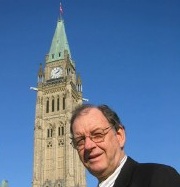
The choice of Gary Vincent Nelson as the next president of Tyndale University College and Seminary is a comment on the continuing quest for both relevancy and gospel faithfulness on the part of Canadian Christian institutions of higher education.
A little more than 20 years ago, I interviewed Nelson. At the time he was one of a group of young, innovative Baptist leaders (I will stop short of calling them radical) involved in BUILD (Baptist Urban Involvement in Leadership Development). Their focus was on relevant church leadership in urban settings in Ontario and Quebec.
In that interview, Nelson told me about a survey conducted on a side street near the University of Toronto, in front of the sprawling red brick campus of historic Walmer Road Baptist Church. The key question in the survey was, as close as I can recall: "Excuse me, could you please tell me where I might find Walmer Road Baptist Church?"
Nelson said that out of every 10 respondents, at least eight or nine said they did not know where to find that church -- even though they were just a few feet from its front doors.
The innovative conclusion was that, in that city context, one Baptist church, at least, faced a fair challenge in relating to its own neighbourhood. The fact that Walmer Road's leadership has consistently worked hard at relevancy should not detract from learning lessons from the challenge itself.
Nelson, now a 56 year old grandfather of three, approaches his new appointment with the desire to lead Tyndale through its next major phase in 116 years of development. And he wants to do so by making relevant, so to speak, the lessons he has learned in his earlier work.
Originating from Atlantic Canada, Nelson earned a bachelor of education degree at the University of British Columbia, before turning to theological studies and two western Canadian pastorates. Fuller Seminary in California was where he obtained both master of divinity and doctor of ministry degrees.
Nelson pastored Broadmoor Baptist, a suburban Richmond congregation in the Vancouver area. And, after his four-year stint with BUILD, he returned to the west for a 12-year stint at First Baptist, Edmonton. There again, relevancy was a continuing theme. The church was located in the heart of a rapidly changing downtown setting, just a few blocks from 'The Ledge,' the Alberta legislative building planted firmly on a natural ledge overlooking the North Saskatchewan River.
Returning east in 2000, Nelson became general secretary of Canadian Baptist Ministries, which arguably could be described as the umbrella body for 'mainstream' Baptists in Canada.
His move to Tyndale comes at a time when, under his predecessor, Brian Stiller, the school emerged from near insolvency in the early 1990s. Before he 'retired', Stiller led in Tyndale's acquisition of a highly-visible university-ready campus, acquired and equipped for close to $60 million.
 Stiller remains as president of the Tyndale Foundation, which will raise the last $20 million need to complete the task of taking over what has, to this point, been the home of the Mother House of the Sisters of St. Joseph and the St. Joseph's Morrow Park High School. That leaves Nelson free, as of July 1, to assume Tyndale's operational leadership.
He is leaving a setting connected to one denomination to be involved in one "with the advantages of interdenominational connections and the cross-pollination that goes with it."
But he is no stranger to Tyndale. "I have been teaching here for 10 years, mostly in the seminary, which has grown increasingly multicultural." Further, his wife, Carla Nelson, is head of the (bachelor of education) teacher education program on the university college side of the operation.
That program is, to Nelson, a demonstration of Tyndale's quest for relevancy. Its stated objective is to help students educated in a Christian milieu to function with excellence in the Ontario public education system.
He clearly admires his predecessor's leadership. "Beyond having led the school into a new campus, he has seen that this place is managed extremely well. "Tyndale's strong liberal arts and boutique programs designed for people working in the public school system, and the Centre for Spiritual Formation, are all reflections of this leadership," he noted.
"There is a momentum, too, that has to do with answering the question: 'What does academic freedom look like?' It is a fair question, in a country that prides itself on tolerance, multiculturalism and the mosaic. In the faith-based Christian university, these are the assumptions we work from -- and I am looking forward to the conversation."
Nelson's comments on academic freedom were shaped around the emerging 'discussion' between the Canadian Association of University Teachers and Trinity Western University. The CAUT, the de facto university teachers' union, has promised to investigate three other schools which, like TWU, have teachers sign a faith statement. Tyndale was not named in CAUT's target list, likely because it, unlike the other four schools, is not yet a member of the Association of Universities and Colleges in Canada (AUCC).
Be that as it may, Nelson appears to envisage whatever Tyndale may need to face, both with respect to relevancy and respect.
"We are open to people who understand that we teach from a Christian framework -- people from other faith traditions. Our Bachelor of Education program has graduated Muslims who encourage other Muslims to enroll, acknowledging that this is a Christian-framed institution."
Nelson concluded with a couple of thoughtful questions: "What does a mosaic really mean? How does one keep his or her voice and orthodoxy, humbly listening with Christian sensibility -- keeping our voice but listening?"
* * * Lloyd Mackey is a member of the Canadian Parliamentary Press Gallery in Ottawa and author of Stephen Harper: The Case for Collaborative Governance (ECW Press, 2006), More Faithful Than We Think: Stories and Insights on Canadian Leaders Doing Politics Christianly (BayRidge Books, 2005) and Like Father, Like Son: Ernest Manning and Preston Manning (ECW Press, 1997). Lloyd can be reached at lmackey@canadianchristianity.com.
February 18/2010