

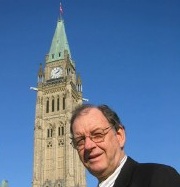
 Today, we will take a look at some faith-based 'back stories' relating to Conservative Senator Gerry St. Germain, American conservative controversialist Ann Coulter and Liberal MP John McKay.
St. Germain rose in the Senate on March 17, to give recognition to what he called the "little known and often forgotten . . . forced migration of the British 'Home Children' to Canada."
He pointed out that from 1869 to 1948, some 100,000 British children, ranging in age from three to 14 years, were sent across the Atlantic Ocean to Canada in search of a better quality of life.
St. Germain noted: "Some . . . were orphans, but many other originated from families who were destitute and could not afford to raise them.
"Although a good quality of life was attained by many of these children in the years that followed, some paid a price for it by being exploited -- and, in limited cases, suffering abuse in unmonitored farm homes and workhouses. Many were subjected to hours of hard physical labour [each day] with little food or rest."
Citing strength and perseverance among the Home Children, the senator pointed out that nearly four million Canadians are descendants of this group of immigrants.
He then traced his own personal ties. His maternal grandfather was a Home Child, who came to Canada after his destitute mother placed two of her four children in a Bernardo Home for Children.
"My grandfather went to Brockville, Ontario, where he was mistreated. He ran away and went back to the Bernardo [home in Toronto] and eventually, was sent to Weyburn, Saskatchewan. On the night he arrived, they said that they would put him in a nice bed in a barn until they found out whether he had any health problems."
The story turned out well, as many did. St. Germain decided to relate this part of his past because Parliament moved, recently, to declare 2010 the 'Year of the British Home Child.'
Those who are familiar with these particular aspects of British and Canadian 19th century history will know that the Bernardo Homes, as well as those set up by the great 'faith' pioneer, George Mueller, were linked to the Plymouth Brethren movement. At the time, these leaders considered their work to be driven by Christian compassion and what would, today, be described as social justice. Later, others would point out, as did St. Germain, that the "justice" was somewhat uneven and, at times, cruel, because of what happened in homes where the children were placed once they got to Canada.
St. Germain, who was in the Mulroney cabinet before his appointment to the Senate, is well known for his Metis heritage, as well as his strong Catholic faith. He indicated this was the first time he had spoken publicly about his Home Children heritage.
There has been a fair amount of ink, in recent days, about the visit of Ann Coulter, the conservative firebrand, to Canada. Particularly in the news was the fact that she was shut down at the University of Ottawa because some thought that she should not have as much right to free speech as, say, Michael Moore, a leftist and equally outspoken firebrand.
I will not comment on the controversy, except to note that Coulter sometimes speaks of her Christianity, as well as her conservatism, as being a reason for her apparently considerable band of detractors.
The last I heard, for whatever relevance it may have to the Christian aspect of what she does: Coulter apparently draws some pastoral care from her connection with the singles ministry of Redeemer Presbyterian Church, a 5,000 strong multi-site Manhattan congregation that many of New York City's sophisticated urban evangelicals find interesting.
I have to say that I don't know where else she goes to church. She splits her time between NYC and Florida and, of course, travels widely for her speaking gigs.
And finally, to John McKay. He is one of the three pro-life Liberals who voted against his party's maternal/child care motion, Tuesday night. That motion called on the government to reject "George Bush" ideology when it leads the G-8 nations in some action to provide maternal and child care in less developed countries.
McKay, as well as two other pro-life Liberals, Paul Szabo and Dan McTeague, voted with the government and against their own party's motion. If they had voted with the Liberals, a tie would have resulted. It would have required that the Speaker cast the deciding vote.
The backdrop in this item is that, a few weeks ago, I wrote a piece for CC.com about McKay and the assignment he had received from Liberal leader Michael Ignatieff. That assignment was to try to win back Christian voters -- particularly evangelicals -- to the Liberal camp.
I said, at the time, that McKay was a stalwart at Spring Garden Church, a Baptist congregation in the north end of Toronto. That, indeed, was true -- until recently. Meanwhile, his wife, Carolyn Dartnell, became the producer of The Living Truth, the weekly television program which is part of the ministry of historic mission-oriented Peoples Church, just a few blocks east of Spring Garden. The couple, parents of five, made the strategic decision to start attending Peoples. They naturally still have many friends at Spring.
I mention this in the interests of accuracy, and to help readers to stay 'up-to-date.'
Lloyd Mackey is a member of the Canadian Parliamentary Press Gallery in Ottawa and author of Stephen Harper: The Case for Collaborative Governance (ECW Press, 2006), More Faithful Than We Think: Stories and Insights on Canadian Leaders Doing Politics Christianly (BayRidge Books, 2005) and Like Father, Like Son: Ernest Manning and Preston Manning (ECW Press, 1997). Lloyd can be reached at lmackey@canadianchristianity.com.
March 25/2010