

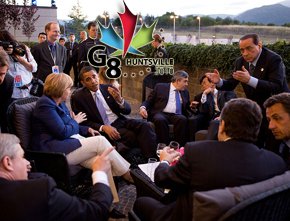
 BEFORE the leaders of the Group of 8 (G8) gather around the conference
table to tackle global issues, Karen Hamilton wants Canadians of all
faiths to gather around the dinner table with their local MP to talk
about the same things.
Hamilton, general secretary of the Canadian Council of Churches, recommends that the MPs not be asked to speak, but rather to listen to their hosts -- as they impress upon the politicians the importance of the G8 honouring the commitments made in 2000 to dramatically improve the lot of people in the developing world.
"Suppose every MP got visits between now and June from different members of their riding belonging to different faith communities, who said: 'We care. We expect Canada to be a strong voice on behalf of the poor and the vulnerable,'" said Hamilton. "The potential is huge."
The proposed dinner table discussions are just one of several attempts being made by Christians over the next few months to influence the outcome of the G8 summit, which takes place in Huntsville, Ontario in late June. Believers are also being urged to impact the G20 summit, which will take place in Toronto immediately afterwards.
The UN Millennium Development Goals set forth eight objectives: eradicate extreme poverty and hunger; achieve universal primary education; promote gender equality and empower women; reduce child mortality; improve maternal health; combat major diseases; ensure environmental sustainability; and develop a global partnership for development.
The G8 had vowed all of these goals would be attained by 2015. Yet Hamilton pointed out that with just five years to go, the degree of progress by the G8 to date toward making good on their promises averages only 51 percent -- and that was before setbacks caused by the global economic crisis. "This is not acceptable. This is about life and death," she said.
"I don't think we've tapped into the potential of the church to really speak out and say these issues are important to us," said Doug Blackburn, the senior manager for education and public engagement with World Vision Canada. And yet he believes that people of faith globally have a lot more power to influence their leaders than most realize.
"If you added them up, people [claiming membership] in a faith group are certainly the majority in the world," Blackburn said. "So let's start to have decisions that reflect the majority and that take care of the most vulnerable amongst us."
To help "release the church for Christian advocacy," World Vision Canada is hosting half-day workshops for church leaders across the country in advance of the G8 summit.
The first 'Taking Down the Goliaths' workshops were scheduled for April 6 in Coquitlam, BC; April 7 in Calgary; and April 8 in Regina. Several more are planned for later this month (see below).
But the main event will be the 2010 World Religions Summit in Winnipeg just prior to the G8 summit; it will bring together faith leaders from across the globe. They will finalize a draft statement to the G8 leaders, urging them to keep the promises they made 10 years ago.
Among the Christian organizations that plan to attend are the Canadian Council of Churches, World Vision, Canadian Baptist Ministries, the Canadian Foodgrains Bank and the Evangelical Fellowship of Canada. Most denominations will also be represented.
"This is not about taking potshots at the G8," Hamilton stressed. "This is about saying what our expectations are, what our faith calls us to do."
But Jim Cornelius, executive director of the Foodgrains Bank, said that even if their lobbying of the G8 fails to produce the desired results, that does not diminish the good that can come from people of faith dialoging together. "What this is," he said, "is really an occasion for people to get together and talk about what our shared values are and communicate those publicly -- and I think that has value aside from specific outcomes at a specific meeting."
Later this month, Christian theologians and international political economists will gather at the University of British Columbia in Vancouver, for God and the Global Economy. The conference is co- sponsored by Regent College's Marketplace Institute and Cardus, a faith-based policy institute in Ontario.
The April 16 - 17 event will consider the key global issues -- but at a much higher level of discourse. They will try to inject some moral reinforcement to the call for action on social justice issues by working on Protestant and evangelical responses to Pope Benedict XVI's encyclical Caritas in Veritate (Charity in Truth).
Released just prior to last year's G8 summit in Italy, the encyclical calls for a world economy that conforms to the principles of "love, truth and charity" as well as sweeping institutional reforms to address the global economic crisis.
While there will be no direct interaction between this conference and the G8, Cardus researcher Robert Joutras said they nonetheless have their respective roles to play. "Sometimes great work can be done in these forums. And sometimes, to be honest, the great work has to be done after them."
World Vision will offer more 'Goliaths' workshops this month: Winnipeg, April 14; Montreal, April 27; Halifax, April 28; and Toronto, April 29.
April 8/2010