

Some observers in Canada's immigrant and refugee community are wondering whether a recent policy addition to the Canadian Border Services Agency (CBSA) enforcement manual might lead to the violation of sanctuary for people like Mikhail Lennikov.
The concern has been raised over a reference in the manual to the possibility that "forced entry" to a church might be required in cases that "pose a threat to the integrity of the immigration system."
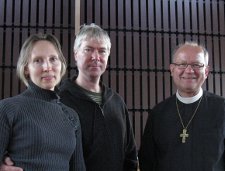
For almost a year, Lennikov has accepted sanctuary at the church where he is a member - First Lutheran, at 41st and Wales on the east side of Vancouver. A resident of Vancouver for 13 years and a student at the University of British Columbia for much of that time, he had sought to stay in Canada.
While he was open about his background as a translator for the KGB, when he first moved to Canada, it was that factor which caused the Canadian Immigration Service (CIS) to block his request for permanent residency. His application went through the usual processes, and was finally rejected by the Federal Court of Canada, resulting in his being ordered deported to Russia last June.
That deportation never occurred, because his church provided sanctuary - under ancient biblical and ecclesiastical customs periodically practiced in modern society.
His wife, Irina and son Dmitri, now 20 and a university student, came with him from Russia. They had been permitted to stay in Canada, on humanitarian grounds.
On those same humanitarian grounds, two opposition MPs from the Vancouver area, Liberal Ujjal Dosanjh and NDPer Peter Julian, are leading a campaign to get the CIS to reverse its deportation decision.
Neither do they want Lennikov's family to move to the homeland with him -- another possibility -- because of the belief that they would be persecuted in the post-Soviet Russia, for his past KGB connections.
The other side of the argument - and one that the CIS apparently needs to keep in mind - is that many immigrants who came from the Soviet Union and its satellites would not be comfortable with anyone who had been in the KGB, no matter how lowly their station or reluctant their recruitment.
All of which returns to the question of sanctuary, and the possible impact of the newly-added border service policy.
Peter Fischer, interim pastor at First Lutheran and the only person authorized to speak for either Lennikov or the church, declined comment on the issue. He explained that he is only temporarily replacing the church's long time pastor, Richard Hergesheimer, who is on a three-month medical leave.
To get a range of perspectives, CC.com interviewed three Canadian academics who have experience in various aspects of the sanctuary movement.
Peter Showler of the Refugee Forum at the University of Ottawa, having examined the policy addition, believes it will not make any difference for practical purposes. But he noted that churches take on a "real burden, when keeping someone in sanctuary."
Further, he suggested that the CBSA generally, in effect, allows sanctuary to work a process of "attrition" - permitting negotiation and time to find alternatives to resolve a deportation issue one way or another.
And, said Showler, most Christian churches that practice sanctuary are both "disciplined" in maintaining a watch on the person and "acting in a Christian way." While the Lennikov situation involves a church helping one of its own members, there have been past situations where Muslims and Sikhs took sanctuary in Christian churches.
Sanctuary, he added, "involves a moral complexity. It is not simply a matter of protecting from persecution."
Vern Neufeld Redekop, head of the conflict studies department at St. Paul University in Ottawa, pointed out that the "strict application of the law sometimes results in injustices being done."
Thus, he suggested, sanctuary or "the honouring of sacred space by the secular authority" is significant, "and should not be intruded on."
While he had not looked closely at the addition to the CBSA manual, he said he would not be happy if serious consideration was given to "violating sanctuary" for modest reasons.
"There needs to be some way to buy time," he said, allowing that there remains the need for vigilance "if there is evidence that [a sanctuary seeker is] a threat to Canadians, or is making bombs [or] planning an attack."
Redekop has done extensive work in relations between First Nations and the police, and was involved recently in efforts -- largely successful -- in defusing potentially damaging protests at the Vancouver Olympics.
Arthur Boers, the Bernardo Leadership chair at Tyndale University College and Seminary in Toronto, and a conflict studies specialist as well, lived for several years in an area of Chicago where there were many central American immigrants who needed some sort of protection or, even, sanctuary. Large numbers of them were "undocumented."
He allowed that "not all refugees are pretty. Some churches, in the 80s, were harbouring people who had committed atrocities in their former countries. For me, one of the challenges for Christians is how we regard offenders -- how we show love and forgiveness, while upholding the law."
Boers recommended the reading of Dead Men Walking, by Helen Prejean, who has worked for many years with people on death row. Such a reading, he suggested, would provide a perspective that would bring a balance to the whole sanctuary issue.
April 21/2010