

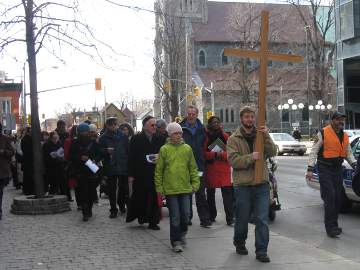
ON GOOD FRIDAY, the third annual Way of the Cross through downtown Ottawa will have special meaning this year, as the Roman Catholic Church and the Pope face an onslaught of media criticism over the handling of clerical sexual abuse.
Ottawa Archbishop Terrence Prendergast said the Way of the Cross is not "just a past reality, but one that still touches the people of our world who suffer in various ways -- and yes, us too."
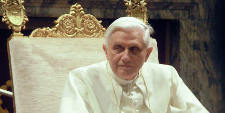
He continued: "With ongoing media attention to the issue of sexual abuse in the church, we realize that the victims and those close to them still suffer from the harm done them by priests. This spills over then to those who mishandled the matter, from whatever motives, and even to those who took courageous action to put an end to this suffering -- such as the Holy Father, who on Good Friday 2005 spoke of 'filth in the church,' of which it needed to be cleansed."
The archbishop emphasized that the Way of the Cross could provide a catalyst for healing. "This year's context can't help but touch us who are being shamed by what is said. So we walk with Christ, as sharers in this mystery of his suffering – and, like St. Paul argues, we can offer our sufferings 'to fill up what is lacking in the sufferings of Christ for the good of his body, that is the church,'" he added, quoting Colossians 1:24.
Communion and Liberation (CL), a movement that began in Milan, Italy in the 1950s, organized the Ottawa Way, as well as those in Montreal, Halifax, Toronto, Edmonton and New York.
Ottawa CL organizer Andre Potworowski said the Way of the Cross events are usually held in a city's downtown core "as a way of witnessing an event that changed the meaning of the history of man."
The Roman Catholic faith, he said, "is under attack all over the world. Even our media in Canada, in many instances, feel that it's okay to denigrate the Catholic Church."
He called anti-Catholicism the last remaining prejudice not eliminated by political correctness.
He said a public event like the Way of the Cross gives Catholics an opportunity to come together and "realize that it's okay to be a practicing Catholic."
The event, he said, offers "an opportunity to support each other in our beliefs, and to reaffirm the central importance of the death and resurrection of Jesus Christ -- to our faith, and to the history of mankind. When faced with a crisis of evil as the Church is experiencing now, we need to go back to the fundamental principles on which the church is built: the death and resurrection of Jesus."
Potworowski said he and other CL members were stunned when the first Walk in 2008 drew 1,000 people -- five to ten times more than they expected. Last year's Way drew a similar-sized crowd. It coincided with a massive demonstration by Canadian Tamils, some of whom joined in as the participants stopped for meditation, prayer and song.
"There is a movement in society to privatize faith, and to keep it from public view," Prendergast said. "What a loss that would be! Such a procession asserts that faith does have a place in civic life, as the expression of our desire to let our faith infuse our actions for the common good."
The Good Friday Way of the Cross starts out at St. Patrick's Basilica at 9:30 am, and ends at Notre Dame Cathedral around noon. The procession will pass the Supreme Court, Parliament Hill, the Peace Tower, the eternal flame, the Center Block, and all the monuments in the area that celebrate Canadian history and heritage, Potworowski said.
There will also be an ecumenical Walk of the Cross in the Kanata section of Ottawa, starting at St. Paul's Anglican Church at noon. This one-hour walk that stops at various churches is a tradition nearly 25 years old.
Courtesy of Canadian Catholic News. Please do not reprint without permission.
April 1/2010