

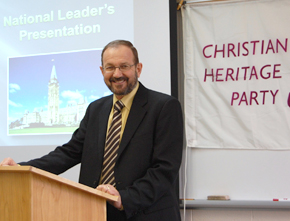
While politics have been continuing as usual in Ottawa, Hnatiuk, new leader of CHP Canada, has been quietly touring the country offering another alternative.
CHP Canada was founded in British Columbia in 1988, as the Christian Heritage Party. Hnatiuk, from Nova Scotia, has led CHP Canada since November 2008, when he took over from B.C.'s Ron Gray.
Hnatiuk spent two weeks in Alberta and British Columbia in mid-April. At the same time, deputy leader Rod Taylor of Smithers, B.C., was touring Ontario.
The tour was part of Hnatiuk's ongoing work to broaden the base of the party. While Gray, a journalist, was a good debater, Hnatiuk said his own skills are more in the areas of strategy and organization; he retired in 1995 after 25 years in the Canadian military.
On the trip, Hnatiuk spent some time with Chris Kempling, who has agreed to run for the party in Kamloops, B.C. in the next election. Kempling gained national attention several years ago when he was suspended from his job as a public school teacher for writing letters to a local newspaper critical of the homosexual lifestyle.
Grassroots
Finding good high-profile candidates is part of Hnatiuk's task. The party wants to run a candidate in all 308 electoral districts; it ran 59 in the last election, about the same number it ran in 1988.
But attracting candidates cannot be done in isolation. Hnatiuk noted that it will be difficult to attract good candidates unless the party gives the candidates the tools they need to be successful.
For one thing, Hnatiuk has also been encouraging the development of EDAs (Electoral District Associations). The party's goal is to have an association in every electoral district in the country.
Grassroots support is key, Hnatiuk said. The party grew from about 2,500 members to 6,000 members under Gray's leadership, and Hnatiuk hopes to increase that number to 20,000. The party now has a full-time development officer in the person of Leslie Bartley of Ontario.
Youth
Hnatiuk has also been spending time in high schools, encouraging young people "to become aware of politics, who the parliamentary leaders are, and how important it is for young people to participate in the political process." The party is developing youth caucuses, and using tools such as the internet and Facebook to keep in touch with them.
"If there are no youth in the party, we won't have a party in the future," Hnatiuk said. "A lot of young people are seeing the problems in Canada, and are excited that CHP exists."
About a third of the delegates at the party convention that elected Hnatiuk were under age 30; and several of the party's candidates in the last election were under age 25. As the party continues to bring in "new blood," that is also bringing back into the party older members who may have gotten discouraged and left, Hnatiuk said.
Better solutions
As part of his tour, Hnatiuk visited with a number of Christian inner city ministries in Calgary and Vancouver. These visits, he noted, will be invaluable in helping the party devise policies that really work, in the areas of poverty and homelessness.
Policy development is another of the tools the party is working on to equip its candidates. It is important that the party speak with "one voice" across the country, Hnatiuk said, adding that it is also important that the party broaden its policies.
The party has been known for its positions on issues such as abortion and marriage, but it is also developing positions in areas such as poverty, economics and the environment. The party's policies are outlined on its website (www.chp.ca); in a new brochure; and in a candidate handbook under the title Better Solutions.
This is also what is behind the party's rebranding to CHP Canada. Hnatiuk said the party wants to be known for its substance, rather than just for its name. Voters who may not be Christian might still be willing to "engage us on the issues, and not walk away due to the name."
For instance, in a by-election in Nova Scotia last year, a group of hunters supported the party because of its position on the long gun registry, confident that the party would not "shove religion down our throats."
This does not mean the party is abandoning its roots, Hnatiuk said. The party remains committed to the Christian values they say Canada was founded on, such as freedom of religion, freedom of speech and support for the family as the foundation of society. However, these policies can be attractive to more than Christians, Hnatiuk said, noting that last year a group of Muslim leaders approached CHP Canada because of their dissatisfaction with other parties.
Characterizing it as a party for "such a time as this," Hnatiuk said CHP Canada is important because it can "make the Christian voice heard" in Ottawa.
"The present approach hasn't worked," he maintained. He noted that Christians have used protest rallies, letter-writing campaigns and lobby groups. They have elected "some very good men and women." But Christians have still lost out on issues such as abortion and same-sex marriage.
This is because "the good Christian people" elected as candidates for other parties are effectively silenced by their own parties. Electing more Christian MPs from those parties won't change the results, Hnatiuk charged. Christian MPs in CHP Canada, on the other hand, would have their party's support.
Of the three-quarters of Canadians who say they are Christians, half don't vote; and the other half split their votes between the other parties, Hnatiuk observed. The Conservative Party, for instance, is able to "take Christians for granted" because it knows "they have nowhere else to go." As the Conservative Party has moved to the centre-left, this leaves CHP Canada as "the only socially and fiscally conservative party in Canada."
CHP Canada's ultimate goal is to run candidates in every electoral district and win enough seats to form the government. But even if it falls short of that ultimate goal, CHP could still prove effective as a voice for Christians, Hnatiuk said.
He noted that CHP Canada is "the second largest party never to have won a seat" -- coming in just behind the Green Party, which has still proved to be an effective voice for environmentalists, even though it is not in Parliament.
Shortly after the Canadian Heritage Party was founded in 1988, it outpolled the Reform Party, Hnatiuk noted. What changed things for the Reform Party was the election of a single Member of Parliament, Deborah Gray -- and "finding a cause you can rally Christians and non-Christians around."
Simply capturing two percent of the vote nationally, or five percent of the vote in an electoral district, would make CHP Canada eligible for government grants. If CHP were to take a significant number of votes away from the Conservative Party, it would be enough to make the Conservatives pay more attention to Christians, Hnatiuk said.
After almost a quarter-century of trying, the party he leads has not yet achieved an electoral breakthrough. Hnatiuk said he is well aware of the difficulties - but he is also convinced that "there is hope."
March 10/2010