

 A LONG-TIME FRIEND and I were lunching on the day Marci McDonald's new book, The Armageddon Factor: The Rise of Christian Nationalism in Canada (Random House, $32), was launched.
Since your humble scribe and his writings were cited about 20 times in the book, I thought it was in order to tell my friend that, if nothing else, he should view McDonald's work as a means to "see ourselves as others see us."
The rest of the lunch conversation might -- or might not -- be fodder for a future OttawaWatch. Meanwhile let me share a couple of 'others'-observing moments for this particular writer.
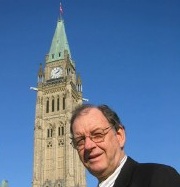
The first is McDonald's description of me, on page 20, as "a bespectacled loner who seldom pursued the stories that obsessed political scribes."
Fair enough. She levels that descriptive within the context of an argument that some journalists had missed the faith aspect of the Harper story.
And true, I am bespectacled -- and have been for over two decades. One of the reasons: the heavy reading accompanying the pursuit of my MBA, 25 years ago.
The second moment concerns a surprising but not unpleasant interruption at the lunch table with my friend.
Shortly before lunch, I had talked briefly with a young man I had met at an Ottawa function - possibly at the Laurentian Leadership Centre. He asked me if I had any comment on McDonald's book. I said I did not yet have my copy - which, in fact, was awaiting me at the press gallery office.
The young fellow appeared a half hour later at the table where my friend and I were eating. He laid down a copy of the book, which he had purchased at a nearby bookstore, and directed me toward an inscription he had written on the flyleaf:
"To Lloyd: May a holy fear burn in you as you read these pages, to respond with vigour and prudence, justice and temperance, with a book of your own."
If the young man is reading this, I hope he will email me. In the rush of the moment, I did not get his co-ordinates -- and his name is not presently in my memory bank.
Let me respond to his challenge, with a little shameless self-promotion.
OttawaWatch is, in fact, a book in the making. Whether it ever finds itself between two covers is still open to question. Much of my column-writing from Ottawa, covering the period between 1998 (when Edna and I moved to the Capital) and 2005, became a book entitled: More Faithful than We Think: Stories and Insights on Canadian Leaders Doing Politics Christianly (BayRidge Books).
The foreword, for which I was most grateful, was written by Preston Manning. Good Christian -- and mainstream -- bookstores either carry More Faithful, or know how to order it. So does Amazon.
So far, the decision has been to post OttawaWatch each week at CanadianChristianity.com. And the good folk that run the site (Christian Info Society, which I had a hand in founding almost three decades ago) are kind enough to archive it.
That means the online reader can go to the site's search box, type in 'OttawaWatch' and any particular topic, and bring up all column references to the named topic. I have written, including this one, a total of 274 OttawaWatch pieces. The first appeared November 30, 2004; the subject of the day was 'Darfur and the 3D strategy.'
This brings my meander to the assessment of the emerging Parliamentary Committee on Palliative and Compassionate Care, which I promised in a previous column. The committee's founding members are Joe Comartin of the NDP (the chair), Harold Albrecht and Kelly Block from the Conservatives and Liberals Michelle Simson and Frank Valeriote.
The committee -- which has the potential to become a multi-party caucus, like the Parliamentary Pro-Life Caucus was meant to be -- came about as a response to the recently defeated Bloc initiative to legalize assisted suicide.
I talked with both Comartin and Albrecht, about the rationale behind the new group.
Comartin noted that "in [the NDP] caucus there were those who were opposed to assisted suicide -- and elder abuse. And people came unsolicited to me, in my law practice. I had too many [elder abuse] cases in my practice.
The group that came together from the three involved parties, he said, recognized that it was not enough simply to oppose assisted suicide. There needed to be proactive "pro-life" initiatives, both from government and in the community.
The initial efforts of the committee, Comartin noted, will be to do research and call witnesses who will be able to build a case for "palliative and compassionate care" that will, among other things, fend off the proclivity for assisted suicide.
"We want to build more understanding and the case for better services. I come out of a community [the Windsor area] with the best hospice in the country. But, across the country, many communities are away under-serviced."
He suggested the committee will start with thinking on how to conduct inquiries, how to parcel out the research work, and how to work with a brisk timeline.
"A lot of this will involve collating existing studies and coming up with recommendations that will make it easier to push current or future governments." He said there will also be "advocacy work with the provinces."
Comartin said meetings have already been scheduled with neurological nurses and doctors -- to come, when they are in town. He pointed out that the committee will, in early days, have a tight budget; but they are talking about ways to cover some costs out of the money available in participating MPs' own budgets.
For his part, Albrecht talked of "extending hope" to people with the challenges of "living with a disability, advanced aging issues or experiencing a life-altering event that has caused major disorientation and loss of equilibrium."
A dentist and a pastor before entering politics, Albrecht outlined clear objectives for the committee:
• Research and identify how to improve and increase the availability of excellent palliative care in Canada.
• Find ways to ensure that every person with a disability is treated with respect and dignity.
• Research and learn how to implement an effective national suicide prevention strategy.
• Recognize the real concerns and problems of elder abuse in Canada and understand how to protect vulnerable elderly Canadians.
From this perspective, the work of the committee has both near and far ranging implications.
The fact that its members can research and explore solutions in a collaborative atmosphere brings potential for conflict management -- not only on these issues, but within Parliament itself.
Last week, I suggested the Social Justice Centre work in Britain carried out by a former Conservative leader was at least a partial factor in the coalition (between a centrist and a centre-right party) forming the government led by David Cameron.
The note worth taking from the British page is that the Liberal Democrats are roughly the equivalent of what I would describe as the "blue liberals".
Those good folk might otherwise find themselves comfortable with the descriptive of "people who have always lived with the idea that they could be small-c conservatives and big-L Liberals at the same time."
Because they tend to be concentrated more in the large cities than in small town and rural communities, they might also answer, at least in their hearts-of-hearts, as "urban conservatives."
The point to be made, for those who have read this particular piece all the way through, is that, despite the work of the folk at UnseatHarper.ca, there is probably a lot of room for collaboration between the present government and the blue liberals.
How this works itself out is up to politicos who are younger and faster-thinking than moi. But I urge those who are really interested in these things to keep an eye on the across-the-pond activities of David Cameron and his new pal, Nick Clegg -- and the plodding work of former Tory leader Iain Duncan Smith, who laid the bricks for the road on which Cameron and Clegg now walk together.
May 13/2010