

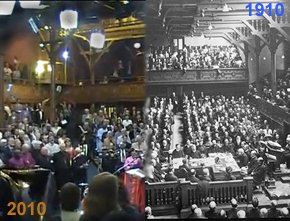
 CENTENARY celebrations of a historic 1910 conference have offered an
opportunity to reflect on the state of the worldwide church.
Edinburgh 2010, a conference held June 2-6 in Scotland, brought the global church together on an unprecedented scale. The World Council of Churches, the World Evangelical Alliance, the Roman Catholic Church and various Orthodox churches worked together to organize the event. WEBLINK: edinburgh2010.org
Edinburgh 2010 was held in the same location -- the Assembly Hall of the United Free Church of Scotland -- as Edinburgh 1910 (also known as the World Missionary Conference). It was intended, in part, as a celebration of that historic event. Yet the two events also had significant differences.
Edinburgh 1910 was a gathering of well over a thousand representatives from Protestant denominations and missionary societies, mainly from Western Europe and North America. No Eastern Orthodox or Roman Catholic missionary organizations were invited.
The theme of the conference was 'The evangelisation of the world in this generation.' Eight commissions, drawing on two years of study, produced position papers intended to guide that evangelization effort.
Edinburgh 2010, on the other hand, drew together 300 scholars and missions experts to examine the reports of nine study commissions; it was the culmination of a complex study process that began in 2002 and included various regional conferences.
Geoff Tunnicliffe, CEO of the World Evangelical Alliance and one of perhaps only two Canadians at Edinburgh 2010, told CC.com it was "one of the most diverse global Christian events that has ever occurred" and therefore very significant.
Yet Edinburgh 2010 was only one of several conferences celebrating the anniversary of Edinburgh 1910, and the range of those conferences demonstrates the powerful and diverse impact of the 1910 gathering. They also demonstrate how much the global church has changed in 100 years.
Two great movements within the global Christian church have claims to be the heirs of Edinburgh 1910.
After a delay caused by World War I, the 1910 milestone led to the formation of the International Missionary Council in 1921 -- and then the formation of the World Council of Churches in 1948. Those in this stream see Edinburgh 1910 as the beginning of the ecumenical movement, which aims to unite the church worldwide.
In this sense, the World Council of Churches are the "institutional heirs" of Edinburgh 1910, Tunnicliffe said. To some extent, Edinburgh 2010, held in the same location as the original event, represented this ecumenical vision. Thus, organizers made a point of including Roman Catholic and Eastern Orthodox representatives.
On the other hand, evangelicals can lay claim to being the "spiritual heirs" of Edinburgh 1910, Tunnicliffe suggested, since they are often the ones who continue to carry on the vision to "evangelize the world."
Evangelicals have organized two major conferences this year which demonstrate this mission legacy of Edinburgh 1910. The World Evangelical Alliance and the Lausanne Movement will be hosting a Lausanne Congress on World Evangelization October 16-25 in Cape Town, South Africa. This will be the third such global gathering since the Lausanne Movement was founded in 1974.
Like Edinburgh 1910, Cape Town 2010 is a gathering of representatives of mission agencies. But there are also differences. While Edinburgh 1910 brought together 1,200 representatives of agencies mainly from North America and Europe, Cape Town 2010 will bring together over 4,000 representatives from more than 200 countries.
The fact that Cape Town 2010 is being held in the global South is significant, Tuinnicliffe said. It demonstrates that, as he told the Edinburgh 2010 conference, "the church is now global in a way that [the 1910 gathering] saw only by faith and not by sight." It is evidence that the mission movement, which was reinvigorated in 1910, has had remarkable success in achieving its goals.
"The mission field has become a mission force," Tunnicliffe said. While the missionary vision of 1910 was for Western missionaries to evangelize the rest of the world, the modern missionary vision for the church is "from everywhere to everywhere."
Perhaps even more indicative of this shift was another conference commemorating the 1910 event: Tokyo 2010, held May 11-14. This conference, on the theme 'Celebrating the Past and Embracing the Future,' brought together 2,000 representatives of mission agencies, but was primarily organized and run by agencies from the global South.
This shift southward is not the only change in the global church over the past century. As mentioned earlier, the divisions between Protestants and Catholics -- and between Catholics and Eastern Orthodox -- are not as great as they were in 1910.
The prominence of evangelicals is also new. A century ago, evangelicals were part of the Protestant movement. However, in the 1920s and 1930s, evangelicals largely withdrew from broader participation due to perceived theological liberalism in the Protestant churches, Tunnicliffe noted. The result was that while Protestants pursued the ecumenical agenda, evangelicals championed the missionary vision.
Also notable at Edinburgh 2010 was the |participation of leaders from the Pentecostal/charismatic movement. Tunnicliffe suggested that charismatics are "part of the same family" as evangelicals. Although prominent in global missions today, the Pentecostal/charismatic movement had barely begun in 1910; it is often dated as beginning in 1906 with the Azusa Street Revival.
"Historically, there have been many things that have divided the different streams of the church," Tunnicliffe told the Edinburgh 2010 conference. "We would be foolish to think that in these few days all those often deeply-held and painfully fought over differences could be resolved." However, he told CC.com that the fact that the various streams at Edinburgh 2010 could "collectively commit" to a common closing declaration is "significant."
That declaration was such that evangelicals could sign it without feeling they had backed away from any of their historic commitments to the authority of scripture, the uniqueness of Christ and the priority of evangelism, Tunnicliffe affirmed.
However, the declaration may also demonstrate that evangelicals' thinking has shifted somewhat over the past 25-35 years. "Evangelicals have always been concerned for the poor," Tunnicliffe said. That is why "the missionary movement has been driven by caring for the needy in practical ways" such as building hospitals and schools. The "subtle shift" that has occurred is that "evangelicals are now more concerned with social justice," and the structures that cause poverty.
This shift is partly due to the growing influence of the global South in evangelicalism, Tunnicliffe said. Evangelicals' understanding had been broadened by those living amidst extreme poverty.
Conversely, Tunnicliffe suggested, the growing power of the global South may be changing mainline Protestantism and the World Council of Churches in opposite ways -- since the growth in Protestant churches has tended to be in the global South where Protestants are more theologically conservative, more committed to the authority of scripture and to evangelism.
It is too early to tell what the impact of Edinburgh 2010 will be, Tunnicliffe said. Since it was primarily attended by academics, its influence will most likely be felt first in schools and institutions -- but that may "ultimately affect the grassroots."
Looking down at global Christianity from "the 30,000-foot level" and from the perspective of the past century, Tunnicliffe noted that there is much reason to be grateful. Despite some isolated unevangelized pockets, and strong resistance to the gospel by Islam and the "radicalized secularism" of Western Europe, it is now possible to talk of global Christianity.
Looked at more closely, Tunnicliffe said, there is also cause for concern. Even where the church is firmly planted in numbers, the church and society continue to be plagued by ethnic rivalry and corruption.
He concluded that there is often "a lack of transformation" -- and "a need for the church to go deeper in every culture."
June 16/2010