

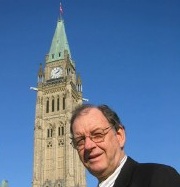
 DAVID Lloyd Johnston, who will assume the governor-general's role October 1, has some interest in the Christian faith, in its Anglican, Mennonite and Catholic forms.
I am aware that the opportunity to ask him faith-based questions is, at present, as likely as finding a needle in the proverbial haystack.
That is probably because his media handlers at the University of Waterloo, where he is wrapping up 11 years as president, want to ensure
journalists do not end up concentrating on something less than the main thing.
A journalist who writes for a faith-based readership is somewhat at a disadvantage competing for that elusive interview, because for his or her readers, the main thing might not be what the gatekeepers want.
Nevertheless, I can report on three snippets about Johnston which, stitched together, provide a small tapestry of his interest in faith and some of the culture surrounding such faith - an interest shared by his wife Joan, who has a PhD in psychology.
* * *
It took four of its journalists to do so, but the Globe and Mail managed, on July 10, to get some reference to Anglicanism and spirituality into a story that portrayed Johnston as a legal scholar, creative administrator -- and a good hockey player when he was a student at Harvard.
The four were John Ibbitson, Bill Currie, Jane Taber and Elizabeth Church. I am not sure which one worked the faith stuff into the story, but I know the first three personally and would suggest that each would be capable of so doing.
The first semi-relevant lines in the story read as follows:
"Lewis Auerbach, a retired public servant, arrived at Harvard at the same time. He remembers Johnston as an unjockish jock. 'He was as straight as they come. . . . He was the kind of guy you imagined did well at Sunday school,' Mr. Auerbach recalls. 'But as someone said years later, as a hockey player, he was good in the corners.'"
Further on, the Globe piece gets slightly more specific:
"'The government is very fortunate that he would want' the post, said Peter Hogg, one of Canada's leading constitutional scholars. But it is Johnston's personal and leadership skills, rather than his legal or policy knowledge, that Hogg said are more likely to be of use to him as governor-general. He will be guided, as well, by his Anglican faith . . . Johnston [once] wrote of 'a growing sense of the spiritual side of life.'"
So far so good. But what about those Mennonites?
For this, we go to another Globe piece, also appearing July 10, and penned by Adrian Morrow.
When they moved to Waterloo from his previous post as principal of McGill University in Montreal, the Johnstons developed a horse boarding and training facility which they dubbed Chatterbox Farm.
 The farm is 20 minutes north of Waterloo, in Mennonite country. A fair number of their neighbours are of the horse-and-buggy stream of the group. So horses fit in fine, apparently. Morrow reports:
"They ensconced themselves in the community from the start. When they moved in, they made the rounds and introduced themselves to the locals; Mrs. Johnston learned the art of caring for horses from her Mennonite neighbours; and when they've hosted dignitaries and other parties over the years, they've bought the food from local businesses . . .
"The Johnstons' approachability has rubbed off on Chatterbox. The future representative of royalty isn't home at the moment, but the stables are open as Maya Markowski, 27, gives riding lessons . . . 'They're very supportive people,' Markowski said of her bosses. 'David will come out here and help the [Mennonites] with the hay.'"
* * *
For an examination of the French Catholic underpinnings of Canada, we note the reference in Johnston's media availability comments on July 8, the day his new role was announced. He referred to Samuel de Champlain as the original governor of Canada, or New France as it was then known. His point was that the monarch who de Champlain represented was the king of France, Louis XIII. And, in that lineage, Johnston would be the 71st governor of Canada, representing Elizabeth II.
All of which, some of my more theologically pristinely readers will remind me, doesn't sound like a solid case for the impact of faith on the life of our nation.
But the history Johnston brings to bear, placed side-by-side with my copy of Canada: Portraits of Faith (edited by Michael Clarke), reinforces that long and early French Catholic influence. The religious leaders in New France -- contemporaries of Champlain -- identified by Portraits, were such as Jean de Brebuef of the Huron Missions, Marie Guyart de l'Incarnation, the 'mother' of New France and Paul de Chomedey de Mainsonneuve, the co-founder of Montreal.
* * *
Johnston's dwelling place, for the last decade, has been among some savvy and spiritually commonsense Mennonites. And between his university president's office and his residential community has been the Waterloo hi-tech district, home of RIM and all those other things that go to make up a sophisticated 'silicon valley.'
Undoubtedly, when Johnston picks up the reigns for his new task, his sense of history, among other things, will help remind us that our Canadian spiritual heritage is worth understanding and exploring.
* * *
Lloyd Mackey is a member of the Canadian Parliamentary Press Gallery in Ottawa and author of Stephen Harper: The Case for Collaborative Governance(ECW Press, 2006), More Faithful Than We Think: Stories and Insights on Canadian Leaders Doing Politics Christianly (BayRidge Books, 2005) and Like Father, Like Son: Ernest Manning and Preston Manning (ECW Press, 1997). Lloyd can be reached at lmackey@canadianchristianity.com.
July 21/2010