

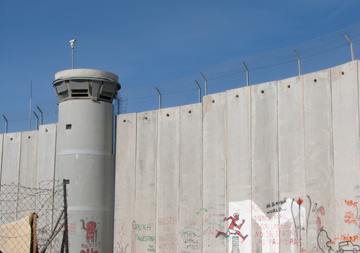
A PALESTINIAN Christian who fights human rights abuses in the Holy Land hopes he provides a peaceful model for seeking justice.
"In our work, we demonstrate to people that it is possible to get your rights peacefully, without using violence," said Raffoul Jabra Rofa. "We don't succeed all the time, but we have a very good rate of success."
Rofa is executive director of the Saint-Yves Society, a Catholic organization providing legal aid and other resources, affiliated with the Latin Patriarchate of Jerusalem.
As a lawyer, he represents both Muslim and Christian Palestinians -- in cases involving land confiscation, house demolition, family unification problems, land access and freedom of movement.
He was in Ottawa June 28 to raise awareness of human rights abuses, meeting with officials from Foreign Affairs and CIDA, as well as with staff at the Canadian Conference of Catholic Bishops (CCCB).
He also hoped to raise awareness of the plight of the diminishing Palestinian Christian community.
Canadians may not realize that not all Palestinians are Muslim, he said. He described the Christians -- Catholic, Orthodox, Melkite, Anglican and others -- as a "bridge of peace" between the Jewish and Muslim communities. Often well-educated and socially aware, Christians have sought justice by peaceful means - and, Rofa noted, have provided social services for everyone, not only other Christians.
But like all Palestinians, they are under great stress, he said.
"I am extremely worried about the future of Palestinian Christians," he said. He warned that the ancient Christian presence in the Holy Land could virtually disappear by 2050 -- if younger members continue to leave for better opportunities elsewhere, and if the birthrate remains low. Most Christians have only two children per couple. Rofa said he worries that no Christians will be left.
"There wouldn't be a live church in the Holy Land; it would only be stones without people to worship in these holy places," he said.
The Catholic Church has been actively trying to preserve a Christian presence in the region, through sponsoring housing projects, granting scholarships for university study, and providing employment for many of the only 10,000 Christians remaining in Jerusalem, he said.
The Christian population in that city was 40,000 to 50,000 in the 1950s, he said. Only 45-50,000 Christians remain in the West Bank; 2,500 to 3,000 live in Gaza; and 120,000 live in Israel.
Each area provides its own set of problems, he said. In Gaza, Christians suffer from the blockade and restrictions on movement, just as Muslims do. In Jerusalem, they face the same problems as Muslims regarding residency rights, property confiscation and home demolition.
If a Christian Palestinian leaves Jerusalem, and lives in another country for more than seven years, he or she loses the right to return to live in Jerusalem, he said.
Family reunification is also a big problem -- especially if someone from East Jerusalem, with a residency permit, marries someone from the West Bank. Permits are difficult to obtain and temporary, and require constant renewal. That causes great stress and uncertainty, he said. Sometimes the renewal does not come right away, putting the applicant in a vulnerable position if he or she is stopped by authorities.
Rofa said security requirements have become too strict. For example, a couple may have a clean record. But if any close relatives -- their siblings, their siblings' spouses, their parents, their children, or their children's spouses -- have any security problems, the Israeli government might cancel a residency permit. Palestinian Christians do not have an automatic right to register their children as residents either, he said.
"People think the Christians are treated differently," he said. "They have one policy that applies to Palestinians."
Rofa said the security fears Israelis have are "of their own making" because they occupy land that belongs to others. Palestinians have been deprived of hope; they lack work, and they lack freedom of movement. "If you put a cat in a corner, the cat will attack," he said.
At the same time, he condemned violence. "I'm definitely against people blowing themselves up," he said. "It's a terrible way of behaving."
He noted suicide bombings have not occurred in Israel since 2004. He added that most Palestinians accept a two-state solution that would give them 22 per cent of the original British Palestinian mandate.
Courtesy of Canadian Catholic News. Please do not reprint without permission
July 14/2010