

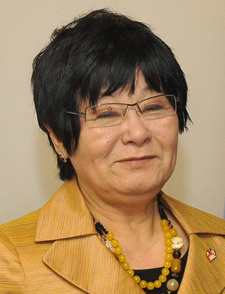
In May 2009, the federal government announced a new approach, involving three key priorities: "increasing food security; stimulating sustainable economic growth; [and] securing the future of children and youth."
"This government promised to make Canada's international assistance more effective, more focused and more accountable," said Minister of International Cooperation Beverley J. Oda, adding: "We have delivered on our commitment, and this will be shaping Canada's international assistance for the coming years."
Canada, she maintained, "is focusing its international assistance so it has a greater impact. Aid can -- and must -- work better. With greater efficiency, focus and accountability, our government's new approach to Canadian aid will be even more effective. This is what the poor of the world need, and this is what Canadians demand of us."
Most of the Canadian government's foreign aid is channeled through the Canadian International Development Agency (CIDA). CIDA, in turn, gives money to NGOs (non-governmental organizations), including many church-based ones, which do the actual relief and development work.
Focus too narrow?
One aspect of the new emphasis on effectiveness is that 80 percent of Canada's foreign aid will be delivered to only 20 countries.
Gerry Barr, president of the Canadian Council for International Co-operation (CCIC), told CC.com that focus can be a good thing and that it may make sense to "work more in our neighbourhood." But he questioned why seven very poor African countries had been dropped from the list of 20, while slightly better off countries in Latin America and Asia will receive aid.
Nevertheless, the Muskoka Accountability Report shows that Canada has doubled aid to Africa, and the government says that the majority of the money for the new Muskoka initiative on maternal and child health will be spent in Africa.
Differing priorities
Barr told CC.com that the government priorities identified by the May 2009 announcement are different from those in the Development Assistance Accountability Act, a private member's bill introduced by Liberal MP John McKay and passed with the support of all political parties in 2008. That act said aid should reduce poverty, take into account the views of those being helped and be provided in a way consistent with human rights standards.
Don Peters, executive director of Mennonite Central Committee (MCC), the relief and development arm of Mennonite churches, noted that some aspects of the effectiveness approach make sense. For instance, after the Haiti earthquake, the government agreed to match contributions raised by non-governmental relief and development agencies; however, the government did not necessarily give the matching money to the agencies which had raised money -- but to the agencies which could present a plan to use the money most effectively.
"Trying to get more bang for your buck" is a good thing, Peters said, but added that the focus on effectiveness was a trend already observable in the Canadian International Development Agency under the Liberals.
Another aspect of the effectiveness approach is that the government "untied" food aid in 2008 and announced plans to untie all aid by 2013. This means that, instead of buying food or other supplies in Canada and shipping them to a developing nation, aid agencies can buy the food and supplies, often at a lower price, in developing nations. This not only helps the country receiving the aid but also helps stimulate the economy in the developing country where the supplies are purchased.
This change in policy has been widely applauded by Canadian non-governmental relief and development agencies.
Controversial cuts
Other aspects of the effectiveness approach have been more controversial. For instance, considerable questions have been raised about two agencies which have had their funding cut.
Kairos lost its funding from CIDA at the end of November 2009 after its previous three-year contract and a temporary two-month funding extension expired. Kairos and its predecessor programs had been receiving CIDA funding for 35 years.
The Canadian Council for International Co-operation (CCIC) has also not had its CIDA funding renewed. CIDA says a final decision has not been made on CCIC, although CCIC's three-month funding extension has now expired.
There are similarities between the two agencies. Kairos is supported by 11 mainline churches and religious organizations, and was formed in 2001 when several joint working groups were put together. These mainline churches have their own relief and development work, but have assigned Kairos to work on social justice issues.
For instance, Kairos supports various organizations in developing countries that provide training to women on their legal rights; it helps the Pacific Conference of Churches do education work on climate change; and it also helps the Sudan Council of Churches monitor the peace settlement in that country and provide human rights education.
Kairos had been receiving some $7 million over a three-year contract. That represented about 75 percent of Kairos' budget. After losing its CIDA funding, Kairos has generally managed to maintain most of its operation in Canada, but has ceased funding its overseas partners.
CCIC is an umbrella organization for 90-100 relief and development agencies, including almost all of the major players -- from World Vision and the Red Cross to the Roman Catholic Church's Development and Peace agency. It doesn't do direct relief and development work -- but brings its partners together in roundtables to coordinate work in various parts of the world, and to do policy development.
CCIC had been receiving about $1.6 to $1.7 million per year from CIDA, which represented about 70 percent of its budget. The lack of CIDA funding means CCIC has laid off two-thirds of its staff and put its headquarters building up for sale. It will likely continue its work on a reduced scale.
On the other hand, some non-governmental organizations -- such as the Canadian Foodgrains Bank -- have had their funding from the Canadian International Development Agency increased in recent years. This is in keeping with a recent G8 emphasis on food security.
CIDA close-mouthed
CIDA would not talk to CC.com about the loss of funding to these two agencies, except to say that Kairos' program did not match the government's priorities on food security, children/youth and sustainable economic growth.
Jennifer Henry, Kairos' manager of dignity, rights and development, noted that the three priorities were announced by the government in May 2009 after Kairos had submitted its request for funding for 2009-2012. Henry said much of Kairos' work supports the government goals, but the application was not phrased in those terms.
Henry noted that human rights training can be "transformative" and support sustainable development in the long term. She suggested that Canadian citizens and government personnel often want to see direct, immediate results, but that this approach is shortsighted. Kairos has reapplied for funding.
Political agenda?
Both Kairos and CCIC have suggested that their loss of funding may be based on politics rather than "development effectiveness criteria" -- that is, that they lost their funding because they have been critical of some policies of the Canadian government.
"What we're experiencing here is punishment politics," CCIC's Barr said in a June 2 news release. "Speak out against government policy and risk losing your funding." WEBLINK: ccic.ca/media/press_e.php
This idea gained credence when Jason Kenney, Minister of Citizenship, Immigration and Multiculturalism, accused Kairos of being anti-semitic for its stand on the Palestinian/Israeli conflict. Kenney later withdrew the remarks. The Conservative government is perceived as being more pro-Israel than previous Liberal governments, and there is some truth to this; but on the other hand, Gaza/West Bank is one of the 20 countries where the government is focusing aid.
Both Kairos and CCIC representatives suggested the defunding will have a "chilling" effect on other agencies' willingness to speak out.
Self-reliance
MCC is a member of both Kairos and CCIC, and also receives funding for its own programs. Don Peters told CC.com that MCC is careful not to be "reliant on CIDA funds for any project" and always makes sure that its own constitiuency contributes money. "We want to do our work and not just be implementation agents of the government."
Peters said MCC "will respond to political issues as they affect the poor and vulnerable," and that the organization often passes on to the Canadian government criticism from its partners in the developing world.
MCC has criticized the Canadian government on some of the same issues as Kairos and CCIC. Perhaps the difference is that MCC engages in "occasional advocacy," in Peters' words, while advocacy is a central focus of the other two agencies.
Complex issues
Surprisingly, one of the things that both the government and agencies such as Kairos and CCIC say is that foreign aid is not the only aspect of international assistance, and perhaps not even the most important part. Henry suggested the long-term goal is not to help people in the developing world, but to enable them to help themselves.
Barr said development agencies have to pay attention to policy development because "all you achieve on the ground can be undone by changes in legislation or trade policy . . . It's not just about the well in the village or the number of classrooms."
For instance, between 2005 to 2008, the G8 countries provided over $54 billion in debt forgiveness to developing countries; this means that instead of paying interest on their debts, governments in the developing world can provide development assistance to their own people. This move was praised by relief and development agencies often critical of the G8. Henry noted that church agencies in Canada helped collect 640,000 signatures on petitions supporting debt relief.
Henry also praised the Canadian government for trying to let countries receiving aid have more input on what should be done, although she suggested grassroots people in the developing world need to be consulted, as well as governments in the developing world.
But there is also disagreement in other areas. For instance, which should take precedence -- the government approach announced in 2009, or the priorities represented by the 2008 Development Assistance Accountability Act?
The G20 summit agreed to cut government spending, arguing that this would stimulate growth and create jobs, including in the developing world. Relief and development agencies have argued that government budgets should not be balanced by cutting development assistance.
The G20 summit also agreed that private investment will help the developing world. The Canadian government supports the development of a mine in Guatemala by Canada-based Goldcorp. Both MCC and Kairos have criticized the mine for harming the environment and not helping many local Guatemalans.
Development is extremely complex. Even when governments and aid agencies agree on goals, they may disagree on methods.
July 14/2010