

 "CANADA is demonstrating the determined political will needed to deliver effective international assistance," Canada's Minister of International Cooperation Beverley Oda stated June 20.
Oda and Foreign Affairs Minister Lawrence Cannon pointed to the G-8 Muskoka Accountability Report as evidence that Canada is fulfilling its commitment to foreign aid.
But is everything as clear and positive as the government says? The 2010 World Religions Summit, which met June 21-23 in Winnipeg, declared that countries in the developed world are not doing enough.
Among other things, Oda and Cannon pointed out that Canada has doubled its foreign aid. This may seem surprising given the Conservative government's image of being suspicious of government assistance.
The doubling claim is, in fact, true, although it also needs to be put into context.
Drastic cuts, slow increase
Jean Chretien's Liberal government drastically cut back Canada's foreign aid ("development assistance" is the official term) in the 1990s. This was one of many budget cuts that enabled the government to move from years of massive budget deficits to years of considerable surpluses.
In 2002, Chretien's Liberal government announced it would increase Canada's foreign aid by eight percent per year; the compounding effect of this policy would double Canada's foreign aid, from $2.5 billion in 2001-2002 to $5 billion in 2010-2011. The Conservative government, elected in 2006, continued the policy, and reached the $5 billion level as scheduled in the 2010-2011 budget year.
While this seems impressive, Gerry Barr, president of the Canadian Council for International Co-operation (CCIC), an umbrella organization for most of Canada's leading relief and development agencies, told CC.com that the doubling merely restored the cuts that had been made earlier.
Foreign aid is measured not just in dollar terms but also in comparison to a country's economic output. Because Canada's economy has been expanding over the last decade and because of inflation, the increase in foreign aid is not as impressive in these terms. Canadian aid increased from 0.27 percent of Gross Domestic Product (GDP) in 2004 to a projected 0.33 percent of GDP in 2010. This is only about halfway to the often expressed goal of having developed countries contribute 0.7 percent of GDP to foreign aid.
This spring, Prime Minister Harper promised an additional contribution of $1.1 billion to his Muskoka Initiative on Maternal, Newborn and Child Health. That will be spread over five years, amounting to about another four percent increase in foreign aid spending this year.
Freeze means reduction
On the other hand, the Canadian government is again in a massive deficit situation due to the recent recession and stimulus spending. In its budget in March, the government announced it would freeze international assistance (along with the budgets of most other departments) at 2010-2011 levels, with the goal of balancing the budget again by 2015-2016.
This is in contrast to projections as late as September 2009 that the foreign aid budget would continue to rise at eight percent a year. The budget also said that these levels would be re-evaluated every year.
Barr told CC.com that this "freeze" would mean that foreign aid funding would drop to about 0.28 percent of GDP by 2014-2015.
Accountability report The G-8 Muskoka Accountability Report is a detailed 92-page summary of the state of foreign aid in the world.
It also illustrates the connection between gatherings of world leaders and foreign aid. It was at the Kananaskis G8 summit in 2002 that Jean Chretien promised to double Canadian aid. In 2005, at the Gleneagles G8 summit and the United Nations summit on the Millennium Development Goals, wealthy countries agreed to increase annual foreign aid levels by $50 billion by 2010.
The Muskoka Accountability Report reveals that foreign aid increased from $80 billion to $120 billion a year from 2004 to 2009, with $24 billion of the annual increase coming from the G8 nations. That left an annual shortfall of $10 billion (or $18 billion when inflation is accounted for) with one year to go.
Therefore, news headlines such as "G8 pacts littered with broken promises on aid" are exaggerated. WEBLINK: ctv.ca/CTVNews/Politics/20100626/g8-trail-of-broken-promises-100626/ The G-8 Muskoka Accountability Report is perhaps more realistic: "Overall, G8 members' progress in meeting these commitments is mixed," with some members meeting their commitments and others not.
| G8 members' progress in meeting commitments is mixed." |
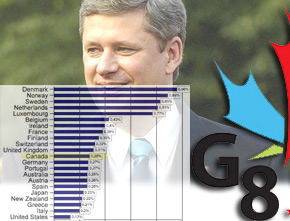
Middle of the G8 pack Globally, Canada is neither the most nor the least generous nation. The Muskoka Accountability Report reported levels of foreign aid compared to GDP for the G8 countries.
From 2004 to 2010 Canada increased its aid from 0.27 to 0.33 percent of GDP. The United Kingdom (from 0.36 to 0.60 percent), France (from 0.41 to 0.46 percent) and Germany (from 0.28 to 0.40 percent) lead the way.
At the other end of the scale are Russia (from 0.015 to 0.07), the United States (from 0.17 to 0.19) and Italy (from 0.15 to 0.20 percent). Japan's giving has decreased from 0.19 to 0.18 percent.
Real gains, likely reductions Has the increased giving done any good? Both the Muskoka Accountability Report and the 2010 United Nations Millennium Goals Report show that progress has been made. For instance the United Nations estimates that the number of people living in poverty will have been cut in half from 1990 to 2015. WEBLINK: un.org/millenniumgoals/
However, the recession and possible reductions in foreign aid may reverse the positive trends. The countries at the 2010 G20 summit in Toronto agreed to cut their deficits in half by 2015, and this will likely mean reductions in levels of foreign aid.
Barr stated, "The Millennium Development Goals cannot be achieved if countries freeze their aid spending." He added that the foreign aid freeze by Canada, "the most robustly recovering country in the world . . . sends a toxic message to other donor states who are in tougher times."
Stephen Harper managed to get commitments of $5 billion from G8 countries for his maternal and child health initiative plus $2.3 billion from private foundations. However, Barr noted this fell far short of the $25 billion from G8 countries that is needed. "The move forward is welcome," Barr said, "but the outcome was modest at best."
July 8/2010