

 IS THERE a 'Christian perspective' regarding the 490 Tamils who
arrived on Canada's shore August 13? Or are Christians bogged down,
struggling with the same conflicting information and perspectives that
are evident in discussions of the matter in the secular media?
In some observers' eyes, there is a greater overriding question: Is the church missing an opportunity to welcome the stranger?
"It's a tricky situation, there's no question about it," said James Grunau, executive director of Journey Home Community Association, which works with refugee claimants in Burnaby, B.C. However, he added, that's no excuse for believers not to apply Christian principles to the situation.
"Canada's first priority must be to protect" the children, said a World Vision (WV) Canada news release issued shortly after the Sun Sea docked in Canada.
The Christian relief and development agency urged "the British Columbia church and faith community to mobilize now to assist . . . in this situation." WV funds two refugee welcome centres in Vancouver, which it anticipates might be called upon to serve a number of the Tamils.
However, noting Christian efforts to combat human trafficking, the news release also encouraged the Canadian government to investigate if "traffickers and smugglers" were responsible for bringing the Tamils to Canada -- and, if so, to prosecute them.
For humanitarian reasons, World Vision hopes the Tamils can be moved out of detention centres as soon as possible, Molly Finlay, WV Canada's director of public relations, told CC.com. World Vision also says the Tamils should be given a fair hearing and judged on an individual basis. Whether some of the 490 might be terrorists or whether they all deserve refugee status, WV will leave to Canadian government investigators. "We simply don't know," said Finlay.
Who are the Tamils?
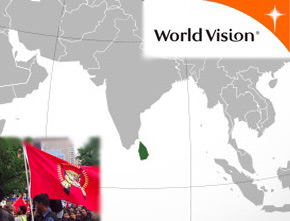
Sri Lanka is a large island at the southern tip of India. Sinhalese make up about 74 percent of the population of 21 million, and are mostly Buddhist. Tamils are an ethnic minority, making up about 18 percent of the population. They are mostly Hindu, but there are also some Muslims. Christians -- both Sinhalese and Tamil, and mostly Roman Catholic -- make up about six percent of the Sri Lankan population.
Over the last several decades, Tamils have been fighting to set up a separate Tamil nation in the northeast corner of the island. The leaders of this conflict have been the Liberation Tigers of Tamil Eelam (LTTE or Tamil Tigers). As outlined on the Government of Canada's website, there is evidence that the Tigers have been guilty of atrocities, including assassinating two Sri Lankan presidents, suicide bombings and even the killing of moderate Tamils.
The LTTE has developed a worldwide support network among Tamil immigrant communities. The largest of these communities, numbering about 200,000 people, is in Canada, centred in Toronto. Like a number of other nations, Canada has labeled the LTTE a terrorist organization, and has forbidden Canadians to contribute to it.
On the other hand, there is also not much question that the Sri Lankan government has also committed atrocities against the Tamils, including arrests, disappearances and other human rights violations. These are now being investigated by the United Nations.
A report written by the Evangelical Fellowship of Canada's (EFC) Religious Liberties Commission has highlighted significant persecution of the small evangelical church in Sri Lanka, including numerous killings and church burnings. For the past few years, the EFC has been warning about a proposed anti-conversion law which may increase persecution of religious minorities in Sri Lanka.
The war, which had been going on since at least 1983, ended in 2009 when the Sri Lankan army overran the LTTE. An estimated 7,000 civilian Tamils were killed in the final campaign, and 280,000 ended up in refugee camps.
World Vision donors support more than 61,000 children in Sri Lanka, including about 17,500 children sponsored by Canadians; but none of those were in the war zone. After the war ended, WV was among the agencies providing relief assistance to the Tamils.
Although most (but certainly not all) of the Tamils have now returned home from the refugee camps, conditions are not still not good; and Tamils charge that human rights abuses are continuing.
Refugees or terrorists?
Reactions among Canadians to the arrival of the 490 Tamils have ranged from calls to send them all back, to a news release from the No One Is Illegal campaign suggesting that Canada should accept virtually anyone who comes.
Canadians' varied answers to the question depend partly on who they assume the 490 Tamils are.
Minister of Public Safety Vic Toews told the press there is evidence those on the Sun Sea may have paid up to $50,000 each for their passage. That raises the question of where the money came from, and who it was paid to.
The World Vision news release applauded the Canadian government's "intention to seek out and prosecute any traffickers and smugglers involved."
A few years ago, several ships dropped people from China on Canada's west coast. Those bringing them in attempted to drop them off secretly; and it is thought they were destined for slave labour in sweat shops, and forced prostitution in the United States.
While the recent Tamil arrivals do not seem to be victims of that kind of human trafficking, those who brought them in may still be guilty of smuggling. However, even confiscation of the ship (worth an estimated $1 million) would be a small penalty, compared to the $20 million the passengers might have paid for their passage.
There have been suggestions in the press that the LTTE may have paid for the passage and that many of the passengers are Tamil Tigers intent on establishing a government-in-exile (or something less formal) which could be used to attack Sri Lanka or carry on the campaign for an independent Tamil nation.
Under this line of thinking, the Ocean Lady, a ship which brought 76 Tamils to Vancouver last October, was a test run for the LTTE. Although the Canadian government suspected that a couple of dozen of those 76 were Tamil Tigers, it has not been able to prove that. All 76 have made refugee claims; and most are living in Toronto, awaiting adjudication of their claims. The Canadian government is afraid more ships carrying Tamils are already on their way.
Another explanation is that the 490 Tamils are simply refugees whose passage was paid by relatives in Canada.
Both explanations may have truth to them. There may have been both refugees and Tigers on the boat. And the line may be difficult to draw, since most Tamils would likely have at least some sympathy for the LTTE's goals.
That is what Canada's Immigration and Refugee Board (IRB) must sort out. The IRB faces a difficult challenge since refugees often arrive without identification documents and it is difficult to investigate their background in the chaotic situations they have come from.
Lessons from history
Even those most sympathetic to refugee claimants recognize the problems. World Vision is leaving it to the government to sort out who is a refugee.
Grunau agreed, saying: "We shouldn't be naive -- because we know that terrorist movements happen."
It is now known that there were Nazis among the millions of refugees pouring out of Europe after the Second World War.
And there have been examples of immigrants using North America as a base to continue struggles back in their homelands. These include Irish settlers (who sent money to the Irish Republican Army), Sikhs (the Air India bombing) and Muslim extremists.
On the other hand, there are also examples of legitimate refugees being denied entry. Official Canadian government apologies have been issued for at least two of them.
In 1914, a shipload of Sikhs on the Komagata Maru were turned away from Canada. When they returned to India, some were arrested, and 26 were shot in an altercation with British soldiers.
In 1939, Canada and the United States refused admission to more than 900 Jews aboard the St. Louis. The ship returned to Europe, and most of its passengers died in Nazi concentration camps.
The immigration context
Fears that Canada will be overwhelmed by Tamils should be put into the larger context.
Canada is an immigrant nation. The Canadian birthrate is so low that we need immigration to keep the population from falling.
According to Citizenship and Immigration Canada statistics, Canada accepts about 250,000 immigrants a year. About 150,000 of these are 'economic immigrants.' They range from businessmen (who promise to invest money here) and highly skilled workers (such as doctors and university professors) to low-paid workers who take jobs Canadians don't want (including nannies and fruit pickers).
About 65,000 are 'family class' immigrants, coming to Canada to join family members already here.
Canada also accepts about 25,000 refugees a year.
A global problem
According to the United Nations Refugee Agency (UNHCR) Global Trends report, there were 43.3 million "forcibly displaced" people in the world in 2009. Of these, 27.1 million were "internally displaced persons" (people who had fled their homes but were still in their home country), and 15.2 million were considered refugees.
The United Nations also reported that in 2009, some 112,400 of these refugees were admitted to 19 countries for permanent resettlement. Canada took 12,500 of these, second only to the United States (79,900) and just ahead of Australia (11,100).
However, Citizenship and Immigration Canada (CIC) figures say Canada accepted 22,844 refugees in 2009. The difference is that the United Nations counted only refugees who applied overseas and arrived in Canada with their paperwork already done.
The CIC counted 7,425 refugees sponsored and funded by the Canadian government and 5,036 "privately sponsored" refugees. The latter are often sponsored by church and community groups.
Those two categories account for the 12,500 refugees in the UN figures. The CIC figures also include 3,181 dependents of refugees (who are counted separately) and 7,202 "refugees landed in Canada."
This last category includes people who arrived in Canada, claimed refugee status after they got here and had their claims accepted by the Immigration Review Board.
Between 30,000 and 40,000 come to Canada each year and formally make a refugee claim. The 490 Tamils are in this category. Most of the others arrive individually by plane.
It takes the IRB two to three years or more to process and decide a claim. More than half of the claims are eventually accepted. The Canadian government recently passed legislation to greatly speed up the process. For some reason, the 7,202 refugee claimants accepted in 2009 is down considerably from the 19,935 accepted in 2005.
In recent years, claimants from Sri Lanka have had a high acceptance rate, because of the conflict there.
Refugees and the law
Those who come to Canada and make a refugee claim are sometimes accused of being "illegal" or of "jumping the queue." If they were trying to come to Canada as regular immigrants, the terms might apply, but refugees are in a different category.
According to the United Nations Convention on Refugees and according to Canadian law, Canada must allow refugee claimants to come into the country and make a claim. They can be "sent back" only if it is legally determined that they are not genuine refugees.
The reason for this legal arrangement is that people fleeing conflict are in a desperate situation, in danger of being killed, and don't have time to complete the legal paperwork before they come. Canada shelters and processes about 30,000 refugee claimants a year. Some much poorer nations have been forced to harbour, at least temporarily, hundreds of thousands of refugees fleeing conflict in a neighbouring country.
Biblical principles
In the 1970s and 1980s, churches brought tens of thousand of Vietnamese 'boat people' to Canada through the 'private sponsorship' process. Since more refugees now make claims after arriving in Canada, Christians and churches have responded by setting up ministries to meet the needs of refugee claimants while their cases are being heard.
The Journey Home Community Association in British Columbia is just one of these.
James Grunau told CC.com that while it is true Canada needs to be vigilant against terrorists coming into the country, Canadian Christians should be careful not to use that as an excuse to ignore biblical principles.
It is very easy for Christians to get sucked into society's prevailing attitude of protectionism and entitlement, Grunau said. "But from the Christian perspective, all we have is a gift." From the laws in Leviticus to the gospels, "Jesus calls us to lay down our lives and open our arms to the stranger."
In being suspicious of immigrants, Grunau said Christians are "squandering opportunities to share the love of God."
He added: "We're not really being counter-cultural when it comes to these issues. We need to be leading the way and being proponents of justice, mercy and grace."
June 19/2010