Jim Paterson's neo-suburban folk art
 You may have seen Jim Paterson's house on the television show Weird Homes.
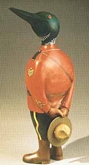
His yard, located in Ontario's upscale City of Oakville, is a backdrop for what he calls the neo-suburban folk art he's created over the past 11 years. The collection, on display year round, features hubcap crosses, totem pole television sets, not to mention wooden people peering over his fence at all who pass by.
When he first began displaying his yard art several ministers from the neighbourhood stopped by to question his motive. The answer was simple. God, he explained, told him to put television sets on his front lawn. From that came the idea to attach a television set to a cross. 'I used it to trigger the question: Where are your beliefs coming from?' Strangers still stop by on a regular basis to find out what it's all about. It has become a great witnessing tool."
A graduate of Waterloo University's fine arts program, Mr. Paterson has successfully managed to merge his love for God with his love of art. In a leap of faith, prior to the birth of the first of his four children, Mr. Patterson gave up teaching to devote himself to art. Whether he's painting or sculpting, he says his work is always God inspired and God directed.
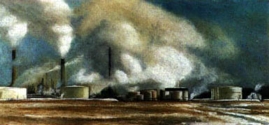
 "Every piece I do is a witnessing piece, always redemptive, never cynical. I work from a Christian worldview," he explains, adding that God gives him ideas and then it's up to him to figure out how to express it to people. How else could he have come up with the idea to paint all of the Maple Leafs' hockey games from January to May, 1999. The tableaus, in all shapes and sizes, served as pages from a journal on which he chronicled the events going on in the world against the counterpoint of passages of Scripture and the highlight of each game.
When the 59 paintings, all done in the primitive style of a folk artist, were completed they were exhibited in a Toronto gallery, creating enough of a stir to garner a two page spread in the National Post and a favourable review in the Globe and Mail. Thirty paintings were sold; one or two to hockey fans, the rest to people who grasped the meaning behind the splashes of blue and white acrylic paint, the crudely printed bits of information and the news, quotes from the Bible and the occasional mini-sermon from the artist.
Mr. Paterson's sensitivity to God's leading is evident not only in his art but in his approach to its sale. When he began working full time as an artist, he initially exhibited at craft shows, making as much as $1,000 a week after expenses. "But God really convicted me about doing business on Sundays. At one point I was booked to do the One-of-a-Kind Show in Toronto. When I discovered it was being held over Easter weekend I withdrew from the show. That was it for basically all shows, because they don't want an empty booth on Sundays. Since then, I've been showing my work in galleries and doing commissioned work for individuals, corporations and churches. It's been hard. There have been times when we wondered what was going on, should I give up, but God keeps telling us to trust Him," he says.
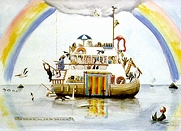
Among Mr. Paterson's most recent projects has been the expansion of a collection he calls his Bible story paintings. Sold as reproductions, each attempts to show that people in the Bible were "just like us." Therefore, Noah builds his ark in a typical suburban backyard with all the neighbours looking on. Another shows Noah floating along in the ark checking for rain, while someone fishes off the bow, an umbrella shields a polar bear from the sun and the family laundry hangs out to dry.
"How many of us are like Noah?" Mr. Paterson asks. "We live under God's promise and benefit from the wonders He works daily in our lives yet, in our hearts, there still lurks a shadow of a doubt."
There are ten published pictures in the series. The latest, based on Jesus' words in Matthew 7 regarding the narrow and wide gates, was commissioned by an Ottawa ministry. "Someday I'd like to incorporate them all into a book. I'd like to write a commentary for each picture that ultimately would cause people to ask questions about their relationship with God?"
In the meantime, Mr. Paterson is working on a collection of three dimensional crosses, which will be shown in March at the Institue for Christian Studies in Toronto. Like all of his artwork, each cross will draw viewers into examining their understanding of Christianity and how it applies to them.
"Non-Christians see the cross as a fashion statement. I'm trying to impregnate it with the symbolism that is there in the Bible, but with a modern interpretation," he explains, adding that among the collection is a plain white melamine cross with a bar code at the base. "The question I'm asking is: 'Are you willing to pay the cost to pick up your cross and follow Christ?'"
Mr. Paterson's work can be seen on his website: www.dove.ca/bga