
Google to moodle
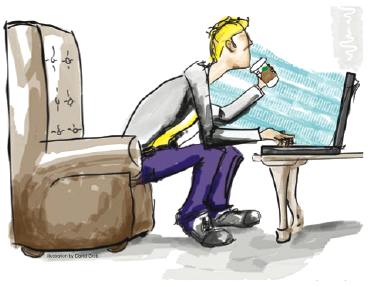 The acceleration of information is unparalleled. Students have never had to grapple with more options or sources. Educators are questioning students use of the web. The process of searching for information often yields far from reliable results. However, surfing the web is irresistible. Broadband 24/7 access, search engine convenience and efficiency, and the click and go speed of following links pulls in huge amounts of information in a very short time. Comments from a recent extensive report from The Online Computer Library Center outlines "Trends toward increased information self-service are clearly evident in the survey results. Most countries surveyed have seen an increase in internet access of 50 to 100 percent. Information consumers are using the internet more - both at the library and elsewhere. Users are as comfortable using web information sources as library sources." Just how do students deal with 'the information overload?' Options interviewed William Badke, author of The Hitchhiker's Guide to the Meaning of Everything (Kregel, 2005) and Research Strategies (iUniverse.com, 2004) and associate professor/associate librarian at Trinity Western University. Badke has written extensively on information technology and education, and over the course of 20 years has been closely in touch with everyday student life.
Options: Thank you Bill for meeting with me. What do you see as the main challenge students face in using the internet in their studies?
Badke: Studies indicate most students see little need to question or critique websites for accuracy or reliability. In fact, you could say that they are uncertain about the methods they need to use to evaluate websites. Partly for this reason, we are seeing some 20 - 40 percent of college and university professors flat out banning web sites in bibliographies.
O: What is the difference between published material in the library of a college and material accessed on a website?
B: Search engines like Google record words from the code that makes up a website. A site may have 'meta tags [hidden descriptor words on the site - eg. Christianity, school, theology], but single or grouped word searches may 'miss the wood for the trees.'
A more accurate comprehension of overall contents is found in library catalogs. Libraries manually describe contents (books, etc.).
Published print (books, periodicals, etc.) has gatekeepers: editors and publishing houses, whose desire to sell books tends to require an author to be authoritative. Journals have both professorial oversight and have undergone a prior peer review process. Information on many websites, however has no such foundation.
GoogleScholar is in beta and gives access to authoritative print sources such as citations; however access to the complete text is often limited by a registration process.
COURSEWARE
O: I heard on the radio that one local university is offering 450 courses with podcasts. How are computers used in delivering and managing courses?
B: 'Courseware,' a new term that describes specific software packages used to deliver course material online, are now being used by an increasing number of professors.
For the average instructor, using courseware is a steep learning curve, so adoption by instructors is slow, but it is growing. These programs, such as the popular 'Moodle,' contain a number of elements that can be used to run a course, mostly without paper. They allow for such things as course handouts to be posted, along with reading material and links. There is a definite move away from paper. Announcements can be posted anytime. Commonly, an online forum is posted by the instructor, where students post responses, online chats and asynchronous comments where each student is required to post responses. Even online quizzes and exams may be offered.
O: But what about cheating?!
B: Cheating is becoming a huge question. The main issue is plagiarism. It's the easiest thing to do, but the easiest thing to find as well.
Five percent or so of students are caught. Some colleges and universities are subscribing to online services such as turnitin.com.
Students submit their papers to this service and they analyze the text, comparing it to other papers of students.
O: What about the potential for distance education?
B: Courseware lends itself perfectly to this. Distance is becoming hard to define; it doesn't necessarily mean far away. It could be a local person, or one enrolled in one institution but taking a course online in another. Although it raises questions about the value of face to face interaction, some students do see an option emerging; to take courses remotely, without the time-consuming travel and without potential scheduling conflicts. www.chem.ox.ac.uk/vrchemistry/webcast/cartwright.htm is an example of this.
O: Do students actually mix and match colleges as well as courses?
B: In British Columbia the provincial government is trying to coordinate distance education across a number of colleges and universities, and under the term BCCAMPUS is providing for a single entry point, where students can sign up for courses that are 'Institution Neutral.'
eBOOKS
O: Are books going to disappear?
B: eBooks are only appearing very slowly. Google is working in five major world libraries, including Harvard and the New York Public Library, digitizing pre-1925 books out of copyright and brand new books with permission. 'Google Book Search' is in beta but offers little more than limited previews.
The largest online library questia.com, with around 66,000 titles, has limited resources but is too small. Libraries are getting eBooks, but there is slow adoption from publishers slow to adopt the technology.
Reading text from a screen with a resolution of 72 dpi is not as pleasant as a printed (300 dpi) book, and 'readers' [specialized computers] have yet to inspire the consumer.
The same trend is not true for scholarly journals, where electronic format is rapidly replacing print as the publishing medium of choice. Students love e-journals.