
Success: Alumni in action
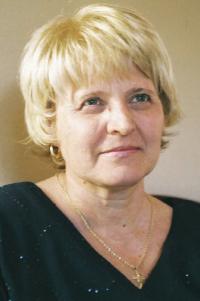 Irene Csontos came to Canada. She attended Trinity Western University in B.C.; after graduating, she went on to establish Hope University School of Medicine in Belize. The school, she says, is a childhood dream come true.
"From an early age, I had a compassionate heart. Often I was visiting the sick . . . I had a strong desire to make a difference in this world.
"I also dreamt that one day I will help orphans, abandoned and homeless children, to give them hope and a future. God planted a mission in my heart that had a grip on me, and I made a promise that no matter how long it takes, where it takes me, I will fulfill my dreams . . .
"The landmark of my life had been rejection; yet, I just could not accept impossibilities. Through many hardships and few triumphs, I learned that 'Impossible is only an opinion!'"
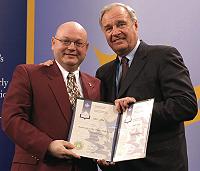 Mark Robbins was honoured in 2005 at a national award ceremony in Ottawa, where he received the Prime Minister's Award for Teaching Excellence. Robbins (seen here with Prime Minister Paul Martin) was one of 15 teachers across Canada to receive the prestigious award.
"I share this award with a remarkable group of young people who are passionate about music and developing their own leadership potential," he said upon receiving the award.
The son of a Salvation Army bandmaster, Robbins completed a Bachelor of Sacred Music at Ontario Bible College (now Tyndale University College) in 1982, winning the Joseph C. McCauley Music Award. He later earned degrees at Wilfrid Laurier University and the University of Toronto in1986.
He is currently head of music at Madawaska Valley District High School in Barry's Bay, Ontario. Robbins has also served as music director at several churches.
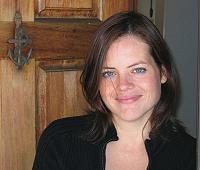 Since graduating from St. Stephen's University, Joanna Henry has managed several disaster and relief projects in Africa. She recently returned to Canada. She wrote the following during an eight-week trip to Malawi:
"All the emotions - beautiful and horrible - that one goes through here daily as one witnesses hardship, poverty, beauty and life at its most resilient, at its best and worst . . . words don't quite capture it.
"I have been given one final assignment before returning home: to analyze the current hunger situation here in Malawi and make suggestions for new programming. This has challenged me to try and find some positive solutions within a situation that feels so big, and sometimes so chronically hopeless.
"I have been forced to move outside of identifying problems and have been asked to offer solutions. Just the possibility that someone is willing to hear my voice and try something new is a great honour, and a great challenge."
More than 200,000 dead, 10,000 children orphaned, up to two million people homeless, more than one billion dollars of infrastructure and economy destroyed; places and people changed forever.
The December 26, 2004 tsunami in Southeast Asia left an indelible print on the landscape, on the survivors, on the world.
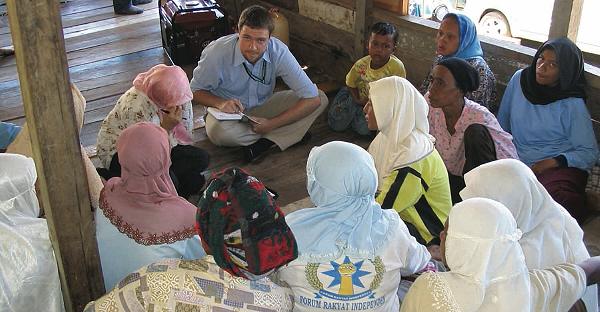
Harry Spaling, an alumnus of The King's University College, has overseen environmental assessments in World Vision's reconstruction endeavours in Indonesia, Sri Lanka, Thailand and India. From May to September 2005, he worked with local partners and communities.
His work, he said, was as much about avoiding further damage as it was about rehabilitating. But the people are eager to rebuild, Spaling noted.
"Hearing their stories of survival, sorrow and hope was moving and inspiring."
Spaling took the opportunity to involve another King's alumnus, Bryan Vroom. Now a Master's degree student at the University of Guelph, Vroom worked in Indonesia, Sri Lanka and India at the community level.
Spaling and Vroom have written a paper on their findings, which will soon be published and used by others in the field.