
The skinny on eating disorders
There is nothing worse than watching one’s child choose to die. Yet for thousands of North American parents, such is the case.
In this country, according to Statistics Canada, more than one in four girls battles an eating disorder. An estimated 20 percent of those victims will die.
Eating disorders are a largely psychological problem, stemming from a hunger for control and acceptance.
Today’s starvation fad can be traced to the invasion of the family unit by the media’s overpowering voice.
Stats Canada also notes that the average adolescent watches one to four hours of television a day. One in every three commercials sends a message about what is ‘attractive.’ Each year, the average teen or preteen is subjected to more than 5,260 ‘attractiveness messages,’ according to the National Eating Disorders Association. Treatment is unique to every victim.
Young girls have indicated in surveys they are more afraid of being overweight than they are of cancer, nuclear war or losing their parents. Sadly, I was one of those girls.
Anorexia nervosa is the purposeful starvation of oneself – combined with excessive exercise – with the intent of becoming thin.
Symptoms and results include anxiety, self-inflicted isolation, shortness of breath, loss of menstrual periods, loss of hair, strained organs and weakened cuticles.
Bulimia nervosa consists of deliberate binging – followed by purging, instigated by depression or stress.
While bulimics often maintain a normal body weight, indications include large consumptions of food, frequent trips to the bathroom and compulsive exercising.
Constant purging results in erosion of tooth enamel, dental cavities, stomach ulcers, dehydration, risk of a heart attack, and rupture of the stomach and esophagus.
At the age of nine, I joined the other 80 percent of my age group who were already dieting. As a pastor’s kid from a home-schooling family, starting public school in grade five served as a huge shock.
I handled it by controlling my weight.
It was my mother’s attempt to regiment my eating that sparked my rebellion. For years, she had dished out my meals. It was a routine that began to make me feel powerless – and I started grasping for some sense of control.
Slowly, I began to cut food out of my life – until I was eating a peach for breakfast, some pickles for lunch and a scoop of corn for supper.
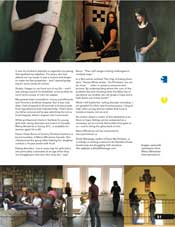

My parents tried counsellors, menus, punishments and Toronto’s SickKids Hospital. But it was only after I had dropped to 60 pounds and was purple from hypothermia that I wanted help. That’s when my father announced he was admitting me into a local hospital, where I stayed until I recovered.
While professional check-in facilities for young girls with eating disorders are scarce in Canada, Mercy Ministries in Surrey, B.C., is available for women aged 16 to 28.
Pastor Helen Burns of Victory Christian Centre is a board member of Mercy Ministries Canada. She championed the group after helping her daughter combat a 10-year battle with food.
Eating disorders “are an easy trap for girls [who] are particularly vulnerable at an age when they are struggling to discover who they are,” says Burns. “Their self-image is being challenged in multiple ways.”
In a Brio article entitled ‘The Trap of Eating Disorders,’ Stacey White writes, “As Christians, we can do more . . . when it comes to anorexia and bulimia. By understanding where the core of the problem lies and checking what the Bible has to say about our bodies, we can grasp a hope and a faith that’s out of this world.”
While I still battle the ‘eating disorder mentality,’ I am grateful for life’s new-found purpose. I long to help other young women realize that food is merely a means, not an end.
No matter where a victim of this obsession is at, there is hope. Eating can be redeemed as a necessary act to nourish the bodies God gave to us – and to bring the glory back to him.
Mercy Ministries can be contacted at: mercyministries.ca.
Emily Wierenga, author of Save My Children, is currently co-writing a resource for families whose loved ones are struggling with anorexia.Her website is EmilyWierenga.com.