
BCCN: Hondurans fear rainy season, raging rivers
• BC Christian News • JANUARY ISSUE 2000 • VOL. 20 #1 • Formerly "Christian Info News" •
Hondurans fear rainy season, raging rivers
- - - - - - - - - - - - - - - - - - - - - - - - - - - - - - - - - - - - - - - - - - - -
 |
By John M. Spidalieri
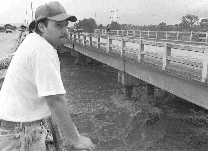
SANTO RAMO has lived along the Ulua River most of his life. Now 60, he regards the river with sadness.
"A year ago I lost my kitchen during Mitch, and some relatives were swept away by the gushing water," he says. "People here," he continues, pointing to the houses of his neighbors, "are afraid. The rains have been hard and strong and the river threatens our homes again."
Like many rivers throughout Honduras and Nicaragua, the Ulua River, just 15 kilometres from San Pedro Sula, the commercial capital of Honduras, rose to flood stage in late 1999. Thousands were forced into shelters. Just one year after Hurricane Mitch decimated the country, tens of thousands of Hondurans again faced the possibility of losing their homes.
Hurricane Mitch "erased people's ability to distinguish between destructive rain and normal rain," asserts Susan Classen, a Mennonite Central Committee (MCC) volunteer in Managua, Nicaragua. "Whereas most try to look at the future optimistically, Central Americans now assume the worst is going to happen. Mitch traumatized the people here. Rain is life-giving. When the rains came this year as part of the natural cycle, it didn't stop. How do you deal with the feeling that something that should be life-giving betrays you?" she asks.
Hope, says Classen, comes from a strong, healthy community. "When there is any kind of crisis, people do things for people who would ordinarily be strangers. During Mitch we heard a lot of stories about people helping those in trouble, people they didn't necessarily know."
MCC has tapped into that spirit to provide concrete help. Coordinating with the La Ceiba Mennonite Church Emergency Project, MCC funded the construction of 66 new homes in Mission de Esperanza. Five North American work-and-learn teams assisted in the construction.
Community members worked together to build the homes, explains Isaias Martinez, a pastor from the San Juan Pueblo Mennonite Church, a few kilometres away. "They didn't know who would get which house, so everyone worked on each house."
Most of the new homeowners attended a ceremony officially opening the community, several months after the houses were completed. Martinez told the crowd a story of a father who advised his eight sons to unify the family. "One stick is easily broken, the man told his sons, but eight together is unbreakable. I thank God for the unity of this community."
Filiberto Cruz, a farmer who heads the town council, lauded the community for pulling together after Mitch. People ap-plauded when he declared: "The community of people unified will never be defeated."
During the rainy season, dark clouds hovered over much of Central America, venting every afternoon in a loud cacophony of thunder and rain. The people, beleaguered by the stress of rebuilding their lives a year after Hurricane Mitch, counted the days until the end of the hurricane season in November.
Yet, despite the emotional torment people here feel, says Ramo, there are still signs of hope even in this setting. He watches a group of children playing near his home. A smile breaks the hard lines on his face.
"You see, there's hope. They know it. We adults have to remember that, especially now."
Call MCC at (604) 850-6639.