
• BC Christian News • APRIL ISSUE 2001 • VOL. 21 #4 • Formerly "Christian Info News" •
Jewish images, Christian church
• Henry N. Claman: Jewish Images in the Christian Church, Mercer, 2001.
 |
BEGINNING in the third century with frescoes in the catacombs of Rome, public art began to illustrate the doctrine of supersessionism (a widely shared view which assumes that Christianity replaced Judaism as God's chosen revelation; Judaism was a necessary prelude to Christianity; and the Hebrew Bible foretells the coming of Christ).
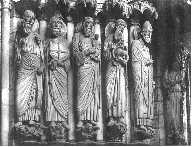
This book, subtitled 'Art as the Mirror of the Jewish-Christian Conflict 200 - 1250 C.E.,' is aimed at the general reader. There are a wide range of depictions of Jewish figures, from positive to negative. Illustrating the two extremes are a Chartres sculpture and a San Zeno Maggiore panel (both pictured here). While Isaiah, Jeremiah and Simeon have haloes along with John the Baptist and Peter in the sculpture, the Jews in the panel are depicted as whipping Christ (a belief used to justify the social and political persecution of the Jews in Western Europe).
Henry Claman's explanation for this apparent paradox is that the Jews of the Hebrew Bible were 'good Jews' -- "their religion was the necessary predictor of Christianity, though they knew it not." But the Jews of Christ's time were seen as completely different, he argues: "They refused his messiahship and were assumed guilty of killing him.
"If we accept the Christian view that the Jews of medieval Europe were descendants of the guilty 'bad Jews,' while the Jews of the Old Testament were the legitimate ancestors of Christianity, or 'good Jews,' there was no inconsistency at all," he adds.
Jewish Images presents -- in black and white -- important evidence about Christian assumptions which have led to the persecution of the Jews over two millennia. We are left to wrestle with his conclusion: "The principle of supersessionism is an essentially elitist tenet. That is, supersessionism says that Christianity is not only different but it is better. In this sense, a supersessionist stance can be used to justify un-favourable attitudes towards, and even actions against, non-Christians."
If we want to argue against Claman's point of view, we will have to do so under the gaze of Chartres' sculpture and San Zeno Maggiore's panel.
--