
• BC Christian News • APRIL ISSUE 2001 • VOL. 21 #4 • Formerly "Christian Info News" •
Funny, honest portrait of church culture
Tent Meeting
Pacific Theatre / Blinding Light
Until April 8
 |
By Meg Johnstone
I MUST admit I was a bit skeptical about seeing this Pacific Theatre and Blinding Light production. How, I thought, could a nostalgic musical about a tent meeting revival set in the depression-era Canadian prairies be anything but a bit sappy, a tad trite?
I was wrong.
First off, Tent Meeting is funny. Not just funny, but at times side-achingly hilarious. Secondly, not only is the play decidedly not sappy, it offers instead a painfully accurate critique of the judgments and hypocrisies that Christians too often hold, all carefully crafted to make us laugh while deftly revealing the failings of our unfortunate subculture.
Written by director Morris Ertman and managing artistic director Ron Reed, Tent Meeting revolves around the estranged relationship between George and Dolly Hoveland, played by Royal Sproule and Seana-Lee Wood, respectively. Their passive-aggressive relationship becomes openly hostile when their former friend Rev. Elroy Phillips, played by Tom Pickett, comes back into town with his 'truckload of meetin'.'
George, we find out, used to sing in a gospel quartet with Elroy. All that ended when George 'stopped singing,' which also means stopped attending church, praying, and doing all the rest of the things 'good Christians' supposedly do.
The dinosaurs in Drumheller are partly to blame. "You're so damn scared of the questions!" George tells Dolly. How is he supposed to believe the Bible when they're digging up dinosaurs in Drumheller, and no one is willing to answer his questions? "They look at me like I've seen up the magician's sleeve," George says. But the real reasons, we learn, go much deeper.
Dolly feels closed out of George's life. But we soon realize the problem is likely of her own making: "You stopped talking to me," George tells Dolly. "Pretty soon I wasn't George, and you weren't Dolly -- I was the back-slidden husband, you were the abandoned wife."
Much of the play involves Dolly trying to 'win' her husband back to church, luring him back through the return of his former best friend, the tent meeting, and the gospel music George loved. The tables are turned when Dolly is forced to come to terms with her own judgment and self-righteousness, which have ultimately driven George away.
"Why does everything have to be a ministry?" George asks. It's all 'bait,' he believes -- the music, the baseball game, the requests to help set up the tent. "It's a g--ddamn sideshow," he says. "Everyone's lining up to see the freaks. They don't do it because they like it; they do it because God asks them to. They're obsessed with religion; they've got to put religion into everything and it spoils it."
How George finds his way with the help of his friends is the rest of the play's journey. Along the way we are feasted with abundant servings of memorable gospel fare such as 'Up Above My Head,' 'Jesus Gave Me Water' and 'Jim and Me,' a song previously unknown to myself that works amazingly well in its context. The play does not have the stereotypical 'musical' quality where actors suddenly burst forth in song for no apparent reason other than to fit the music in; the gospel in this performance is integrated and does not jar the viewer.
The play makes brilliant use of minor subtleties to create outstanding effects: billiard balls clicked together become both the truck's engine and sound effects for the pool hall. The use of props is very economic: the piano doubles as a truck, a water pail as a radio sound-effect. The play also requires three actors to play two separate characters each, with changes indicated through subtle costume shifts: a hat, a cigar. Sproule does an excellent job with his two characters, convincingly playing both the bitter George and the eager, puppy-like Bob Lefsrud.
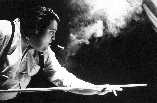
Jonathan Bruce as cigar-smoking pool hall owner Sam Lundquist is a warm, real and clever character. His Angus McPhee is a little less distinguishable, however. Pickett as Elroy delivers another solid performance, and is a joy to watch. His sermon delivery has real poetry and eloquence. In addition, Neil Minor plays pastor Ernest Douglas, who makes a convincing character shift from uptight, overly serious people-pleaser to honest shepherd. It is a credit to the authors that each of the five main characters undergoes significant character transformation throughout the course of the play.
My one concern with the play is that George's transformation is a touch heavy-handed. A little restraint with the baptism might have made it more believable for the average Canadian audience.
If you don't go see Tent Meeting for the great gospel quartet sounds, go see it for what it is: a significant critique of Christian culture that is just plain fun along the way.
Tent Meeting plays until April 8. Call the theatre at 731-5518 for details.