
November 2001
Music hath charms . . .
BC Christian News, · Counselling Supplement
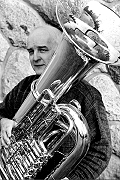
WATCHING Dr. Paul Hoelzley conduct Trinity Western University (TWU) band and jazz ensemble performances is a familiar experience for Lower Mainland audiences. What many may not know is that Hoelzley, a professor of music at TWU, is also a credentialed music therapist.
The profound effects that he has witnessed in his private practice with autistic and unruly children, as well as patients with Alzheimer's and cerebral palsy, have prompted Hoelzley to offer a new course at TWU. The course, an introduction to concepts of music therapy in special education, will teach students basic principles which enrich the lives of children who have sensory, physiological and mental impairments.
"These exceptional children . . . are, because of lack of funding, facilities or trained teachers, very frequently mainstreamed -- put into the regular classroom," says Hoelzley. "Because there are so many exceptional children going into public school, we have to do something to prepare our students to better meet the needs of these children."
In the course, Hoelzley gives guidance on the causes and symptoms of various impairments, as well as how to use music to improve the life skills of exceptional children. Music, he says, "can be a tool for rehabilitation and remediation, helping people compensate for -- or, in some cases, even overcome -- specific deficits in learning or development . . . Music is a great motivator."
Hoelzley first observed music's healing effects at age 19, when he was a tuba player in the U.S. Army Field Band of Washington, D.C. The band was performing for patients at Philadelphia's children's hospital, many of whom were wailing in distress or pain. After hearing only four notes of 'The Star Spangled Banner,' the children became silent; they were totally focused on the music. Hoelzley was too overcome with emotion to continue playing.
"That was my first encounter with how music has power to work past physical and emotional pain," he says.
Over the years, Hoelzley has often found music effective in dealing with autism. "Autistic children don't respond to the social cues that other people pick up on, like a mother's voice or outstretched arms. They are often non-verbal and don't like to be touched. The low sounds of the tuba, or the tone quality of a bass clarinet, may stimulate a response that the human voice cannot. The challenge is to find an instrumental sound to which the child will respond."
Once Hoelzley isolates a particular instrument that causes a reaction, like a momentary pause in play or a quick glance in his direction, he begins the process of using that instrument to communicate with the child.
"Even something like the ability to hold a mallet to strike a triangle can be transferred to holding a spoon or a pencil or a toothbrush. A music teacher teaching students rhythm to a song might want to teach an exceptional child balance, for example, through marching or walking to the song."
His course, he says, is intended for students who are interested in having a transformational effect. He emphasizes that, in addition to aptitude, they will need one other crucial ingredient.
"You can do all of the technical learning that you want, but you have to have that special something in your heart that demonstrates love to these exceptional children."