
November 2001
A simplistic rejection of Christian counseling
BC Christian News, · Counselling Supplement
• Gary L. Almy: How Christian is Christian Counseling? Crossway, 2000.
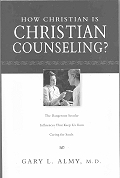
THE AUTHOR, a psychiatrist who has become disillusioned with 'talk therapy,' states that he has written this book "for those who care about learning the truth concerning counseling psychology as it is practiced today."
In the spirit of the 'biblical counseling' movement, Almy rejects any attempt to integrate psychology with a biblical approach to counseling. He contrasts the fundamentals of biblical counseling with the fundamentals of psychotherapy, and then explores what he sees as the destructive consequences of the latter.
According to Almy, the foundations of counseling psychology are tainted by the naturalistic and atheistic beliefs of psychology's founding fathers -- who, he maintains, have subjected Christianity to heretical assaults. Almy presents psychotherapy as a false gospel, and cautions the church against embracing its anti-scriptural character under the auspices of Christian counseling.
Almy correctly identifies psychotherapy as a system of thought that incorporates certain values, beliefs and philosophies. He emphasizes the importance of being aware of the intangibles behind the therapeutic encounter, and stresses that therapy in itself cannot address the ultimate issues of the human condition. It is Almy's desire to be faithful to biblical teaching, as he reaffirms the importance of godly living and individual responsibility in the pursuit of mental health.
He insists on the necessity of nurturing a relationship with God through sound, biblical instruction -- rather than investing in a relationship with a therapist through the practice of psychotherapy.
Some of Almy's points are helpful. However, his tendency to dichotomize between biblical counseling and counseling psychology, and between faith and science, gives the book a falsely restrictive and sometimes simplistic tone. In formulating his perspective, he neglects to include key concepts -- such as natural theology and general revelation -- which suggest that God is able to speak outside of scripture. In other words, God may speak through psychology just as he can speak through the sciences or theology.
Almy also fails to consider that it is possible for science, psychological study and faith to complement each other -- a consideration which is consistent with the belief that God is the Lord of all. A holistic perspective would draw upon God's universal principles, found inside and outside of scripture, to help provide direction in the counseling setting.
The implications of Almy's 'Bible only' position are also problematic. His perspective, if taken seriously, can lead to the neglect of client-specific problems -- and can be limiting in the application of godly principles. It is a position which will invalidate counsel that reflects godly principles, if that counsel goes beyond the strict limits of scripture.
Doug Hampson is assistant professor of psychology at Trinity Western University.